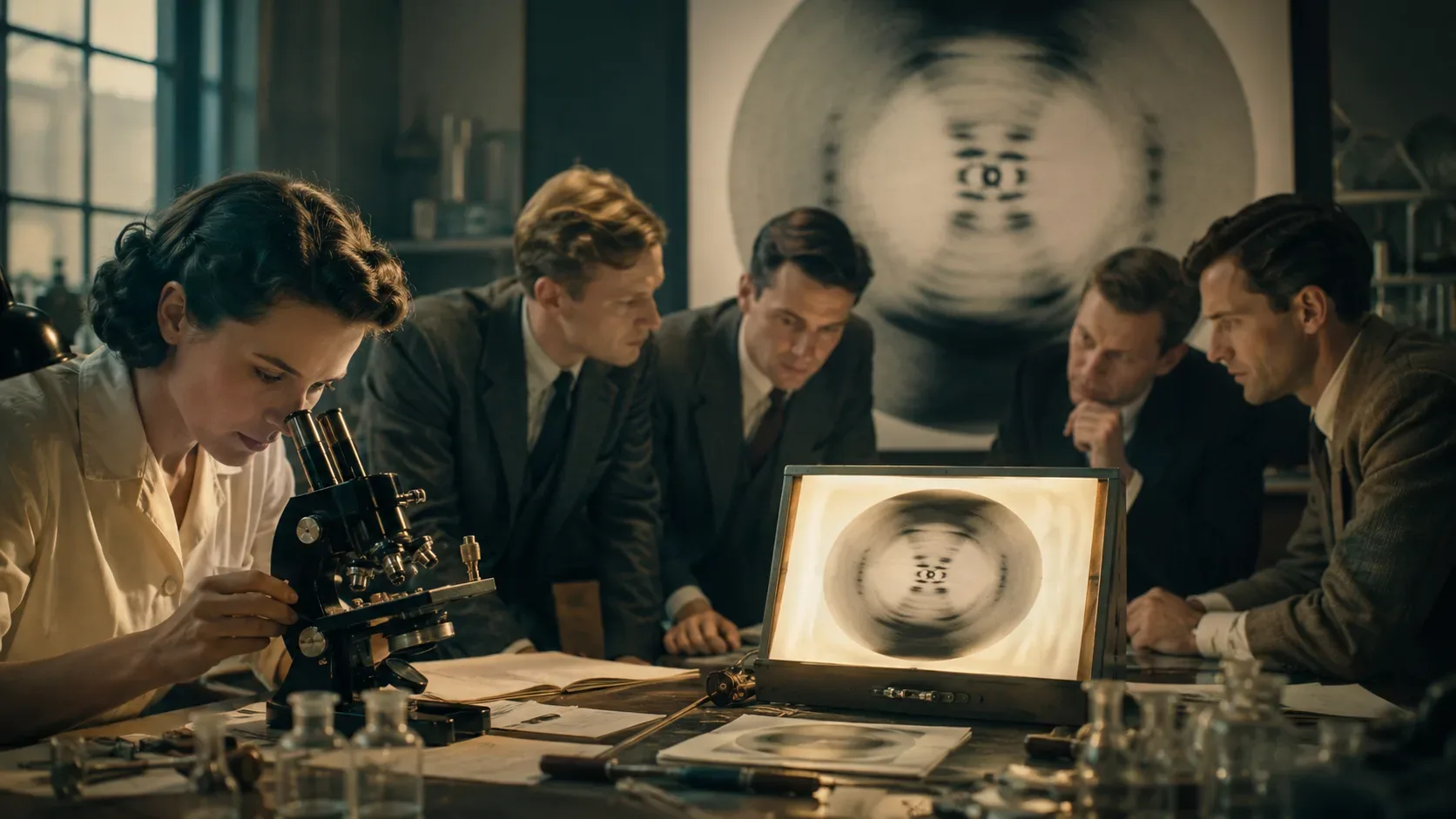
Calling Photo 51 “stolen” mixes three different questions: who produced the image, who had access to the data, and who transformed the available evidence into a structural model of DNA.
The most accurate answer is this: there is no evidence that James Watson physically stole Photo 51 or that Watson and Francis Crick simply copied a ready-made model from Rosalind Franklin. What is documented is that Maurice Wilkins showed Watson a copy of the image in January 1953 without Franklin knowing. Shortly afterwards, Max Perutz gave Crick access to a Medical Research Council (MRC) report that contained unpublished results of Franklin's work. This data helped Watson and Crick in the decisive step of building the model.
It would also be incorrect to go to the opposite extreme and reduce Franklin to someone who merely produced a useful photograph without understanding its significance. Her experimental results established important constraints on any correct model of DNA, and by early 1953 she herself was reaching conclusions very close to the double helix. The episode is better understood when experimental production, data circulation and theoretical modeling are separated.
Who really took Photo 51?
Photo 51 is an X-ray diffraction pattern of the B form of DNA, not a conventional photograph of a molecule. The experiment was carried out at King's College London in May 1952. According to records presented by King's, exposure began on May 2, ended with revelation on May 6, and accumulated 62 hours of x-ray exposure. The cross-shaped pattern was a strong indication of helical structure and contained information consistent with about ten bases per turn of the helix.
There is an important nuance when asking who “took” Photo 51. A correction published later by Genome Biology records that Raymond Gosling confirmed that he had physically taken the image, under the guidance of Rosalind Franklin. Gosling was a doctoral candidate and worked with Franklin. In the scientific attribution of the experiment, therefore, Photo 51 is the result of the work of Franklin and Gosling; both also signed the 1953 paper in which the results were published.
Just saying “the photo of Rosalind Franklin” is understandable as historical shorthand, because she ran that experimental program and interpreted the data. But erasing Gosling also distorts authorship. If the question is who managed to obtain that specific image, the answer is Gosling, under Franklin's guidance. If the question is who produced, analyzed and published that body of evidence, the correct attribution is Franklin and Gosling.
How did Photo 51 reach Watson?
The image did not disappear from the laboratory nor was it clandestinely stolen by Watson. In early 1953, as Franklin prepared to leave King's College and Gosling was to return to work under Wilkins' supervision, a copy of Photo 51 was with Wilkins. A reconstruction published in the FASEB Journal reports that Franklin asked Gosling to deliver the image to Wilkins in this transitional context.
The controversial step came later: Wilkins showed Photo 51 to Watson. King’s College explicitly records that Franklin did not know this had occurred. Wilkins apparently considered the information part of the group's shared work and assumed that Watson already knew previous helical diffraction patterns. This helps explain his action, but does not turn the episode into Franklin's consent.
Watson immediately recognized the importance of the much sharper pattern of the B shape. The image provided geometric constraints that made a helical structure difficult to ignore and gave new impetus to model building at Cambridge.
So the historically safest description is not “Watson stole Photo 51,” but rather: Wilkins showed Watson experimental data from Franklin and Gosling without Franklin knowing it was being shown to a scientific competitor.
Photo 51 was not the only Franklin data that reached Cambridge
The image gained enormous symbolic value, but there was a second way to access Franklin's results.
In December 1952, an MRC commission visited the biophysics unit at King’s College. Max Perutz, from the Cambridge laboratory, participated in the committee and received a report on the unit's work. The document included a section with Franklin's results. Shortly after Watson saw Photo 51, Perutz made this report available to Crick. Historians Matthew Cobb and Nathaniel Comfort record that Perutz explained in 1969 that the report was not marked confidential, although he regretted sharing it without first consulting the King's group.
This point is important because it reduces the usefulness of simple classifications such as “stolen secret document”. The report was circulated institutionally and had no confidentiality mark. At the same time, it contained unpublished results from a competing researcher, who was not consulted before they arrived at the team competing for the same structure.
Biochemist Thoru Pederson argues that this report may have been even more decisive than Photo 51 itself. Among the data were measurements compatible with a C2 crystallographic symmetry. Crick, who had particular experience with this type of symmetry, realized that it favored two chains oriented in opposite directions, that is, antiparallel. This assessment is a historiographical interpretation, not unanimity about which individual piece of data was “the most important,” but it shows why the discovery cannot be reduced to a single image.
What did each researcher actually do?
| Researcher | Direct contribution | Role in access or use of data |
|---|---|---|
| Rosalind Franklin | He greatly increased the quality of DNA diffraction studies, distinguished forms A and B and obtained essential structural measurements with Gosling. In March 1953, he was working with a probably helical and possibly double structure. | Watson was not informed that Photo 51 had been shown; His results were also in the MRC report delivered to Cambridge. |
| Raymond Gosling | PhD student who worked first with Wilkins and then with Franklin. He confirmed that he physically took Photo 51 under Franklin's guidance and was co-author of the 1953 article. | His position between the Wilkins and Franklin programs made him a direct part of the experimental continuity at King’s. |
| Maurice Wilkins | I was already researching DNA by X-ray diffraction before Franklin's arrival and had obtained patterns with Gosling. Continued to produce and test structural DNA evidence. | He was the one who showed Photo 51 to Watson without Franklin knowing. He also maintained scientific exchanges with Cambridge. |
| James Watson | Worked on building the model and arranging the bases. With Crick, he arrived at the double helix model with specific pairing, which immediately suggested a mechanism for copying genetic material. | Saw Photo 51 through Wilkins and incorporated experimental evidence from King’s into the modeling. |
| Francis Crick | Brought strong mastery of symmetry, helical diffraction and structural modeling. With Watson, he integrated chemical and experimental constraints into a coherent framework. | Perutz had access to the MRC report with Franklin's results and realized the importance of C2 symmetry for the orientation of the chains. |
The table shows why the question “who discovered the structure of DNA?” does not have a satisfactory answer with a single name. Wilkins and Gosling were already producing diffraction data before Franklin's arrival; Franklin took experimental work to a new level of precision; Watson and Crick had the combination of modeling and structural interpretation that allowed them to quickly bring together different pieces of evidence into a solution. King’s College describes Wilkins and Franklin as primarily responsible for obtaining the experimental data that supported the Cambridge model.
Did Franklin know DNA was a helix?
Another popular version of the story claims that Franklin produced Photo 51 but did not realize what it showed. This formulation is also misleading.
Franklin was cautious with helical models, especially because the A form of DNA produced a pattern that was more difficult to interpret. But his thinking evolved with the data. King's College records that in March 1953 she prepared a manuscript in which she considered a highly probable helical structure, most likely a double helix, with about ten bases per turn, bases facing inward and phosphate groups facing outward.
This does not mean that Franklin had already produced exactly Watson and Crick's model. It had not presented the complete specific pairing arrangement between adenine and thymine and between guanine and cytosine that made the Cambridge model especially powerful. Watson and Crick's merit was not just in pronouncing the word “helix”: it was in constructing a chemically and geometrically plausible three-dimensional structure that integrated several lines of evidence and offered an explanation for the replication of genetic material.
Thus, two extreme statements must be avoided: Franklin was not a technician who stopped understanding her own data, but neither did Watson and Crick receive from her a finished model that they simply presented as their own.
What Watson and Crick added
Watson and Crick were not the main producers of the DNA diffraction data. Their work was mainly model synthesis and construction.
They combined experimental results from King’s with chemical knowledge, already published data on the composition of bases — including results associated with Erwin Chargaff — and molecular geometry constraints. The article published in Nature on April 25, 1953 proposed two intertwined chains and specific base pairing. The text itself highlights that this pairing immediately suggested a way in which genetic information could be copied.
It is also significant that Watson and Crick's paper acknowledged having been influenced by general knowledge of unpublished results and ideas from Wilkins, Franklin, and their colleagues. This mention existed, so it is not correct to say that Franklin was completely omitted from the article. The limitation is another: the text did not explain to the reader how information from Franklin had reached the authors nor did it make clear the weight that some of it had during the construction of the model.
The articles of April 25, 1953 help to see this division of labor. Nature subsequently published Watson and Crick's model, the experimental work by Wilkins, Alec Stokes and Herbert Wilson, and the study by Franklin and Gosling. Franklin and Gosling's paper was not simply a further verification of something already known: the data it contained had participated in the process that led to the model.
So, Photo 51 was stolen?
Physical theft: this is not what the sources document
There is no basis for narrating the episode as if Watson had entered a laboratory and stolen a photographic plate. Wilkins showed him a copy. Furthermore, there is evidence that Franklin herself had transferred Photo 51 to Wilkins as part of the reorganization of work at King’s.
Access without Franklin's knowledge: yes
This point is much more solid. King’s College claims that Franklindid not knowthat Wilkins had shown Photo 51 to Watson. In the case of the MRC report, Perutz later regretted having shared it without first consulting the King's group, although he maintained that the document was not confidential.
Therefore, even without calling the episode a “theft”, there is a legitimate issue of scientific practice and credit: unpublished data from a researcher reached competitors working on the same problem without her participating in that decision.
Model plagiarism: the word also oversimplifies
Watson and Crick did not reproduce a model created by Franklin. The structure they published involved their own modeling work, knowledge of chemistry and symmetry, base pairing and integration of results produced by different groups.
This does not eliminate the debt to Franklin, Gosling and Wilkins. It only eliminates the false choice between two equally incomplete stories: “Watson and Crick did it all themselves” or “Watson and Crick just stole Franklin’s discovery.”
In 2023, historians Matthew Cobb and Nathaniel Comfort argued that the image of Franklin as merely a passive victim also reduces his scientific stature. For them, new archival evidence reinforces the view of Franklin as an intellectual participant in the process. An editorial in Nature itself, published on the same occasion, emphasized the other side of this conclusion: the double helix was the product of team science, but Franklin did not receive the recognition commensurate with his role during his lifetime.
What about the 1962 Nobel Prize?
The 1962 Nobel Prize in Physiology or Medicine was shared between Francis Crick, James Watson and Maurice Wilkins for their discoveries about the molecular structure of nucleic acids and their importance for the transfer of information in living beings.
Rosalind Franklin had died in 1958. It is tempting to turn the Nobel Prize into a kind of definitive verdict on “who discovered DNA”, but the award does not function as a complete audit of scientific authorship. It is also not possible to know, as a historical fact, what the composition of the award would have been if Franklin had still been alive. This is a counterfactual.
More useful is to look at the 1953 documentation: three papers appeared together in Nature, each corresponding to a different part of the problem. Later history long privileged the clarity of Watson and Crick's model and the names associated with the Nobel Prize, while the importance of Franklin and Gosling's experimental data took longer to occupy an equivalent place in the public narrative.
The most accurate attribution
If the goal is to say who did what without turning a complex scientific story into a one-sentence judgment, the most defensible attribution is:
- Photo 51: experimental work by Rosalind Franklin and Raymond Gosling; Gosling confirmed that he physically created the image under Franklin's guidance.
- Structure-constrained diffraction data: produced primarily at King’s by Franklin, Gosling, Wilkins, and other colleagues, in programs that overlapped and also competed.
- Controversial circulation of data: Wilkins showed Photo 51 to Watson without Franklin's knowledge; Perutz shared the MRC report with Crick without first consulting the King’s group.
- Double helix model with specific base pairing: built by James Watson and Francis Crick, combining King’s data with other chemical and structural evidence.
- Historic discovery of DNA structure: collective result. None of the five names, in isolation, explains the entire chain that led to the 1953 model.
So simply saying “Photo 51 was stolen” conveys a real part of the problem—accessing data without Franklin's knowledge—but loses historical accuracy. The most accurate formulation is thatunpublished data from Franklin and Gosling reached Watson and Crick through channels that did not involve Franklin's direct consent; These data were important for the model, but the correct model of the double helix and its pairing mechanism were Watson and Crick's own intellectual contribution within a much broader scientific effort.