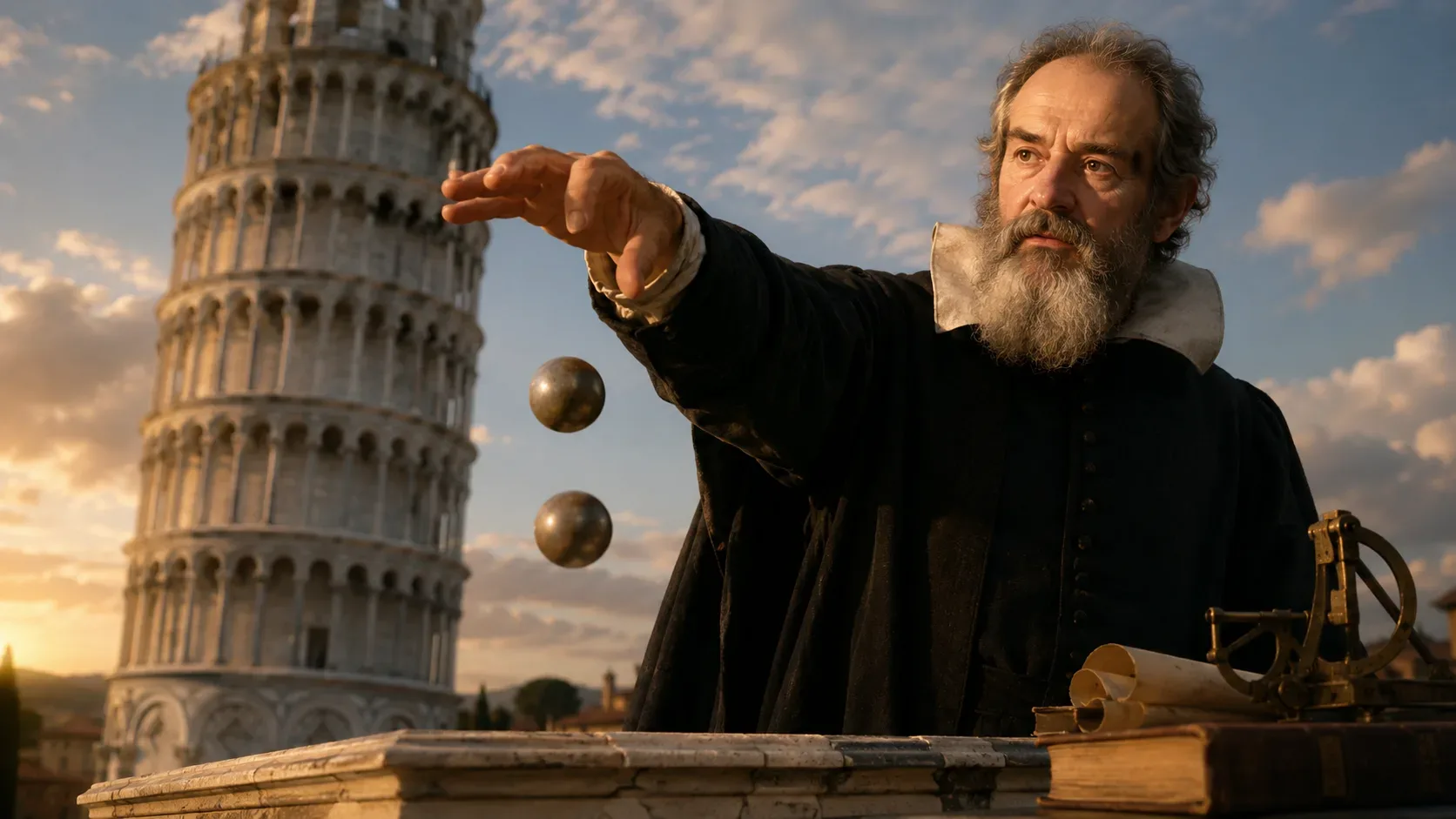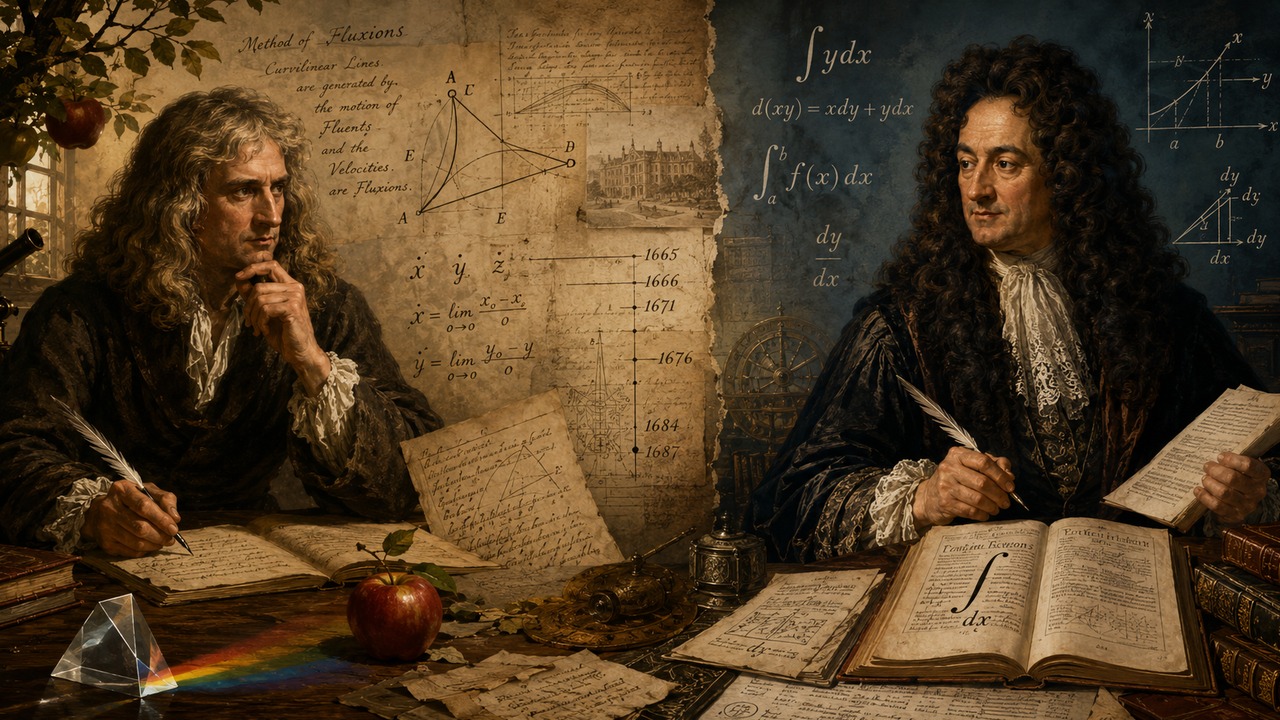
Short answer: Newton's apple story probably has a real historical core, but the schoolbook version usually merges three different claims. Sources close to Newton say that a falling apple led him to think about how far gravity might extend. Those accounts do not say that the fruit hit him on the head. And the law of universal gravitation did not appear fully formed in that instant: it emerged from work that continued for years and culminated in the Principia, published in 1687.
What Newton is said to have told about the apple
The most famous evidence comes from William Stukeley, a physician, antiquarian and Fellow of the Royal Society. In his memoir of Newton, Stukeley recalled a conversation that took place on 15 April 1726. After lunch, the two went into the garden and drank tea under apple trees. According to Stukeley, Newton said that the setting reminded him of the time when the notion of gravitation came into his mind, “occasioned by the fall of an apple”, while he sat in a contemplative mood.
The key point in the account is not a blow to the head but a question: why does the apple always fall toward the ground rather than sideways or upward? In Stukeley's narrative, Newton connected the fall with the Earth's attraction and then, “by degrees”, extended the idea to celestial bodies. The manuscript is preserved and transcribed by the Newton Project; the Royal Society also presents the episode from its collections.
Stukeley is not the only source close to Newton
John Conduitt, Newton's relative by marriage and a member of his close circle, left a biographical draft with a similar version. He wrote that during the period when Newton withdrew from Cambridge because of the plague, the mathematician was musing in a garden when he thought that the same gravity that made an apple fall from a tree might extend much farther from the Earth — perhaps as far as the Moon.
This draft, available through the Newton Project, is especially useful because it does not present the story as a complete, instantaneous discovery. The text itself mentions calculations that initially failed to match the hypothesis and were revisited later using a better measurement of the Earth's size.
Voltaire helped turn the episode into a famous story
The episode also entered print culture early. In 1727, the year Newton died, Voltaire published a brief version saying that Newton, walking in his garden, had the first thought of his system of gravitation after seeing an apple fall from a tree. The wording helped make the episode memorable and portable: a vast scientific system condensed into an everyday scene.
It is important to separate popularization from origin. Voltaire did not simply invent the whole episode. Biographical material connected to Newton's circle survives, and Stukeley later recorded that Newton had told him the story directly. Voltaire's role was to help circulate the apple as an emblematic scene of scientific discovery.
Did the apple fall on Newton's head?
The accounts closest to Newton do not support that detail. Stukeley describes an apple falling while Newton sat in contemplation. Conduitt describes an apple falling from the tree to the ground. Voltaire's published version also says Newton saw an apple fall. None of these accounts says that the fruit struck him.
An important source for understanding the later transformation is Isaac D'Israeli's essay “Poets, Philosophers, and Artists, Made by Accident”, included in Curiosities of Literature. There the episode becomes much more theatrical: Newton is said to have been reading under an apple tree when a fruit fell and struck him a smart blow on the head. The text is available through Project Gutenberg.
In the nineteenth century, mathematician and historian Augustus De Morgan was already treating that detail as an addition to the tradition and said he did not know where D'Israeli had obtained the blow-to-the-head element. It is therefore safer to say that the apple-on-the-head version is a later embellishment, not a detail supported by accounts tied to Newton.
Did Newton “discover gravity” at that moment?
That is another simplification. People knew long before Newton that objects fall. The decisive scientific question was different: could the force that makes bodies fall near the Earth's surface be the same force that governs the motion of the Moon and the planets?
In the apple accounts, the intellectual leap attributed to Newton is precisely this attempt to connect terrestrial falling with celestial motion. But the mature formulation required mathematics, comparison with astronomical data and a long sequence of work.
What happened between the apple and the Principia
Newton spent part of 1665 and 1666 at Woolsthorpe, his family home, during the closure of the University of Cambridge caused by the plague. The National Trust, which cares for Woolsthorpe Manor, connects this period with Newton's investigations into gravity, optics and mathematics.
Even if the apple memory is accepted as broadly true, more than two decades separate that period from the publication of the Philosophiae Naturalis Principia Mathematica in 1687. During that interval, Newton kept working on problems in dynamics and astronomy. His correspondence with Robert Hooke in 1679–1680 was important to the development of ideas about motion and centripetal attraction.
In 1684, Edmond Halley visited Newton to discuss the problem of planetary orbits. The Newton Project records that Newton sent Halley, months later, the tract known as De motu corporum in gyrum, a decisive step toward the Principia. The Royal Society highlights Halley's role in encouraging, organizing and enabling the publication of the work.
This changes how the anecdote should be read. If it happened as Newton recalled, the apple may have served as a moment of insight or as a compressed memory of the beginning of a line of inquiry. It did not replace the scientific process that followed.
What each version of the story allows us to say
| Claim | What the sources allow us to say |
|---|---|
| Newton saw an apple fall | It is plausible and supported by more than one account close to Newton's circle, including Stukeley and Conduitt. There is, however, no record made at the moment of the supposed event in 1665–1666. |
| The apple hit him on the head | It does not appear in the accounts closest to Newton. It is a later dramatization. |
| The fall led Newton to think about gravity | This is the core of the story attributed to Newton himself by Stukeley and it also appears in Conduitt. |
| The law of universal gravitation was born fully formed there | No. Its development was gradual and continued for years through calculations, correspondence, astronomy and mathematical work. |
| The apple “discovered” that things fall | No. Newton's problem was to connect terrestrial gravity to the dynamics of celestial bodies and formulate a quantitative theory. |
Why the head version became so powerful
There is an obvious narrative reason, although it is an inference rather than a documented fact: an apple merely observed is less visual than an apple striking the hero's head. The blow turns a long intellectual process into a single “eureka” instant that is easy to draw, teach and repeat.
That simplification also changes the historical meaning of discovery. Instead of showing science as an accumulation of problems, calculations, debates and revisions, it suggests that a theory can appear complete by accident. In Newton's case, the very sources used to support the anecdote point to something more interesting: the falling apple may have prompted a question, not supplied a finished theory.
So is the story myth or fact?
The best answer is: there is a historically plausible episode inside a greatly expanded legend. Newton told Stukeley a story about a falling apple and gravitation; Conduitt recorded a similar version; Voltaire helped popularize it. That gives the core anecdote a stronger basis than a myth invented from nothing.
But two popular elements do not survive the same test. There is no good evidence that the apple struck Newton's head, and there is no basis for treating the scene as the instant when universal gravitation emerged complete. What the sources show is a more realistic origin: an everyday observation connected to a powerful question, followed by decades of work before a theory could link falling bodies on Earth with the motion of the Moon and the planets.
Historical and institutional sources used
- William Stukeley, account of his conversation with Newton — Newton Project
- John Conduitt, biographical draft on Newton — Newton Project
- Royal Society — Newton's apple tree
- Voltaire, An Essay upon the Epick Poetry (1727), p. 104
- Newton Project — introduction to texts related to the Principia
- Royal Society — context for the production and publication of the Principia
- Isaac D'Israeli, Curiosities of Literature — Project Gutenberg
- Augustus De Morgan, A Budget of Paradoxes — Project Gutenberg