At the end of the 19th century, when electricity began to leave laboratories to light streets, houses and factories, a question was still open: which system should take this energy to people?
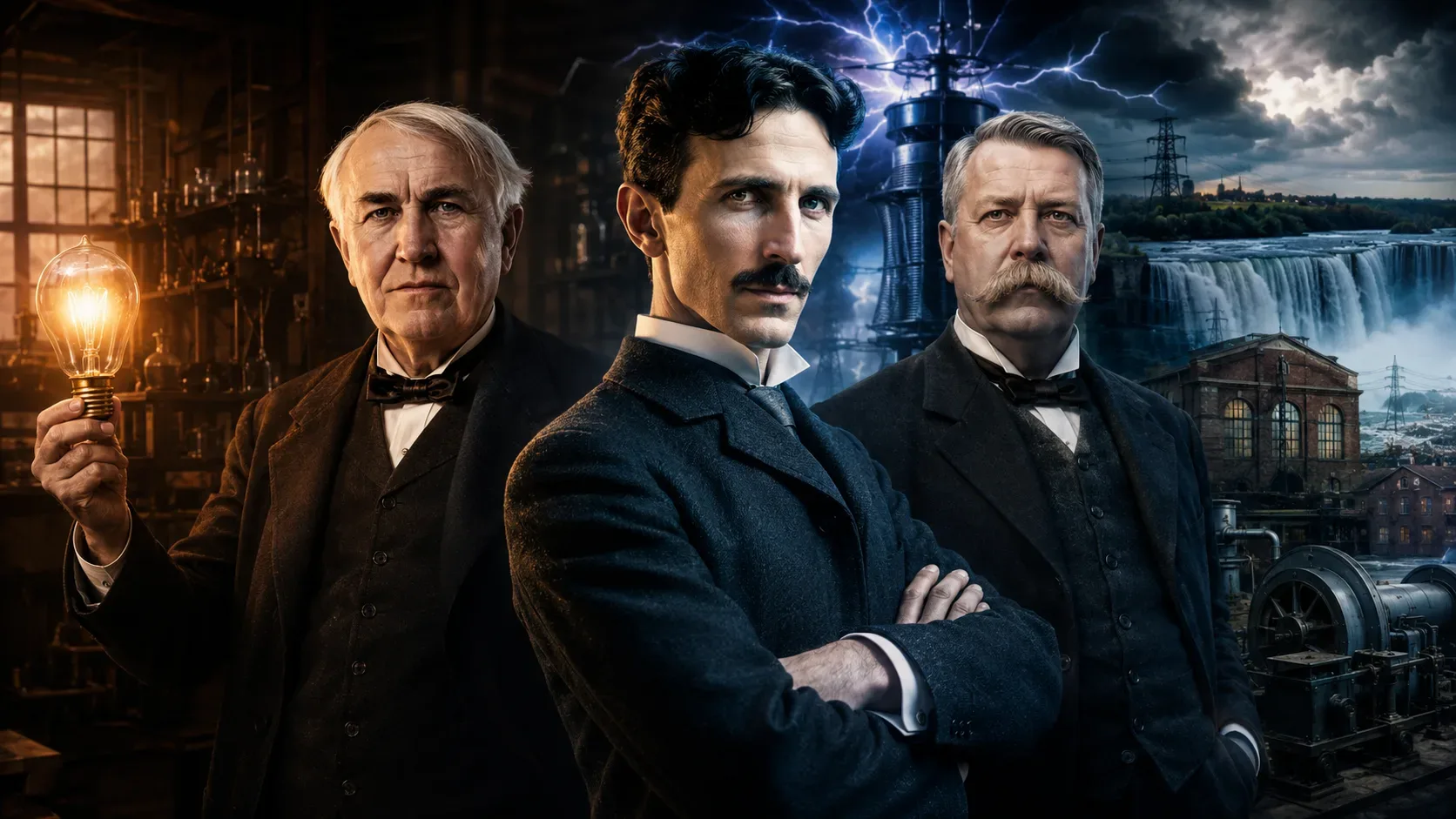
Thomas Edison advocated direct current, or DC. George Westinghouse believed in alternating current, known as AC. Nikola Tesla entered this story with inventions that would help transform alternating current into a system capable of not only lighting lamps, but also of moving motors and transporting energy over great distances.
The confrontation became known as the War of the Currents. Despite the name, there was no war in the military sense nor a single decisive battle. It was a technological, business, legal and public image dispute that gained strength in the second half of the 1880s and lost intensity in the early 1890s. Projects such as the Chicago World's Fair in 1893 and the Niagara Falls hydroelectric plant, installed in the following years, demonstrated in an increasingly difficult way to contest the advantage of alternating current for large-scale transmission systems.
But telling this story as just “Edison versus Tesla” oversimplifies what happened.
Before the war, there was a problem: how to get electricity far away?
Edison had built much more than a lamp. Its objective was to develop a complete electrical lighting system, including generators, wiring, meters and power production stations. In 1882, its Pearl Street station in New York became one of the great landmarks of commercial electrification with direct current.
The system worked. The problem was the distance.
The direct current used by Edison operated at low voltage and faced significant losses when it needed to travel greater distances. This forced companies to install generating stations relatively close to consumers. To electrify entire cities or bring energy from a distant plant to urban centers, this characteristic became an important economic limitation.
Alternating current offered another possibility. With transformers, its voltage could be raised for long-distance transport, reducing losses, and then lowered near the point of consumption.
This meant that a single installation could serve a much larger area.
The technology, however, still needed to be perfected.
William Stanley showed that alternating current could work in practice
A character less known to the general public, but essential in this story, was the engineer William Stanley Jr.
Working for George Westinghouse, Stanley improved transformers based on earlier work by inventors such as Lucien Gaulard and John Dixon Gibbs. In March 1886, he demonstrated in Great Barrington, Massachusetts, a practical lighting system in which transformers adjusted different voltage levels of alternating current.
The IEEE recognizes this experiment as the first practical demonstration of an alternating current electric lighting system using transformers to control distribution voltage levels.
It was just the kind of solution Westinghouse was looking for.
George Westinghouse: the businessman who saw the scale of the problem
George Westinghouse was already a successful inventor and businessman before entering the electrical industry. Among his previous achievements was the development of air braking systems for railways.
When he started investing in electricity, he realized a fundamental difficulty with Edison's model: to grow, energy distribution needed to reach greater distances without indefinitely multiplying the number of generating stations.
Westinghouse adopted alternating current and brought together engineers, equipment, and patents to turn it into a commercial system. William Stanley's experiment in 1886 was an important step in this direction.
From then on, Edison had before him a competitor capable of not only presenting a different technology, but also of building an industry around it.
Thomas Edison: why did he advocate direct current so much?
Today it may seem obvious that Edison simply chose the wrong technology. In the 1880s, the situation was much less simple.
Direct current already powered motors, could charge batteries, and was part of an infrastructure into which Edison and his investors had put a lot of money. Early alternating current systems also had technical limitations and raised real safety concerns, particularly because they used higher voltages.
The Smithsonian itself notes that there were technical reasons for Edison's initial preference. The great advantage of AC emerged as transformers became practical and made it possible to raise and lower voltage efficiently. For short lines, the difference could be small; over long distances, it became decisive.
There was, therefore, technology, investment and commercial interest at stake.
But the dispute would end up going far beyond engineering.
Nikola Tesla enters history
Nikola Tesla is probably the character who has gained the most space in popular culture when it comes to the War of Currents.
In 1888, Tesla presented his work on a polyphase alternating current system and received patents related to motors and power distribution. George Westinghouse acquired rights to several of these patents and took Tesla to collaborate with his company.
One of the most important advances was the induction motor based on a rotating magnetic field. Unlike previous motors, it offered an efficient way of using alternating current itself to produce movement.
The Smithsonian preserves engines developed by Westinghouse based on Tesla's work and identifies one of them, produced in 1888, as the first commercial alternating current engine.
This addressed a major weakness of the CA.
By then, Edison could argue that his system was not just for lighting: direct current also had mature applications in motors. With Tesla and the development of the polyphase system, alternating current began to offer a convincing answer to this problem.
Still, to say that Tesla single-handedly “invented alternating current” would be incorrect. AC systems, generators and transformers were already being developed by several engineers. His decisive contribution was mainly in the polyphase system and induction motor, later integrated into Westinghouse's engineering efforts.
When the technological dispute became a propaganda war
The expansion of high voltage systems caused accidents and frightened a population that was still learning to live with electrical wires in the streets.
Edison believed that placing high voltages in urban areas posed a risk. Their business interests, however, were also directly threatened by expanding competition.
From 1888 onwards, the dispute became much more aggressive.
Alternating current became publicly associated with danger and death. Edison and interests linked to his system supported efforts to demonstrate the lethal effects of AC. Animal electrocution experiments carried out in Edison's laboratory were also linked to debates over execution methods considered more humane by New York State.
In this period another important character appears: the engineer Harold P. Brown, a declared critic of alternating current. Brown participated in demonstrations designed to prove its danger and was involved in the debates surrounding the development of the electric chair.
The issue ended up going directly to the criminal system.
The electric chair entered the War of Currents
New York was looking for an alternative to hanging to execute death row inmates. Electrocution was chosen.
William Kemmler, convicted of murder, became the first man sentenced to die in this manner.
The choice of alternating current for the electric chair offered Westinghouse's opponents a powerful association: if the same current used by the competitor could execute a person, it would be easy to present it to the public as a dangerous technology.
Westinghouse opposed the use of his system for this purpose and assisted in the legal challenge to Kemmler's execution. Edison, in turn, gave testimony in the process related to the constitutionality of electrocution.
The Thomas Edison Papers, maintained by Rutgers University, show that the story was more complex than the caricature of Edison personally building a chair to destroy Tesla. Business interests linked to the Edison system played an important role in obtaining a Westinghouse generator for execution, but the dispute involved companies, engineers, authorities, lawyers and electrocution advocates.
Kemmler was executed in 1890.
The attempt to link alternating current to death, however, failed to prevent its commercial expansion.
And the famous story of Topsy the elephant?
One of the most repeated stories about Edison states that he electrocuted an elephant named Topsy to demonstrate that alternating current was dangerous.
The episode actually existed, but the direct association with the War of Currents is historically misleading.
Topsy was killed on Coney Island in 1903, more than a decade after the decisive phase of the dispute between the systems. The Edison Manufacturing Company filmed the event, but researchers at the Thomas Edison Papers note that presenting this death as a demonstration organized by Edison during the War of the Currents is a myth.
Edison was, indeed, linked to previous animal electrocution experiments during debates about electrical safety and execution methods. Confusing these events with Topsy, however, mixes episodes separated by many years.
1892: Edison leaves the center of the electrical industry
While the public battle continued, the electricity sector underwent major corporate consolidation.
In 1892, Edison General Electric merged with the Thomson-Houston Electric Company. From this union, General Electric was born.
The move also marked Edison's departure from direct leadership of the electricity businesses that bore his name. The Thomas Edison Papers treat this merger as the culmination of approximately twelve years in which Edison was in charge of the corporate development of his electrical systems.
The dispute, however, would still have two major episodes capable of making the advantage of alternating current visible to millions of people.
Chicago, 1893: electricity becomes a spectacle
The World's Columbian Exposition, held in Chicago in 1893, was one of the greatest technological showcases of its time.
Westinghouse was tasked with providing the exhibition's lighting system. Records from the Library of Congress highlight that the company demonstrated the viability of alternating current on a large scale there, while the Smithsonian preserves documentation of the Westinghouse and Tesla polyphase system displayed at the event.
At night, electrically lit buildings and fair spaces created a public display that few advertising campaigns could match.
It wasn't just a disputed theory.
Alternating current was working in front of huge crowds.
Niagara turned commercial victory into infrastructure
The next step was even more ambitious: harnessing the power of Niagara Falls to produce electricity and send it far away.
In 1893, Westinghouse received contracts related to the project. Large generators were later installed, and the system became operational in the middle of the decade.
In November 1896, energy produced in Niagara was transmitted to Buffalo, dozens of miles away. For the National Park Service, this project symbolizes the victory of alternating current in the battle against the direct current system for long-distance power transmission.
The fundamental advantage was proven on an industrial scale: it was possible to produce electricity far from consumer centers, raise its voltage to transport it with lower losses and reduce it again before use.
This principle is at the heart of the large electrical networks that would develop in the 20th century.
After all, how long did the War of Currents last?
There is no single universal date for the beginning and end of the War of Currents.
In a more restricted sense, the Thomas Edison Papers place their main phase between 1886 and 1892, a period in which the commercial rivalry between the Edison and Westinghouse systems became especially intense. Rutgers' own documentation treats the years 1890 to 1892 as the final phase of the “Battle of the Currents.”
In a broader interpretation, it is possible to follow the dispute from the commercial expansion of alternating current in the mid-1880s to the great demonstrations in Chicago, in 1893, and Niagara, between 1895 and 1896.
Therefore, simply stating that the war “lasted ten years” creates a precision that historical sources do not offer.
The most correct thing is to say that the dispute gained strength in the second half of the 1880s, lost intensity in the early 1890s and had its technological superiority for long-distance transmission consolidated by the large projects carried out until 1896.
Who really won?
If the question is which technology has become dominant for large-scale power generation and transmission, the answer is clear: alternating current won.
Its ability to work with transformers and different voltage levels allowed it to transport energy over much greater distances in a more economically efficient way. With the development of polyphase motors, another major limitation disappeared.
But this does not mean that direct current has been eliminated.
It continued to be useful in batteries, industrial processes, electronic systems and many other applications. Today, modern high voltage direct current transmission technologies, known as HVDC, are used in specific situations.
The Smithsonian itself summarizes the historical result well: what in the 19th century seemed like a dispute in which only one system could survive has lost meaning over time, because alternating current and direct current continue to be used where their characteristics are most appropriate.
Edison, Westinghouse and Tesla did not occupy the same role
Part of the strength of this story lies precisely in the contrast between its protagonists.
Thomas Edison was an inventor, entrepreneur and system builder. He had put enormous financial, technical and reputational resources into direct current and believed that the high voltage of alternating current posed real risks.
George Westinghouse was also an inventor, but his greatest strength in this dispute was organizing a company capable of transforming various alternating current technologies into a competitive commercial infrastructure.
Nikola Tesla brought fundamental ideas to polyphase motors and systems that greatly expanded the possibilities of AC. His patents played a decisive role, but it was Westinghouse engineers and factories who worked to transform the concepts into commercial equipment.
William Stanley made the practical use of transformers in distribution systems much more viable.
Harold P. Brown, on the other hand, has become a central figure in the public battle over safety and electrocution.
The War of Currents, therefore, did not just have two geniuses facing each other. It was the result of the meeting — and the clash — between inventors, engineers, entrepreneurs, investors and institutions who were trying to decide how a completely new technology would become part of everyday life.
In the end, it wasn't simply the most brilliant inventor or the most aggressive businessman who won. The system that was able to best solve the problem that was growing together with cities won: taking large quantities of electricity further and further and then delivering them in suitable conditions to the consumer.
This is precisely why the War of Currents remains interesting more than a century later. It shows that an invention can be extraordinary and still not conquer the world alone. To change an era, technology, infrastructure, financing, security and execution capabilities need to work together.