The collaboration between Andy Warhol and Jean-Michel Basquiat does not fit well into a choice between “partnership between equals” and “exploitation of a young artist”. The paintings show a concrete creative exchange: one artist altered, covered and provoked the other's work, sometimes over several rounds. At the same time, the two occupied very different positions in the art world.
Warhol was 32 years older and already had international recognition. Basquiat was much younger and faced an artistic system in which race, market and institutional access had obvious weight. But that doesn't mean he was an unknown discovered by Warhol. Before the most intense period of the partnership, Basquiat was already exhibiting internationally; at age 21 he participated in Documenta and, at 22, in the Whitney Biennial. The Brooklyn Museum also notes that its gallery exhibitions were already attracting collectors and had sold out quickly.
The most productive question, therefore, is not simply who “used” whom. It is understanding how the canvases were actually constructed, what each artist began to do under the influence of the other and why an artistically reciprocal collaboration could coexist with an asymmetrical social and commercial relationship.
From an experience with three artists to an almost daily duo
The starting point was the Swiss art dealer Bruno Bischofberger, who formally approached Basquiat and Warhol in October 1982 and later proposed a collaboration that would also involve Francesco Clemente. In the first experience, the three worked separately and the works circulated between them. Fifteen paintings resulted from this project.
Warhol and Basquiat decided to continue without Clemente. The Fondation Louis Vuitton, which dedicated the largest exhibition ever held to the group in 2023, estimates that the two produced around 160 paintings between 1984 and 1985, some on a monumental scale. The institution describes a period of almost daily work.
This passage is important because it shows that the duo was not simply fulfilling a project conceived by the dealer. Bischofberger himself reports that when he returned to the Factory in 1985, he discovered that Warhol and Basquiat had produced a large number of new collaborations on their own and considered that the dealer had no privileged right to them.
The collaboration also made sense within Warhol's longer trajectory. His practice already involved assistants, friends, photography, printing, cinema and collective production. It is precisely this previous infrastructure that helps to understand why shared authorship was not foreign to him — a topic that can be delved into in depth in the article “Andy Warhol was born on August 6: how the Factory transformed individual authorship into a creative network”. What changed with Basquiat was the arrival of another artist with a strong authorial language, capable not only of participating in the production, but of visually confronting what Warhol put on the screen.
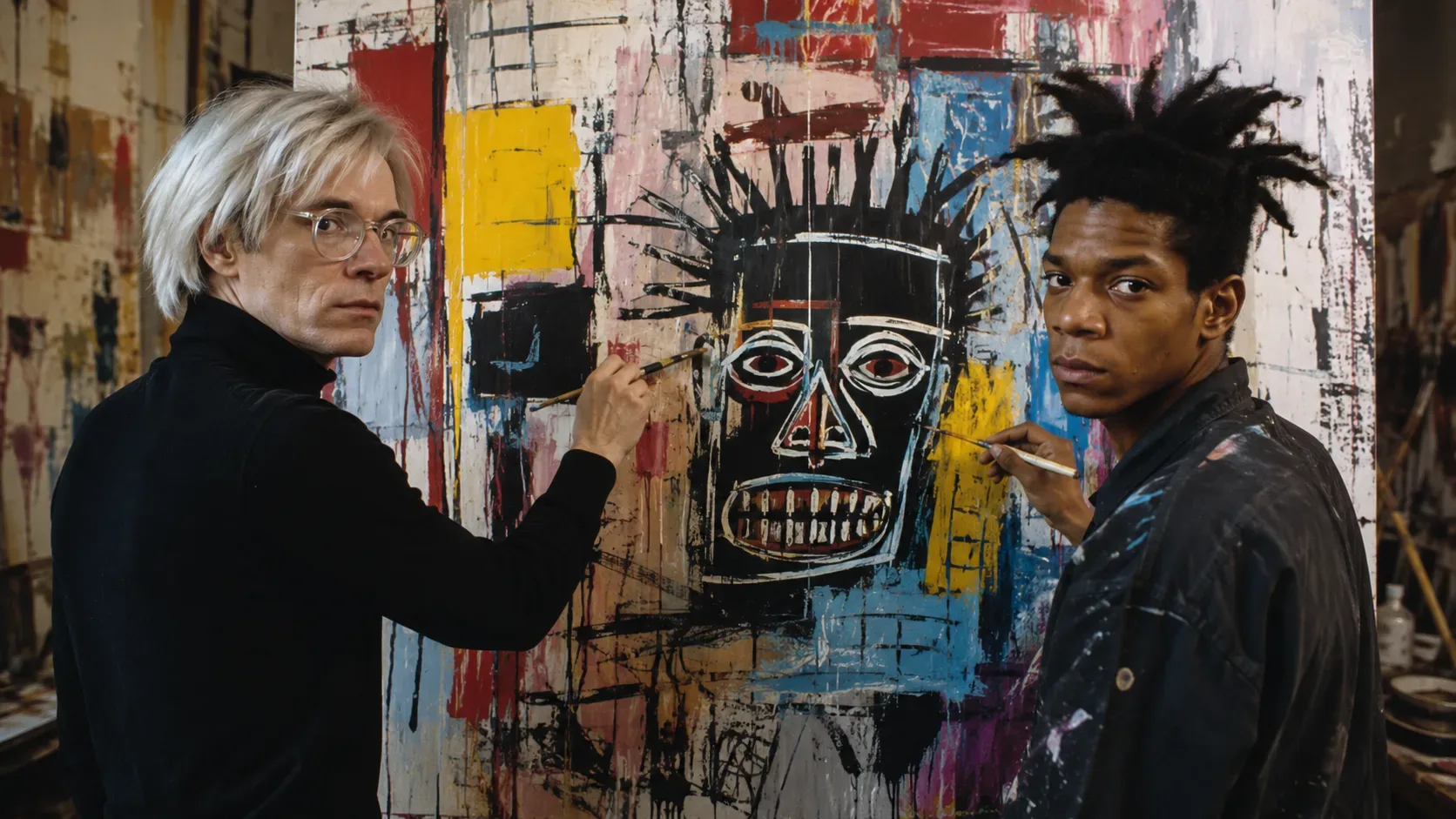
How Warhol and Basquiat made a four-handed painting
There was no rigid division in which each artist received half of the canvas. The process was closer to a sequence of provocations.
Often, Warhol would begin. It could design and trace a recognizable image, print a silkscreen or introduce elements taken from newspapers, advertisements and commercial brands. Basquiat then came in with figures, words, numbers, fields of color and gestures that could occupy the empty spaces, cross the previous images or cover them almost completely. After that, Warhol could return to work, followed again by Basquiat. The Whitney notes that some paintings went through two or three rounds before reaching an equilibrium.
Basquiat himself described his intervention as a kind of “disfiguration” of the recognizable images introduced by Warhol. The word is revealing: collaborating, in this case, did not mean politely preserving the partner's contribution. It was allowed to erase, cover, contradict and force the other to respond.
This tension appears in Paramount, from 1984–85. The Whitney describes Warhol beginning the painting with silk-screened images and Basquiat intervening on them. Artist T. J. Wilcox notes that there was also a competitive component: records and diaries indicate that Warhol became irritated when Basquiat covered precisely sections he liked.
It was not, therefore, a clean sum of “Pop Art on one side” and “Basquiat on the other”. The strength of some of these works lies precisely in making it difficult to separate the authors.
Basquiat didn't just paint about Warhol: he changed the way Warhol painted
Perhaps the strongest evidence of reciprocity lies in the effect of the partnership on Warhol himself.
After decades associated mainly with screen printing and mechanical procedures, Warhol returned to working more intensely with manual painting and large formats. The Fondation Louis Vuitton and the Whitney relate this resumption directly to the contact with Basquiat. The Andy Warhol Museum even interprets the period as a renewal of the final phase of his career.
The influence also did not run in a single technical direction. Basquiat experimented with screen printing in some collaborations, while Warhol returned to the brush. In Bischofberger's account, there are works in which Basquiat used screen printing first and Warhol came in later as the second artist.
This dismantles a simple reading in which Warhol would only provide a ready-made base for the young artist to complete. In certain works, the procedures associated with each name changed hands.
Keith Haring, who accompanied the two, described this production as a physical conversation carried out by painting. Decades later, institutions such as the Andy Warhol Museum began to highlight the balance between different languages and Basquiat's influence on Warhol's late work.
So why was the partnership seen as exploitation?
Because artistic reciprocity does not eliminate power differences.
Warhol was already an international celebrity, had a decades-long career and was linked to an extensive network of gallerists, collectors, celebrities and collaborators. Basquiat had achieved extraordinarily rapid success, but he was a much younger black artist circulating in a market in which his identity was constantly transformed into theme, commodity, and public narrative. His own work repeatedly dealt with racism, power, wealth and exclusion.
It is also incorrect to describe Basquiat as someone who depended on Warhol for a career. When the main collaborations began, he already had international exhibitions, important institutional participation and his own market. The idea of a Warhol who simply “created” Basquiat erases the speed and scale of the artist's independent rise.
Asymmetry existed, but it does not automatically coincide with a lack of agency.
This distinction was lost in part of the reception in 1985. In the joint exhibition presented by the Tony Shafrazi Gallery, in New York, critic Vivien Raynor, from The New York Times, revived the image of Basquiat as a possible “art-world mascot” and presented Warhol as the mentor who had helped in his ascension. The review interpreted the set as yet another manipulation by Warhol and Basquiat as an overly willing participant in the game.
The framing was powerful because it transformed the very difference between the artists into an explanation for the works: Warhol would be the veteran manipulator; Basquiat, the young man absorbed by the fame machine.
But the evidence of the creative process makes this reading insufficient. Basquiat covered Warhol, insisted that he return to canvas, convinced him to paint in a different way and participated in the continuation of the project beyond the initial commission. This doesn't seem like the behavior of an artistically passive collaborator.
The market makes the story even more complicated
There is, however, another actor that should not disappear when discussing exploitation: the commercial system around artists.
A report published by Vanity Fair in 1988 recorded a dispute between Basquiat and Bischofberger over the payment terms for the artist's participation in twenty other collaborative works. Basquiat said he understood a $500,000 settlement differently; The dealer, in turn, stated that there were outstanding advances and defended the payment method used. It's a documented commercial controversy with conflicting versions.
It does not prove that Warhol financially exploited Basquiat. It shows something more precise: paintings by four hands existed within a network of dealers, sales, ownership of the works and financial expectations that was more complex than the personal relationship between two painters.
Confusing this entire structure with a unilateral action by Warhol could hide precisely where some of the commercial disputes were taking place.
Did the 1985 review end the collaboration?
It was an important breaking point, but simply saying that “criticism destroyed the friendship” is more categorical than the sources allow.
After the negative reception of the 1985 show, the two did not develop another major cycle of collaborative paintings. Later accounts describe Basquiat as deeply affected by the criticism and more distant from Warhol. At the same time, other reconstructions of the relationship indicate that the personal bond has not completely disappeared. The Andy Warhol Museum itself places the friendship and professional relationship between 1982 and 1986.
For this reason, Raynor's review helps to understand the artistic rupture, but it should not become a single cause for a much longer and contradictory personal relationship.
The image of the two with boxing gloves, created to promote the 1985 exhibition, ended up working almost too well as a metaphor. They really competed, erased each other and fought for space on the same surface. But struggle and collaboration were not opposites in that process: they were part of the same method.
Creative partnership and unequal relationship can be true at the same time
The available set of documents favors a less comfortable and more interesting conclusion.
The collaboration was artistically reciprocal. Basquiat did not function as Warhol's assistant; he changed his language, his techniques and even the way in which the older artist returned to using the brush. Warhol, in turn, offered images of advertising, press, and mass culture that Basquiat could attack, displace, and incorporate. The result depended precisely on this mutual interference.
At the same time, the relationship took place within a real asymmetry of age, fame, race and institutional position. Recognizing this does not require turning Basquiat into an unwilling victim or Warhol automatically into an exploiter.
Perhaps it is precisely this double condition that explains why the paintings continued to be reevaluated. In 2023, the Fondation Louis Vuitton brought together 80 jointly signed canvases in an exhibition dedicated to the duo's work; the exhibition received 662,016 visitors. Instead of treating the works as a minor or failed episode, recent institutions began to study them as a decisive part of Warhol's late production and Basquiat's trajectory.
The interest remains current. On June 25, 2026, the Brazilian publication ArteRef returned specifically to the controversy of the partnership and the reception of 1985. The discussion also gained new editorial material: Taschen announces for September 2026 an edition of Warhol on Basquiat, made in collaboration with the Andy Warhol Foundation and the estate of Jean-Michel Basquiat, bringing together photographs, files and records of the relationship.
Forty years later, the paintings remain interesting precisely because they resist the simple story of the master and the disciple. When they work better, it is no longer easy to tell where Warhol ends and Basquiat begins. And it was exactly this momentary loss of authorial boundaries that the two seemed to seek.