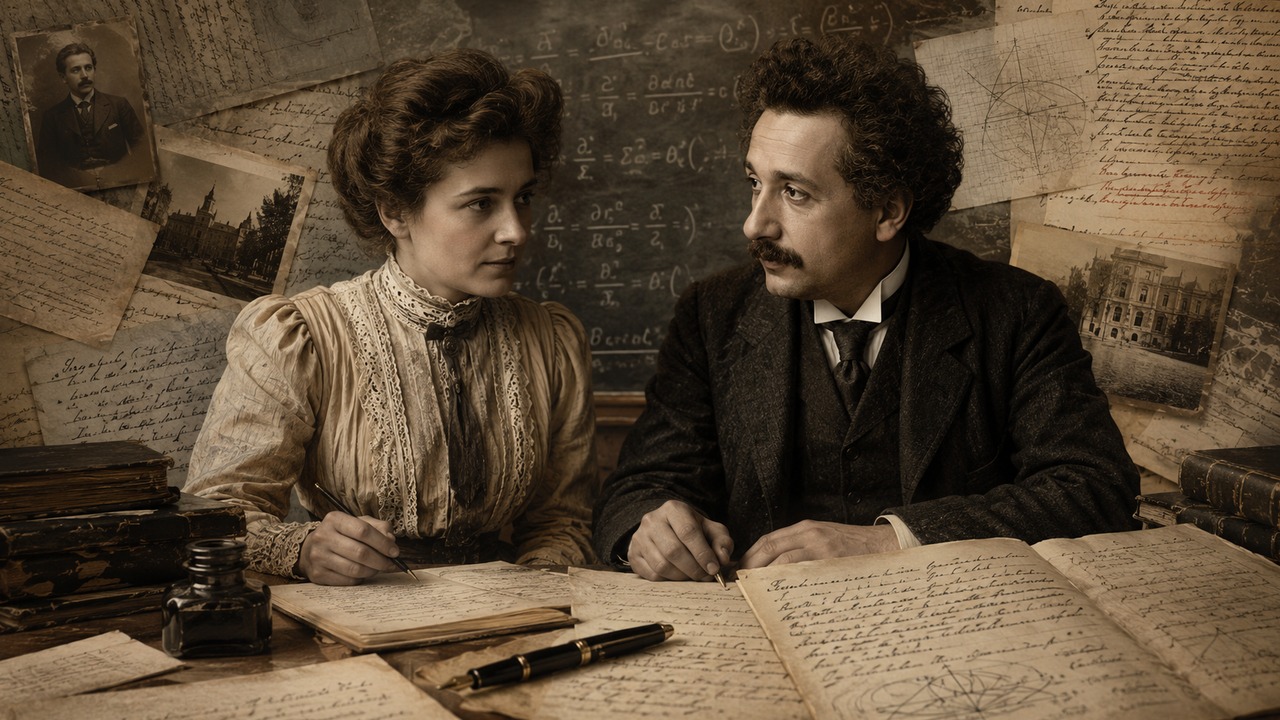
The question is usually presented as a duel between two absolute answers: either Mileva Marić was erased from history as co-author of Albert Einstein's works, or she had no intellectual participation in the period leading up to the annus mirabilis of 1905. The surviving documents do not authorize either of these extremes. They show a relationship in which science, study, affection and intellectual conversation were mixed. At the same time, they do not identify a derivation, calculation, argument or excerpt from the 1905 articles that can be documentedly attributed to Mileva.
This difference is decisive. Saying that Marić was Einstein's scientific interlocutor is compatible with the letters. To say that she was an uncredited co-author of the 1905 papers requires more specific evidence, and that evidence has not surfaced to this day. The most responsible case, therefore, is not “Mileva did nothing”, but “the available documentation does not allow demonstrating a concrete scientific contribution to the 1905 articles”.
What we know before discussing authorship
Mileva Marić and Albert Einstein studied together at the Zurich Polytechnic, now ETH Zurich, on the course aimed at training mathematics and science teachers. ETH itself records that Marić was the only woman enrolled in that group. She performed well in most of the course, but was unable to pass the final exam, even after a second attempt. Einstein completed his degree in 1900.
This context matters because it dismantles a recurring caricature. Mileva was not someone unfamiliar with physics who just lived with a scientist. She had advanced university training in mathematics and physics, read scientific literature and was part of the same intellectual environment as Einstein. This makes it perfectly plausible that the two discussed scientific problems. What still needs to be demonstrated, case by case, is whether these discussions produced an identifiable authorial contribution to the published works.
“Our work on relative motion” is the strongest piece of the letters
The most cited phrase in the controversy appears in a letter from Einstein to Marić dated March 27, 1901. In it, Einstein talks about bringing “our work on relative motion” to a conclusion
successful. The formulation is genuine and deserves weight. It is not right to treat it as if it never existed or as if it were irrelevant.
But a plural phrase also does not alone resolve an authorship dispute. It was written more than four years before the publication of the article on special relativity and does not specify which part of the problem falls to each. In other letters from the same period, Einstein describes concrete ideas about the electrodynamics of moving bodies using the first person singular. In December 1901, for example, he reported his ideas to Alfred Kleiner and said he intended to write an article about them.
The file therefore allows strong reading and limited reading at the same time. The strong reading is that Einstein saw Mileva as someone with whom he could share projects and scientific enthusiasm. The limited reading is that the pronoun “our” does not identify a technical contribution. To prove co-authorship, one would need something like a letter discussing a calculation made by Marić, a manuscript in his hand with original development, a clear contemporary attribution, or another document that links his work to a recognizable part of the article. Nothing like this about the 1905 texts survives.
The correspondence shows intellectual partnership, but is asymmetrical and incomplete
The preserved letters are important precisely because they bring the discussion closer to the primary sources. They show Einstein writing to Mileva about physics, readings and projects, and show Marić interested in books and scientific authors. In a 1901 letter, she mentions reading and asks Einstein about Planck. Science was part of the couple's language.
There is, however, a documentary asymmetry. Many of Marić's letters to Einstein have not survived, while several of his letters to her have been preserved. This gap prevents excessively negative conclusions. The silence of the archive cannot be turned into proof that she never contributed.
The same care applies in the opposite direction. A documentary absence cannot be automatically filled with the hypothesis most favorable to co-authorship. Historians work with what can be demonstrated and distinguish possibility from evidence. The fact that letters have disappeared leaves open questions; does not transform the lost contribution into an established fact.
There is also an important indication of authorship attributed to Einstein. In a letter from Mileva to her friend Helene Savić, written after the 1905 publication period and reproduced in later documentary collections, she refers to the many scientific articles that her husband had been writing. The formulation does not prove that she was outside of all conversations, but neither does it register a claim for joint work.
What the 1905 articles actually show
In 1905, Einstein sent to Annalen der Physik the works that became associated with the photoelectric effect, Brownian motion, special relativity and the equivalence between mass and energy. The chronology of the Center for History of Physics, at the American Institute of Physics, records the submissions and publications of these articles throughout that year. In the published versions, the authorship is Albert Einstein.
This fact does not, in principle, end all historical investigation. The history of science knows cases in which people contributed without receiving formal credit. But the published name is direct documentary evidence of how authorship was presented to the scientific community at that time. To replace this attribution with hidden co-authorship, it is necessary to find positive evidence to the contrary.
The original submission manuscripts of the main 1905 articles are not available for inspection to resolve the controversy. Therefore, claims about what appeared on a missing leaf need to be treated with special rigor. It is precisely at this point that
“Einstein-Marity” story gained much greater weight than the original source allows.
“Einstein-Marity”: Joffe’s account was transformed when retold
Soviet physicist Abram F. Joffe published a text in memory of Einstein in 1955. In later popular versions, it was said that Joffe had seen the original 1905 manuscripts signed by “Einstein-Marity”, which would be a clue that Marić appeared as a co-author before having her name removed.
A reading of Joffe's text does not support this narrative. He speaks in the singular about the author of the three works he highlights and calls this author, then unknown, an employee of the patent office in Bern. He then uses the form “Einstein-Marity” and explains “Marity” as the wife’s surname attached to the husband’s. Joffe does not say, in this passage, that there were two authors. Nor does he state that he saw the original manuscripts or that Mileva's name was removed in the publication.
Alberto A. Martínez showed how later retellings converted this passage into a much stronger statement. The difference is not small. “Joffe called Einstein Einstein-Marity” is an observation about the form of the name used in the obituary. “Joffe saw manuscripts signed by Einstein and Marić as co-authors” is a completely different documentary claim, and is not what the 1955 text claims.
Even if Joffe's explanation of naming customs in Switzerland is discussed, this does not create co-authorship. The central point of the audit is grammatical and documentary: the excerpt describes a single author and does not record a double signature.
The argument for collaboration needs to be separated from the argument for co-authorship
There are researchers and publicists who defend a more inclusive reading of the evidence. Pauline Gagnon, for example, maintains that the letters and testimonies show the couple's collaboration in a broad sense, although she recognizes that it is not possible to credit Marić with a specific part of the work. This is a different position from the proven co-authorship thesis: it emphasizes the shared work environment, intellectual exchange, and the possibility of unrecorded help.
Estelle Asmodelle went further in a 2015 article. After re-examining letters, social context and hypotheses about the collaboration, she proposed that Marić be considered for a form of honorary co-authorship on one or two works. Interestingly, the author herself does not point to the special relativity article as the best candidate; It suggests above all the 1901 text on capillarity and, with more emphasis, the 1905 article on light quanta. For relativity, it speaks of prior collaboration or assistance, not demonstrated co-authorship of the final article.
This study is useful because it explains the argument most favorable to Mileva, but it also shows the difference between inference and document. At some points, he repeats as fact the version that Joffe would have seen manuscripts signed “Einstein-Marity”, precisely the interpretation challenged when the 1955 text is directly examined. The recommendation for “honorary co-authorship” is, moreover, a contemporary proposal for recognition, not a discovery of a hidden historical signature.
What the most skeptical historians consider demonstrable
John Stachel, an early editor of the Einstein Papers Project, interpreted the correspondence as evidence that Marić functioned primarily as an interlocutor, someone educated enough to listen, question, and follow up on ideas. Galina Weinstein, when reviewing the controversy, concluded that historical and primary sources do not support the scenario of hidden co-authorship in the 1905 articles. Allen Esterson and David Cassidy reached a similar conclusion when re-examining, in a book, the main allegations accumulated over the decades.
This position does not depend on stating that Marić was incapable of cooperating. It depends on an attribution pattern. What is most direct are the articles published with Einstein as
author, letters in which he mixes common project language with descriptions of his own ideas and the absence, among the preserved documents, of a specific scientific contribution by Mileva that can be linked to the 1905 texts.
Caution also protects Mileva's story. Transforming her into a “secret genius” without solid documentation may seem like a reparation, but it ends up replacing a real woman, with a difficult academic trajectory and plausible intellectual participation, with a character constructed to fill gaps in the archive.
So, Mileva helped Einstein with the 1905 papers?
If “helped” means that she was an intellectual partner, had a background in physics, shared readings, listened to ideas and probably discussed science with Einstein, the answer is that there is a documentary basis to take this possibility very seriously. The 1901 letter itself with “our work on relative motion” prevents the scientific relationship from being reduced to domestic coexistence without intellectual content.
If “helped” means that she produced an identifiable part of the four major articles of 1905, made the decisive calculations, or provided arguments that should have made her a co-author, the surviving documentation does not support this. There is no preserved passage that attributes a specific technical result of these works to it.
If the question is even stronger, “Was Mileva an uncredited co-author?”, the documentary answer today is negative: the thesis has not been demonstrated. The story of “Einstein-Marity” does not prove double authorship, and the published articles present Einstein as the sole author. The lack of original manuscripts leaves a margin of ignorance, but ignorance is not proof of co-authorship.
Intellectual partner: yes, with documentary limits
The category that best fits the evidence is that of intellectual partner, as long as it is used accurately. She recognizes that Mileva had a scientific background and participated in Einstein's universe of ideas without transforming this proximity into a technical credit that the documents cannot specify.
Scientific collaborator in the 1905 articles: not demonstrated
There may have been informal collaboration, review, discussion or practical help that left no trace. The file does not allow excluding these possibilities. But it also does not allow us to convert them into facts. For the history of science, an authorial contribution must be attributable to something concrete.
Co-author deleted: not supported by surviving sources
The hypothesis remains attractive because it combines a real scientific relationship, gender inequalities and documentary gaps. These elements justify investigation, not automatic conclusion. When claims are audited one by one, the strong evidence for co-authorship disappears before the strong evidence for intellectual partnership.
What this case teaches about authorship in the history of science
The Mileva Marić case is valuable precisely because it does not end with a catchphrase. He shows that scientific authorship is not the same thing as influence, conversation, support, review or a shared intellectual environment. A person can be important for the formation of ideas without it being possible to attribute a formal part of an article to them. There may also be real contributions that the archive has lost forever.
Responsible historical work needs to support this buffer zone. The barriers faced by women in early 20th century science make it legitimate to be wary of narratives of solitary genius. But correcting a structural injustice cannot be done by inventing individual authorship that the sources do not demonstrate.
With regard specifically to the 1905 articles, the best documentary synthesis is this: Mileva Marić was an intellectually qualified interlocutor and an important part of the environment in which Einstein matured his ideas, but the letters and documents known today do not allow us to identify her as a scientific collaborator with specific content nor as an uncredited co-author of those articles.