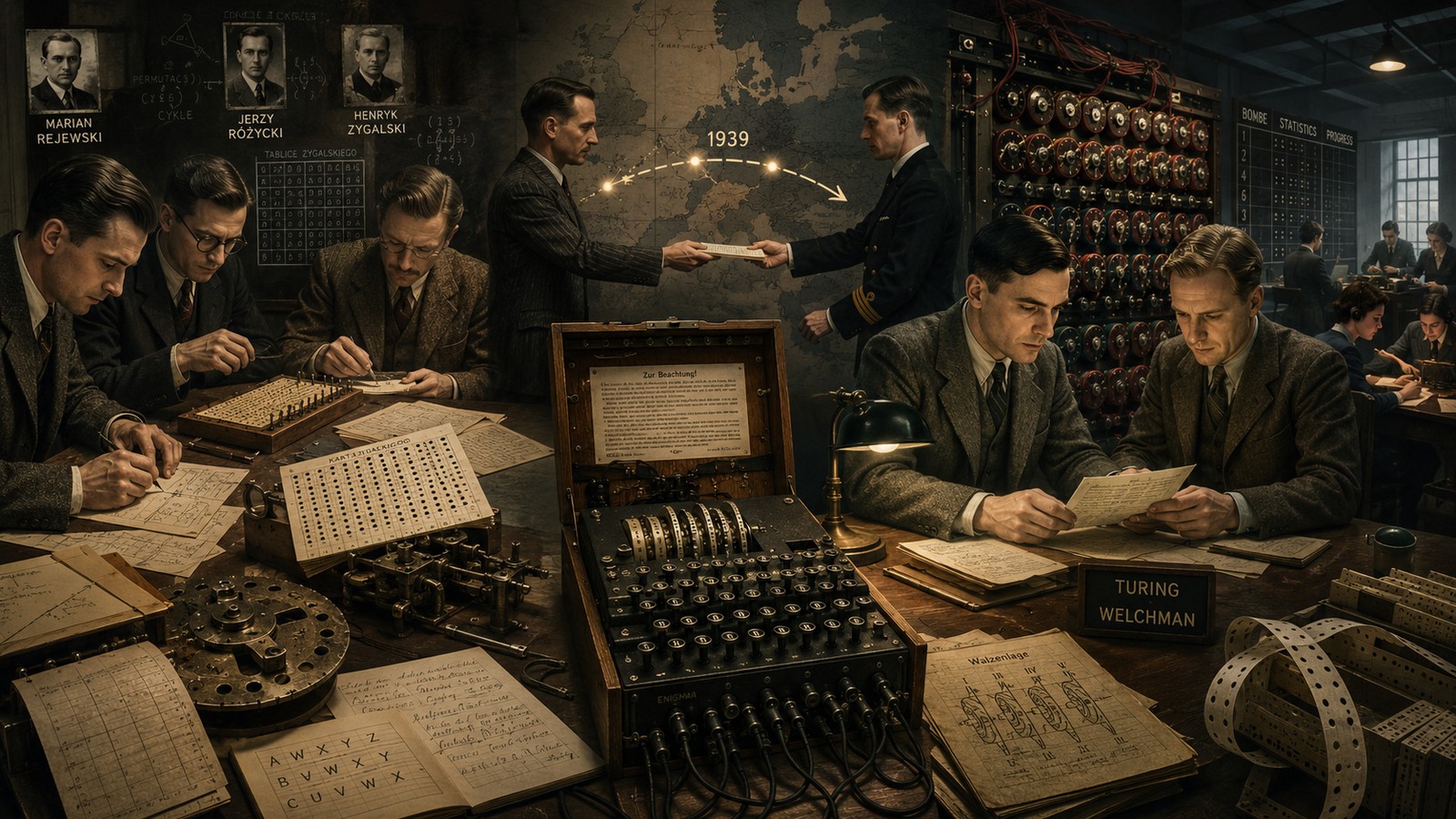
The short answer is: Alan Turing didn't break Enigma alone and he didn't start from scratch. The first major disruption of the military Enigma occurred in Poland, at the end of 1932, when Marian Rejewski mathematically reconstructed the functioning of the machine with decisive support from material obtained by French intelligence. Jerzy Różycki and Henryk Zygalski helped turn this discovery into practical methods for recovering keys in the face of German changes. In 1939, the Polish team shared its results with the French and British. From this base, Turing, Gordon Welchman and British engineers developed a new Bombe, suitable for other procedures. Bletchley Park ultimately transformed cryptanalysis into a large-scale, ongoing operation.
This sequence matters because the question "who broke Enigma?" mixes different problems. Figuring out the machine's wiring, rebuilding a military Enigma, recovering a day's settings, adapting to new rotors, automating searches, attacking the naval Enigma, and processing thousands of intercepts were not the same task. The story gets more precise when you ask who solved which problem.
French intelligence before the Polish break
In the early 1930s, German military Enigma was already resisting traditional methods of cryptanalysis. A commercial copy was not enough, because the version used by the German armed forces had important modifications, including the connection panel and a different internal configuration of the rotors.
French intelligence obtained documents and keys related to Enigma from Hans-Thilo Schmidt, an employee linked to the German cryptographic system. French official Gustave Bertrand shared this material with Biuro Szyfrów, the Polish Cipher Bureau. The documents did not simply reveal the internal wiring of the rotors. They reduced unknowns and provided data that could be combined with intercepted messages.
It was at this point that Marian Rejewski made the mathematical breakthrough. Instead of relying solely on linguistic techniques, he treated Enigma's operation as a permutation problem. With the French data, he was able to reconstruct the rotor wiring and the operating principle of the military version. Poland was then able to produce replicas of the machine and move beyond the problem of "how is this machine assembled?" to the everyday problem "what configuration is she using now?".
This helps to separate two contributions that are often confused. France provided critical human intelligence. Rejewski performed the mathematical analysis that transformed this intelligence into a military machine solution. The first breach was not born from a single stroke of luck, but from a combination of espionage, signal interception and mathematics.
Różycki and Zygalski: keep the break going
Solving the Enigma structure did not mean that all future messages would automatically be readable. German operators used variable settings and changed procedures. Cryptanalysis needed to discover keys repeatedly, often on a daily basis.
Jerzy Różycki developed the so-called clock method, used to help determine rotor selection and tuning from observable properties of traffic. Henryk Zygalski created a method based on perforated sheets of paper, later known as Zygalski sheets. When multiple sheets were overlapped, perforation alignments helped eliminate possibilities and pinpoint candidate configurations.
Rejewski also pursued automation. The cyclometer helped to catalog characteristics produced by rotor combinations. In 1938, faced with new German changes, he designed the Polish cryptologic bomb, an electromechanical device that tested positions much faster than a manual search.
Therefore, simply saying that "Rejewski broke Enigma" is correct only if the phrase is understood as the initial rupture of the military system. The continued reading work depended on the team and a sequence of methods. Różycki, Zygalski, technicians from the Cipher Bureau and the company AVA, which built replicas and equipment, were part of the system that transformed theory into message reading.
1938-1939: when methods found new limits
Germany continued to reinforce its procedures. At the end of 1938, two new rotors were added to the available set, so that operators could choose three out of five. This multiplied the combinations that needed to be considered. Changes to the indicator system also directly affected methods that explored specific operating habits.
The difficulty was not that Polish knowledge had become useless. The problem was that expanding the search space required much more equipment, material and operational capacity. The Polish bomb, built for an earlier scenario, would have to be multiplied on a scale that the Cipher Bureau was unable to finance and operate at that time.
This phase is essential to understand why there is no "definitive break date". Enigma was not a lock opened once and forever. The machine, the sets of
rotors, procedures and keys formed a moving target. A method could work for months and lose effectiveness after a German operational change.
July 1939: transfer to the allies
On July 25 and 26, 1939, just weeks before the invasion of Poland, Polish, French and British cryptanalysts met near Warsaw. The Poles revealed how far they had advanced, presented their methods, demonstrated the cryptologic bomb and provided the allies with Enigma replicas and working materials.
For the British, this was not a historical curiosity. GCHQ describes the meeting as a transformation of the starting point of British cryptanalysis. The Government Code and Cypher School team received knowledge about Polish machine reconstruction, attack techniques, and years of accumulated experience against German changes.
This is also why the narrative "Turing arrived at Bletchley Park and invented the solution" erases a decisive link. By the time he began working full-time on the war effort, Britain had already received the Polish technical heritage. In January 1940, Turing met Rejewski and other Polish cryptanalysts, then refugees in France, to deepen this exchange.
The 1939 transfer did not end Polish participation. Rejewski, Różycki and Zygalski continued working in cryptological centers in France after the invasion of their country. What changed was the scale and center of gravity: Bletchley Park began to concentrate the largest Allied interception, engineering, personnel and machinery capabilities.
What Alan Turing Really Created
Turing's merit was not in remaking the Polish bomb piece by piece. The new problem required a different design. The Polish bomb relied heavily on features of the old indicator procedure. If the Germans changed this procedure, the method would lose the basis that guided the search.
Turing thought of a machine that worked with cribs, that is, chunks of plain text that analysts had good reason to assume appeared in a message. Instead of looking for a specific match in the indicator, the future British Bombe would cycle through configurations and eliminate those incompatible with the relationships between the ciphertext and the probable passage.
This change was conceptually important. The machine did not "read German" or understand the message. It performed a logical search for possible configurations, guided by previous human work. Bletchley Park's own educational documentation highlights that the Bombe did not break the cipher on its own: analysts first needed to find a crib and transform the relationships between letters into a menu to configure the machine.
Turing therefore created a new cryptanalytic search engine built on a problem already opened by the Poles, but adapted to conditions that had changed. Calling it mere copying diminishes British innovation; calling it an independent invention that bypassed Poland erases the basis on which it was developed.
Gordon Welchman and the diagonal panel
Gordon Welchman is one of the most important figures in correcting the simplified version of history. As Turing developed his concept, Welchman realized that a reciprocal property of the Enigma wiring board could be exploited in conjunction with the search engine's circuitry.
He created the so-called diagonal board. Integrated into Turing's design, this feature allowed eliminating a much larger volume of incompatible configurations. Instead of ending up with thousands of candidates, a well-crafted run could reduce the search to a small set that analysts then verified.
Harold "Doc" Keen, an engineer at the British Tabulating Machine Company, turned Turing and Welchman's ideas into manufacturable equipment. This detail matters because war cryptanalysis does not end at the blackboard. A mathematical concept needs to become a machine that is reliable, repairable, replicable and operable by teams in shifts.
Therefore, the most accurate way to attribute the British Bombe is to recognize at least three layers: Turing conceived the search architecture based on cribs; Welchman added the diagonal panel which dramatically increased efficiency; Keen and the engineering team converted the concept into production machines.
Naval enigma: why Turing gained so much visibility
Turing also played a central role in one of the most difficult targets: the German naval Enigma. At Bletchley Park he led the work of Hut 8, the unit dedicated to the cryptanalysis of naval communications. Kriegsmarine traffic was particularly important because it was linked to submarine warfare and the Atlantic routes.
Bombe was an important part of this effort, but again it did not act in isolation. The attack on a naval key could depend on interceptions, message patterns, cribs, procedural analyzes and, in certain phases, captured materials. Once the configuration was found, other teams could decipher messages, translate them, assess their military value, and distribute intelligence in a controlled manner.
This protagonism in Hut 8, added to Turing's later fame as a computing pioneer, helps explain why popular culture made him the face of the Enigma crash. The association is not invented: he was one of Bletchley Park's leading cryptanalysts and a decisive figure. The error appears when your contribution is converted to a single origin story.
Bletchley Park: from discovery to scaled operation
The difference between discovering a method and exploiting an enemy system for years is the difference between a laboratory and an operation. Bletchley Park needed to turn captured radio signals into usable intelligence repeatedly, against many German networks and with changing keys.
The process began outside the park, at intercept stations known as Y-stations, which captured transmissions. At Bletchley, messages were recorded and separated by network. Cryptanalysts were looking for cribs and other structures that could produce a menu for Bombe. Operators configured the machines, which tested possibilities. Candidate configurations were checked; When the key was recovered, adapted equipment could reproduce Enigma's operation to
decipher traffic.
Then came a less cinematic and equally important second half: translation, gap correction, military analysis, prioritization, source protection and intelligence distribution. In Hut 6, for example, the focus included Army and Air Force Enigma; Hut 8 concentrated the naval Enigma. Other sectors handled and evaluated the results.
More than 200 British Bombs were built during the war. This number shows what "breaking Enigma" has come to mean at Bletchley Park: not a miracle machine in a room, but an infrastructure of people, interceptors, mathematicians, linguists, engineers, operators, analysts and machines working as a chain.
Who solved which problem
Initial intelligence: França and Schmidt
French intelligence obtained German documents and keys and shared them with Poland. This material did not contain a ready-made solution, but it provided information that allowed the reduction of unknowns and made Rejewski's mathematical analysis viable.
First military break: Marian Rejewski
Rejewski mathematically reconstructed the wiring and operation of the military version at the end of 1932. This is the strongest point to answer who made the first major failure of the military Enigma. The result, however, depended on intelligence cooperation and soon turned into teamwork.
Key recovery: Różycki and Zygalski
Różycki developed the clock method. Zygalski created the perforated sheets that bore his name. These techniques tackled the recurring task of discovering configurations and helped maintain readability when Enigma was no longer a structural mystery.
Polish automation: Rejewski and the bomb
The 1938 Polish bomb automated some of the setting search. It preceded the British Bombe and demonstrated that Enigma's cryptanalysis could be supported by electromechanical machines. Its design, however, was linked to German procedures at the time and lost efficiency when these procedures changed.
British automation: Turing, Welchman and Keen
Turing redesigned the problem around cribs and logical deletion of configurations. Welchman added the diagonal panel, which made searching much more efficient. Keen turned the design into a machine that could be manufactured and operated at scale.
Naval puzzle: Turing and Hut 8
Turing led the Hut 8 front dedicated to naval Enigma and developed important methods for this traffic. The answer, however, continued to depend on interception, cryptanalysis, Bombe operation, decryption and intelligence teams.
Scale operation: Bletchley Park
Bletchley Park connected methods, machines and thousands of human tasks into a system capable of repeating key cracking and exploring large volumes of messages. This
industrialization of cryptanalysis is different from the initial Polish discovery, but it was indispensable for transforming mathematical discoveries into continuous warfare intelligence.
So, Turing cracked Enigma?
Yes, if the phrase is to say that Turing was one of the main people responsible for making the British break in Enigma traffic possible during the war, especially for his contribution to the Bombe and the work against naval Enigma. No, if the phrase means that he was the first person to discover how the military Enigma worked or that he solved the problem himself.
The first decisive mathematical breakthrough came from Marian Rejewski, supported by French intelligence and later joined by Różycki and Zygalski. The Polish team read Enigma for years before the war, developed key recovery techniques, built replicas, and created a cryptologic bomb. In July 1939, he transferred this knowledge to the allies.
Turing and Welchman didn't get a problem solved just by pressing a button. They received a valuable foundation and faced a Puzzle that kept changing. They created a new search engine, incorporated new ideas and helped build the system that Bletchley Park would operate at scale.
The most correct way to tell the story
The best answer to "who broke Enigma?" It's a timeline, not a podium. French intelligence provided critical material. Rejewski performed the initial mathematical breakdown of the military Enigma. Różycki and Zygalski expanded key recovery methods. Poland automated part of the process and shared its results in 1939. Turing, Welchman and Keen developed and materialized the British Bombe for a new scenario. Hut 8 attacked the naval Enigma. Bletchley Park turned all of this into a continuous operation of interception, search, decipherment, translation and analysis.
Historical credit does not need to be divided to produce a single winner. It becomes clearer when each contribution is linked to the problem it actually solved. In this framework, Turing remains decisive, but fails to erase Rejewski, Różycki, Zygalski and French intelligence; and the Polish pioneers are no longer used to diminish the later work of Turing, Welchman and thousands of people at Bletchley Park.