On August 6, 2026, Hiroshima will hold another Peace Memorial Ceremony. At 8:15 a.m. local time — the moment the atomic bomb exploded over the city in 1945 — there will be a minute of silence and the ringing of the Peace Bell. The city's official estimate is that approximately 140,000 people had died by the end of December 1945, although the exact number remains unknown.
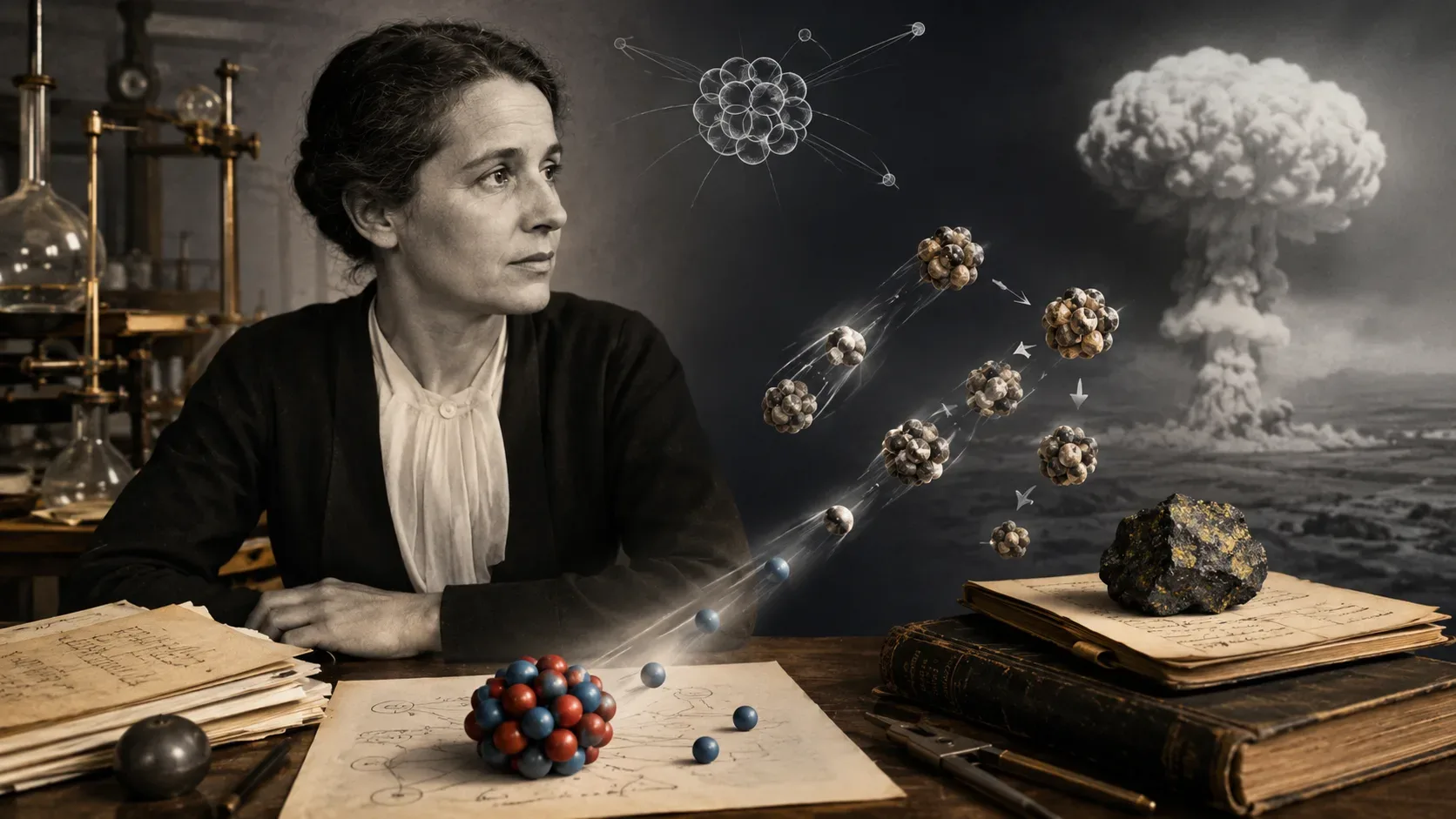
The proximity of the date usually brings back the name of Lise Meitner, an Austrian physicist who participated in the research that led to the discovery of nuclear fission. Her story, however, loses precision when it is transformed into a simple narrative about a lonely scientist, a stolen discovery or an ethical decision capable of erasing everything that came before.
Meitner's contribution can be summarized as follows:Otto Hahn and Fritz Strassmann produced chemical evidence that uranium had originated barium; Lise Meitner and Otto Frisch realized that the nucleus had divided, calculated the energy released and physically explained the phenomenon. Years later, Meitner refused to work on the Manhattan Project. The Nobel Prize in Chemistry for 1944 was awarded only to Hahn.
Before fission: a three-decade partnership
Lise Meitner was born in Vienna, then part of the Austro-Hungarian Empire, on November 7, 1878. She entered the University of Vienna in 1901 and, in 1905, became the second woman to obtain a doctorate in physics there. He then moved to Berlin, where he worked with Max Planck and began a 30-year collaboration with chemist Otto Hahn. The two carried out research into radioactivity and, in 1918, announced the discovery of protactinium.
The division of labor was important: Hahn mastered the methods of radiochemistry; Meitner investigated the physical phenomena produced by nuclear transformations. Fritz Strassmann, an analytical chemist, later joined the experiments with uranium.
This collaboration helps to understand why history cannot be reduced to a single “discoverer”. Fission emerged from the encounter between chemical measurements, knowledge of nuclear physics, correspondence between researchers and interpretations constructed in different countries.
The escape from Nazism interrupted the laboratory, but not the scientific dialogue
Meitner's Jewish background made her stay in Germany increasingly dangerous. For a few years, his Austrian citizenship offered precarious protection. This situation ended after Nazi Germany annexed Austria in March 1938.
In mid-July of that year, at the age of 59, Meitner clandestinely fled Berlin. It passed through the Netherlands and Copenhagen before arriving in Stockholm. In addition to losing the laboratory and the institutional position he had built, he found limited working conditions in Sweden. Even so, he continued exchanging letters with Hahn and following the experiments carried out in Berlin.
Nazi persecution produced a material distortion in the record of the discovery: Meitner could no longer be in the laboratory nor appear normally in a German publication alongside her former colleagues. His absence from the experimental articles did not mean that he had stopped participating intellectually in the problem.
The experiment: Hahn and Strassmann find barium
In late 1938, Hahn and Strassmann bombarded uranium with neutrons and analyzed the reaction products. They expected to find elements close to uranium in the periodic table, possibly even heavier elements. Chemical tests, however, indicated the presence of barium, a much lighter element.
The result seemed so unlikely that the authors themselves presented it with caution. Chemistry said there was barium; the physics known until then did not explain how a uranium nucleus could produce something so smaller.
Hahn and Strassmann sent their article to the magazine Naturwissenschaften on December 22, 1938. The work, published in January 1939, recorded the existence of alkaline earth elements among the products of uranium irradiation. It was the decisive experimental evidence, still without a satisfactory physical explanation.
Hahn also wrote to Meitner reporting the result. Rather than dismiss the finding as an experimental error, she assumed that Hahn and Strassmann had correctly identified the barium. The question became another: what nuclear transformation could produce that element?
The interpretation: Meitner and Frisch realize that the nucleus has split
During the holiday season, Meitner met her nephew, physicist Otto Robert Frisch, in Kungälv, Sweden. Probably on December 24, 1938, the two discussed Hahn's letter and resorted to the model that compared the atomic nucleus to a drop of liquid.
A heavy nucleus could elongate after absorbing a neutron. The electrical repulsion between its protons could then overcome the force holding the “drop” together, causing it to separate into two parts.
Meitner estimated the difference in mass between the initial nucleus and the fragments. Applying the equivalence between mass and energy, he reached a value close to 200 million electron volts per fission. Frisch made an independent calculation based on the electrical repulsion between the fragments and found a similar order of magnitude.
The conclusion explained the barium: the uranium had not just undergone a small transformation or lost a few particles. Its core had broken.
Meitner and Frisch called the phenomenon fission, in analogy to the division of biological cells. The article “Disintegration of Uranium by Neutrons: a New Type of Nuclear Reaction” was published by Nature magazine on February 11, 1939.
Frisch also set up an experiment to directly detect the highly energetic fragments predicted by the interpretation. The result was published on February 18, 1939, providing physical evidence for the splitting of the nucleus.
What each scientist did
| Scientist | Training and main function | Contribution to fission |
|---|---|---|
| Lise Meitner | Nuclear physics | He participated in the experimental program before his exile, interpreted the barium results with Frisch and calculated the energy released by the division of the nucleus. |
| Otto Hahn | Radiochemistry | He conducted experiments in Berlin and, with Strassmann, chemically identified barium among the products of irradiated uranium. |
| Fritz Strassmann | Analytical chemist | Performed decisive separations, verifications and chemical controls to demonstrate that the product behaved like barium. |
| Otto Robert Frisch | Physical | He developed the interpretation with Meitner, introduced the term “fission” and experimentally confirmed the presence of energetic fragments. |
This distribution does not diminish the importance of any of them. On the contrary: it shows why the discovery was collective and interdisciplinary. Without the chemical experiment, there would be no phenomenon to explain. Without physical interpretation, barium would remain a perplexing result. Without Frisch's confirmation, direct physical observation of the fragments would be lacking.
Nuclear fission was not yet a bomb
Meitner and Frisch's explanation demonstrated that a nuclear reaction could release an extraordinary amount of energy. This did not, however, equate to the design of a ready-made weapon.
Building a bomb would require confirming the emission of new neutrons, producing an extremely fast chain reaction, obtaining sufficient quantities of fissile material, separating isotopes, calculating critical masses and developing industrial and engineering systems capable of assembling the device.
These steps mobilized thousands of people, enormous facilities and state resources. The Manhattan Project was a much broader military and industrial operation than the work that interpreted fission in 1938 and 1939. Confusing the two moments turns a collective scientific discovery into an automatic causal line and erases the political, military, and technical decisions made afterward.
This distinction also prevents Meitner from being sensationally called the “mother of the atomic bomb.” She helped explain a natural phenomenon. He did not design the weapon launched over Hiroshima, did not participate in its manufacture and was not part of the Manhattan Project.
Lise Meitner's refusal
In 1942, Meitner received an invitation to work on the Manhattan Project. According to the United States National Park Service and historical records reproduced by the American Physical Society, she categorically refused: “I will have nothing to do with a bomb”
The refusal must be understood precisely. Meitner did not abandon nuclear physics nor did he consider all research on the atom to be illegitimate. She rejected participation in the development of a weapon. Historical sources from the Max Planck Society record that it received other offers related to the war effort and also declined them.
His decision does not make previous science morally neutral, nor does it allow a single researcher to be held responsible for later military use. It shows something more concrete: between the production of knowledge and its transformation into technology there are institutions, financing, political commands and individual choices. Meitner made her choice when she was invited to cross that border.
Why was Lise Meitner left out of the Nobel Prize?
The 1944 Nobel Prize in Chemistry was awarded in full to Otto Hahn “for his discovery of the fission of heavy nuclei”. As the prize was not awarded that year, Hahn received it in 1945. Fritz Strassmann, Lise Meitner and Otto Frisch were not included.
The decision remains one of the most discussed omissions in Nobel history. Still, explaining it simply as a deliberate robbery carried out by a single man oversimplifies the process.
In 1997, historians Elisabeth Crawford, Ruth Lewin Sime and Mark Walker analyzed previously classified documents from the Nobel committees. They identified four central problems: the difficulty of evaluating an interdisciplinary discovery; the lack of knowledge of theoretical physics among the evaluators; Sweden's scientific and political isolation during the war; and a failure to see how Nazi persecution of the Jews had distorted the published record of research.
The institutional separation between chemistry and physics also harmed Meitner. For the chemistry committee, the decisive result was Hahn's experimental identification. For a possible award in physics, his interpretation was underestimated or treated as a consequence of the experiment, and not as a conceptual discovery of its own.
Gender, exile, and anti-Semitic persecution formed the context in which his contribution became easier to ignore. The available documents, however, do not allow reducing the decision to a single cause. Exclusion resulted from a combination of disciplinary boundaries, poor assessments, wartime conditions, and inequalities already present in scientific institutions. The official Nobel archive records dozens of Meitner nominations throughout her career, but no awards.
The timeline from discovery to bomb
| Date | Event | What does it mean |
| March 1938 | Nazi Germany annexes Austria. | Meitner loses the precarious protection of his Austrian citizenship. |
| July 1938 | Meitner flees Berlin and heads to Sweden. | The experimental partnership is interrupted by Nazi persecution. |
| December 1938 | Hahn and Strassmann identify barium after irradiating uranium. | Chemical evidence emerges of an unexpected nuclear transformation. |
| December 24, 1938, approximately | Meitner and Frisch interpret the result with the liquid drop model. | The process is now understood as division of the nucleus. |
| January 1939 | Hahn and Strassmann's article is published. | Chemical evidence becomes public. |
| February 11, 1939 | Meitner and Frisch publish the explanation of fission. | The phenomenon receives a physical interpretation and a name. |
| February 18, 1939 | Frisch publishes the detection of energetic fragments. | Nucleus division gains direct physical confirmation. |
| 1942 | Meitner is invited to the Manhattan Project and refuses. | It distinguishes nuclear research from participation in weapon development. |
| 1944–1945 | The 1944 Nobel Prize in Chemistry was awarded only to Hahn and awarded in 1945. | Theoretical contribution and interdisciplinary collaboration are excluded from the award. |
| August 6, 1945 | A uranium bomb is dropped on Hiroshima. | Fission is used as a weapon on an urban scale. |
| 1966 | Meitner, Hahn and Strassmann receive the Enrico Fermi Prize. | Subsequent recognition brings together central members of the discovery. |
Four myths that history does not support
“Lise Meitner discovered fission alone”
No. His interpretation was indispensable, but it depended on experimental evidence produced by Hahn and Strassmann and was developed in dialogue with Frisch.
“Otto Hahn did everything and Meitner just explained it later”
No either. Meitner had been involved in the uranium research program for years, continued to discuss the results after his exile, and provided a physical interpretation that was not automatically contained in the chemical identification of barium.
“Discovering fission was the same as building the bomb”
No. Between the 1939 articles and the 1945 weapon there was a chain of scientific, industrial, military and political decisions, including research into chain reactions, uranium enrichment and weapons engineering.
“The refusal of the Manhattan Project eliminates any ethical issue”
Refusal is a relevant biographical decision, not a general absolution from science. Meitner's story is valuable precisely because it allows us to discuss where the responsibilities of researchers, governments and institutions begin and end.
The recognition that came later
Meitner received several scientific distinctions after the war. In 1966, she shared the Enrico Fermi Prize with Hahn and Strassmann for pioneering research that led to the discovery of fission. In 1997, the chemical element 109 was named meitnerium in his honor.
No subsequent recognition changes the Nobel decision. It helps, however, to restore a narrative in which experiment and theory once again appear as parts of the same process.
The memory of Hiroshima offers a sobering framework for this story. The bombing should not be used as a dramatic scenario to transform Meitner into a perfect heroine, nor as proof that an equation inevitably produces a weapon. It forces you to look at the entire sequence: the discovery of a phenomenon, its interpretation, the organization of a military project and the choices made by people and states.
Meitner helped explain how the nucleus breaks. When she was asked to work on the pump, she said no. Between these two sentences lies one of the most important stories about knowledge, scientific recognition, and responsibility in the 20th century.
Save this timeline to see each researcher's contributions and subscribe to the series of documented biographies on the history of science.