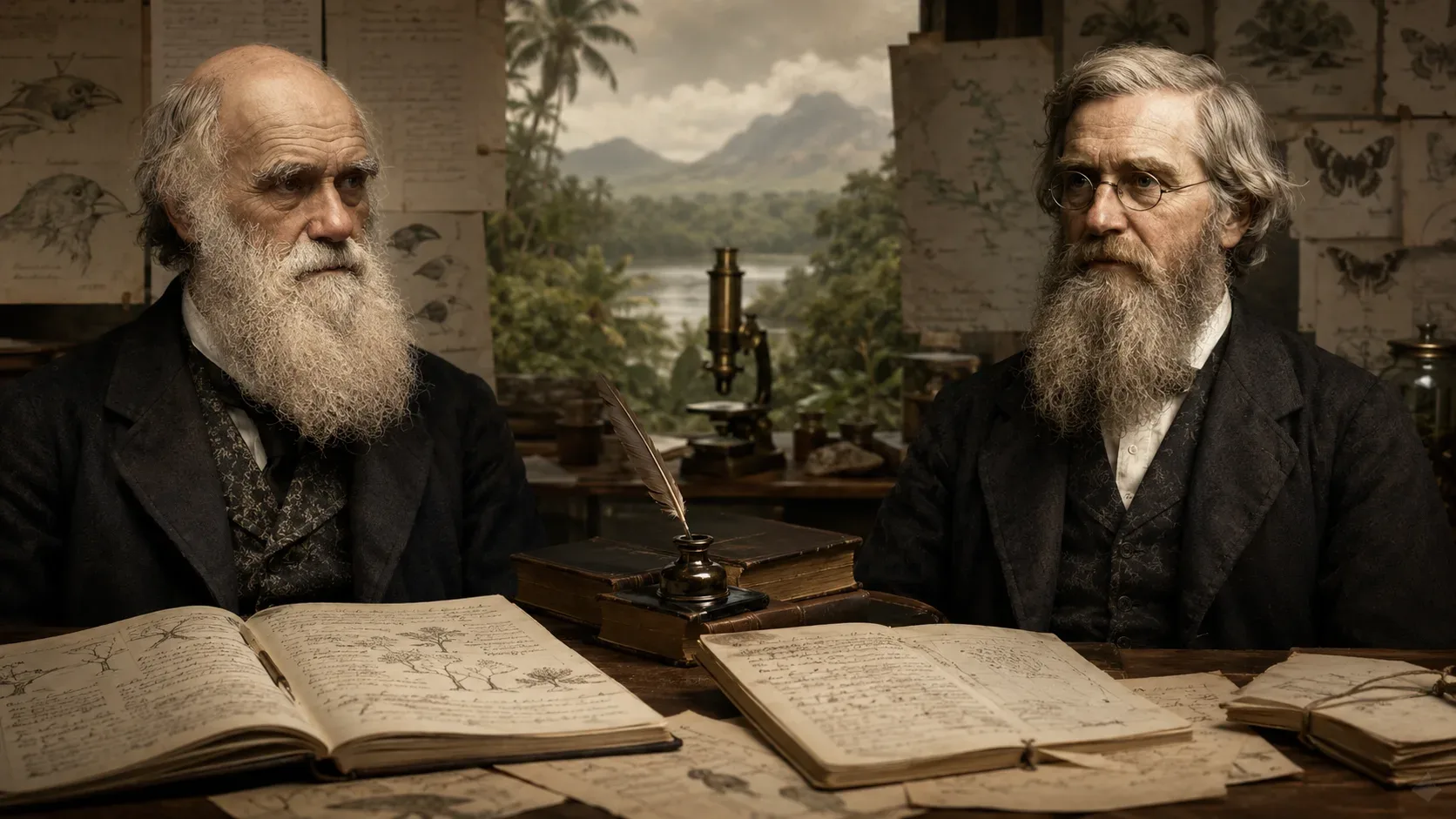
The short answer is: there is no solid documentary evidence that Charles Darwin stole the idea of natural selection from Alfred Russel Wallace. What the documents show is a more uncomfortable — and more interesting — story.
Darwin had developed the core of his theory years before receiving Wallace's essay. Wallace, unaware of these private manuscripts, independently arrived at a very similar mechanism in 1858. When the two lines of work collided, it was Charles Lyell and Joseph Dalton Hooker, Darwin's influential friends and colleagues, who organized a joint presentation designed also to preserve Darwin's earlier priority. Wallace was on the other side of the world and did not participate in this real-time decision. Months later, however, he expressly approved what had been done.
This is why three questions that seem the same need to be separated: who first conceived of natural selection, who formulated it independently, and who made it public first.
Darwin had the theory before receiving Wallace
The strongest evidence against the hypothesis that Darwin simply took Wallace's idea is material: earlier texts exist.
Darwin produced a draft of his theory of species in 1842 and a much more extensive version in 1844. The catalog of his manuscripts preserves these documents, including sections devoted to variation in nature and “natural means of selection.” In September 1857, months before Wallace's decisive essay, Darwin sent the American botanist Asa Gray a summary of his ideas on natural selection and divergence. This document also survives.
There's even a small historical correction hidden in this documentation. In the presentation prepared in 1858, Lyell and Hooker claimed that a work by Darwin had been drafted in 1839 and copied in 1844. The modern editors of the Darwin Correspondence Project note, however, that there is no archival evidence for an 1839 draft: the material that came to be identified in this way was later dated to 1842. Darwin's priority over Wallace remains earlier, but the secure document begins in 1842, not in 1839.
This does not mean that Darwin had already published the theory. This is precisely the problem with the story: for many years, he accumulated notes, evidence and manuscripts without making public a complete exposition of his mechanism.
Wallace arrived at natural selection on his own
Alfred Russel Wallace did not need to have read Darwin's secret manuscripts to arrive at a similar idea. Contemporary sources and their correspondence point to an independent discovery.
In February 1858, during his research in the Malay Archipelago, Wallace wrote the essay known by the title On the Tendency of Varieties to Depart Indefinitely From the Original Type. The text described a struggle for existence in which varieties better adapted to environmental conditions would tend to survive and, over time, replace less suitable forms. He also related this process to the progressive divergence of varieties.
The original manuscript sent by Wallace and the accompanying letter were not preserved. The known version is the one published later by the Linnean Society. Wallace also said, decades later, that he had thought again of Thomas Malthus's population arguments when he realized how differential mortality could produce changes in species.
Darwin and Wallace had not arrived at theories that were identical in every detail. The Linnean Society itself today describes the works as independent and very close, but recognizes differences in emphasis between the mechanisms conceived by the two naturalists. The decisive point is that in 1858 Wallace had his own formulation capable of explaining evolutionary change through selection.
The letter that made Darwin realize he could lose priority
Wallace sent his essay to Darwin and asked him to forward it to Charles Lyell if he found the work interesting enough.
On June 18, 1858, Darwin wrote to Lyell that he had received the manuscript that day. His reaction hardly matches that of someone who was encountering an idea there that he had never had before: he stated that he felt anticipated and that the coincidence was so great that Wallace seemed to have produced a summary of his own draft from 1842.
The next letter is even more revealing. On June 25, Darwin reminded Lyell that his 1844 text had been read by Hooker and that the summary sent to Asa Gray in 1857 could demonstrate that he had not taken his doctrine from Wallace. At the same time, he showed discomfort with the possibility of publishing at that time and appearing to be using the arrival of his competitor's essay to preserve his own precedence. He said he would rather abandon his book than be seen as someone who had acted meanly.
This correspondence does not prove absolute purity of intentions — letters are also documents produced by people interested in the outcome. But, taken together with the earlier manuscripts that still exist, it provides a documentary sequence that is difficult to reconcile with the thesis that natural selection was simply copied from Wallace after June 1858.
Lyell and Hooker built the Linnean Society solution
The solution did not come from Wallace. The arrangement was arranged by Charles Lyell and Joseph Dalton Hooker.
In their communication to the Linnean Society on June 30, 1858, the two men explicitly stated that Darwin and Wallace had arrived at the theory independently and without knowledge of each other's work. They also made it clear that they were thinking about relative priority claims.
To document Darwin's previous history and, at the same time, publish Wallace's work, the communication brought together materials from both:
- an excerpt from Darwin's 1844 essay;
- the summary of Darwin's ideas sent to Asa Gray in 1857;
- Wallace's essay written in 1858.
This detail matters. The publication that became known as the joint Darwin-Wallace work was not an article written by the two side by side. They were separate contributions brought together in the same communication, preceded by the presentation by Lyell and Hooker. The work appeared in Journal of the Proceedings of the Linnean Society of London, Zoology, volume 3, pages 45–62.
There are also later studies showing that the editorial control exercised by Lyell and Hooker was greater than a simplified version of the story suggests. An analysis published in the Biological Journal of the Linnean Society argues, from Darwin's letters, that he did not even expect the excerpt from his 1844 essay to be used in that way; the selection and final format were mainly in the hands of the two organizers.
This does not make the process neutral. Lyell and Hooker had known Darwin for years, knew of his manuscripts, and constructed a presentation that unambiguously recorded the antiquity of his work. Darwin's scientific network played a role in how the priority conflict was resolved.
On July 1, 1858, neither of them were in the room
The paper was presented to the Linnean Society of London on July 1, 1858. Neither Darwin nor Wallace were present. Wallace remained in the Malay Archipelago; Darwin was in England, facing illness in the family and mourning the recent death of his son Charles Waring Darwin. The Linnean Society itself records the absence of both.
The reading placed for the first time before a scientific audience, together, Darwin's and Wallace's respective explanations for species change. The printed version was published in 1858, with Darwin and Wallace associated with the title of the communication.
Wallace only learned later how his colleagues in London had resolved the situation.
And his reaction greatly complicates the narrative that he was an indignant victim of Darwin.
Wallace considered the agreement fair
In a letter to Hooker dated October 6, 1858, Wallace thanked him and Lyell for what they had done. He said he considered himself favored by the decision to recognize merit also in a person who had independently arrived at a theory after the first discoverer.
More important: Wallace claimed that correspondence with Darwin had allowed early publication of some of Darwin's research and preserved his claim to priority. He also said that he would have regretted it if Darwin's generosity had led to the publication of Wallace's essay alone, without Darwin's much earlier ideas.
That doesn't mean Wallace should have the final say on all of the episode's institutional justice. He was in a different scientific and social position than Darwin, Lyell and Hooker, and had no opportunity to negotiate the arrangement before presentation.
But your answer is important primary evidence. The thesis that Darwin and his allies mounted a fraud against Wallace's declared will needs to deal with the fact that Wallace himself, upon learning of the solution, was grateful for it.
What about the accusation that Darwin hid the letter for weeks?
One of the strongest versions of the plagiarism thesis holds that Wallace's essay arrived before June 18 and that Darwin retained it for some time, taking advantage of this interval to incorporate ideas into his own work.
This hypothesis gained ground because another letter sent by Wallace from the region arrived in England before the date recorded by Darwin. The problem is that the correspondence did not necessarily leave on the same postal ship.
In 2012, historians John van Wyhe and Kees Rookmaaker reconstructed the mail routes and connections between Ternate and England. The conclusion of the study was that the essay probably left on the postal steamship of April 1858 and that the resulting route is compatible with its arrival at Darwin's house precisely on June 18th. For the authors, this removes the main chronological basis for the accusation that Darwin hid the text for two weeks.
The interpretation did not end the entire historiographical discussion; Critical work continued to examine what Darwin, Lyell, and Hooker knew and how priority was constructed. The safest point is another: it is not necessary to assume plagiarism to explain the similarities between the texts, because Darwin's previous manuscripts document his theory before the arrival of Wallace's essay.
So who got to natural selection first?
Depends on priority type.
In the pre-1858 documented formulation, Darwin came first of the two. There is a draft from 1842, an essay from 1844, and the summary sent to Asa Gray in 1857.
Wallace arrived at the mechanism independently. His 1858 essay does not appear to be derived from Darwin's private writings, and both Darwin and Lyell and Hooker recognized the independence of the discovery.
In the public communication of 1858, the priority was shared. The works were presented together to the Linnean Society on July 1 and published under a communication that associated the two names.
In later fame, Darwin was far ahead. The decisive step came the following year. On November 24, 1859, he published On the Origin of Species, an extensive exposition of the theory supported by a much larger body of evidence. The book transformed a priority dispute between naturalists into an international scientific discussion and lastingly linked Darwin's name to evolution by natural selection.
This explains the apparent contradiction of the books and current searches. Simply saying that “Darwin invented natural selection” erases Wallace. To say that “Wallace discovered everything and Darwin stole it” erases almost two decades of previous Darwin documentation.
What the documents allow you to conclude
The best sustained story is not one of a thief and a victim, nor one of a lone hero.
Darwin first developed, privately, a theory of natural selection and accumulated evidence for years without publishing his complete exposition. Wallace independently arrived at a comparable mechanism and, by submitting his essay in 1858, created a real crisis of priority. Lyell and Hooker resolved this crisis with a joint publication that acknowledged Wallace but also used ancient documents to protect Darwin's anteriority. Wallace did not participate in the decision before the presentation, but later explicitly approved it.
So the question “Did Darwin steal Wallace?” produces more heat than accuracy. Available documents favor independent discovery, with Darwin's chronological priority for private formulation and shared public credit in 1858.
What posterity distributed in a much less balanced way was fame.