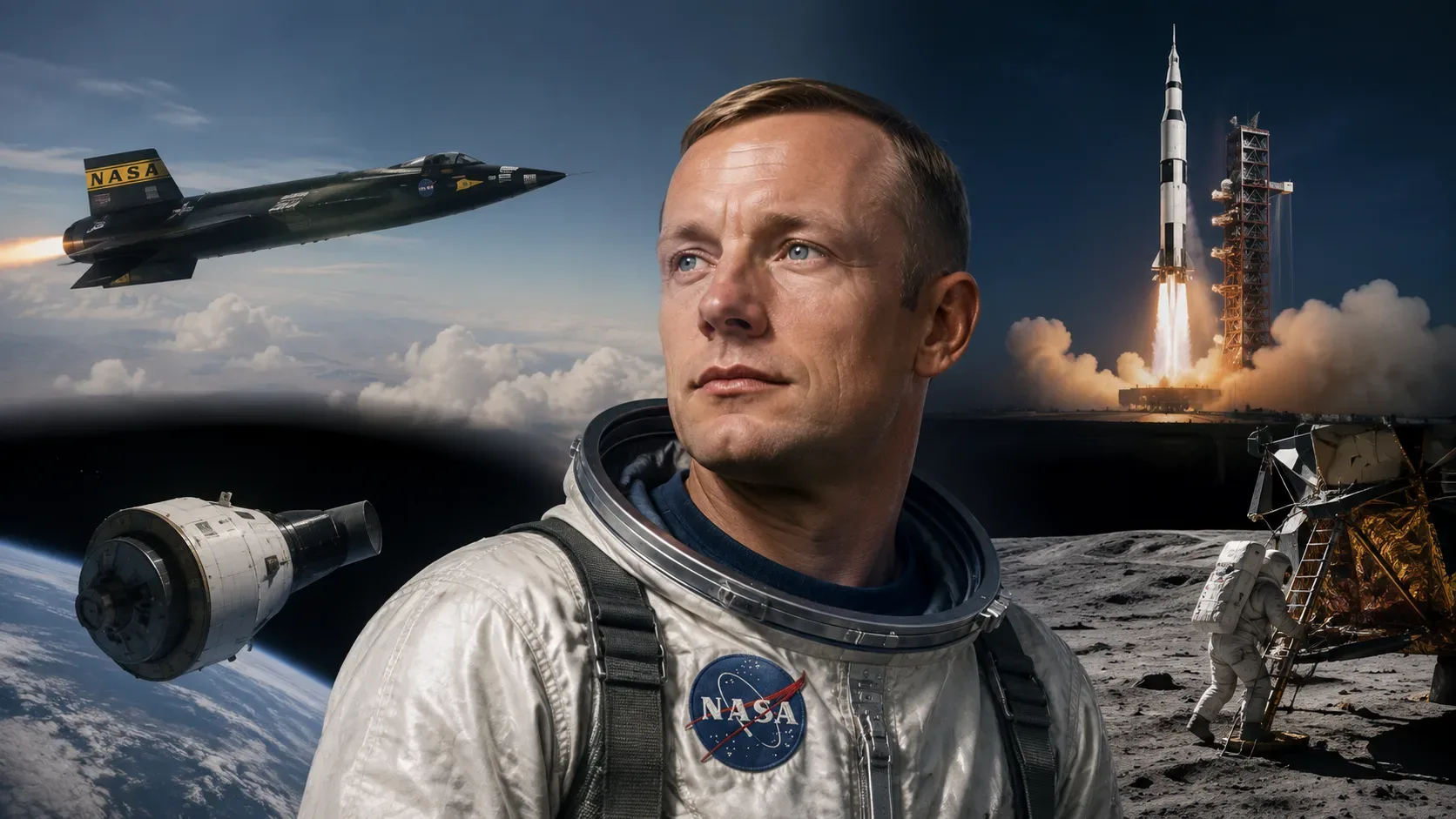
On August 5, 2026, Neil Armstrong will be 96 years old. The date usually revives the best-known image of his life: the astronaut descending the ladder of the lunar module and setting foot on the Moon on July 20, 1969. But that scene, extraordinary as it is, only shows the visible result of a preparation that began decades earlier.
Before commanding Apollo 11, Armstrong was an aeronautical engineering student, naval aviator, Korean War veteran, research engineer, and experimental aircraft pilot. He flew machines that operated at the limits of the atmosphere, participated in the development of control systems, and faced emergencies in which saving the crew required abandoning the original plan.
His trajectory before the Moon helps to understand why NASA entrusted him with missions in which piloting and engineering could not be separated. Armstrong didn't come to the space program just as someone capable of controlling an aircraft. He arrived as a pilot accustomed to observing the behavior of incomplete systems, interpreting instruments and deciding when an experiment needed to end.
Technical training came before myth
Neil Alden Armstrong was born on August 5, 1930, in Wapakoneta, in the US state of Ohio. In 1947, he entered Purdue University to study aeronautical engineering through the so-called Holloway Plan, a program that combined a university education with training and service in naval aviation.
The route was not linear. After the first two years of university, Armstrong was called up for Navy training. He served as a naval aviator from 1949 to 1952 and participated in the Korean War. Between 1951 and 1952, he carried out 78 combat missions, accumulating 121 flight hours in this type of operation. He left active duty in August 1952 and returned to Purdue, where he received a bachelor's degree in aeronautical engineering in January 1955.
These years added operational experience to academic training, but it is important not to turn the war into a simplistic explanation for everything that came after. Military aviation taught discipline, navigation, procedures and reaction to failures. The university provided tools to understand why an aircraft behaved a certain way.
In Armstrong's case, these two dimensions would remain linked. He did not treat engineering knowledge as something restricted to the project on paper, nor piloting as simple manual dexterity. His later work would develop precisely in the region where calculations, instruments, commands and human behavior needed to function as a single system.
From university to aeronautical research
During his senior year at Purdue, Armstrong applied for a research pilot position with the National Advisory Committee for Aeronautics, NACA, the agency that preceded NASA. He was hired in 1955 and started at the Lewis Flight Propulsion Laboratory in Cleveland, now the Glenn Research Center.
There, he participated in flights in aircraft such as the F-82 Twin Mustang and the C-47 Skytrain. In June 1955, a vacancy arose at the High-Speed Flight Station, located at Edwards Air Force Base, in California. Armstrong transferred to the site, which would become one of the main North American centers for research into high-speed flight.
Edwards was not a conventional flying school. It was a laboratory in which experiments took place in real aircraft, often modified or built to explore regions of flight that were still little known.
A research pilot needed to fulfill the mission plan, but also record anomalies, evaluate instruments, communicate feelings of control, and collaborate with engineers after landing. The question was not just whether the aircraft could fly. It was how it responded, what margins it had, and what the data revealed about future projects.
Throughout his career, Armstrong flew more than 200 models of aircraft, including jet planes, rockets, helicopters and gliders. Variety mattered because each machine featured a different combination of stability, controls, propulsion, and emergency procedures.
The X-15 was a laboratory launched from a bomber
Among the aircraft associated with Armstrong, none better symbolizes the transition between aviation and space exploration than the X-15.
The rocket plane was flown to high altitude under the wing of a B-52. Once released, it activated its engine and accelerated towards the upper layers of the atmosphere. Missions typically only lasted eight to 12 minutes. In the end, without power, the pilot needed to drive the X-15 to a marked runway over a dry lake in the desert.
At high altitudes, conventional aerodynamic surfaces lost efficiency because the air became thin. Therefore, the X-15 also used small thrusters to control its orientation in conditions close to vacuum. Its external structure employed Inconel-X, a nickel and chromium alloy capable of withstanding the high temperatures produced by hypersonic flight.
The program investigated issues that would be important for later space vehicles: heating, stability, control outside the dense atmosphere, human performance, navigation, and unpowered return. It wasn't just about breaking records. Each flight expanded a region of the so-called flight envelope — the set of speeds, altitudes and conditions in which an aircraft can operate.
Armstrong made seven flights in the X-15 between December 1960 and July 1962. It reached a maximum speed of 3,989 miles per hour, equivalent to Mach 5.74, and reached an altitude of 207,500 feet, approximately 63 kilometers.
His involvement was not limited to the cockpit. He participated in the engineering aspects of the program and performed flights linked to the introduction of new equipment. Among them were a sensor installed in the nose to measure the direction of airflow and the MH-96 adaptive control computer, designed to assist the aircraft in different flight conditions.
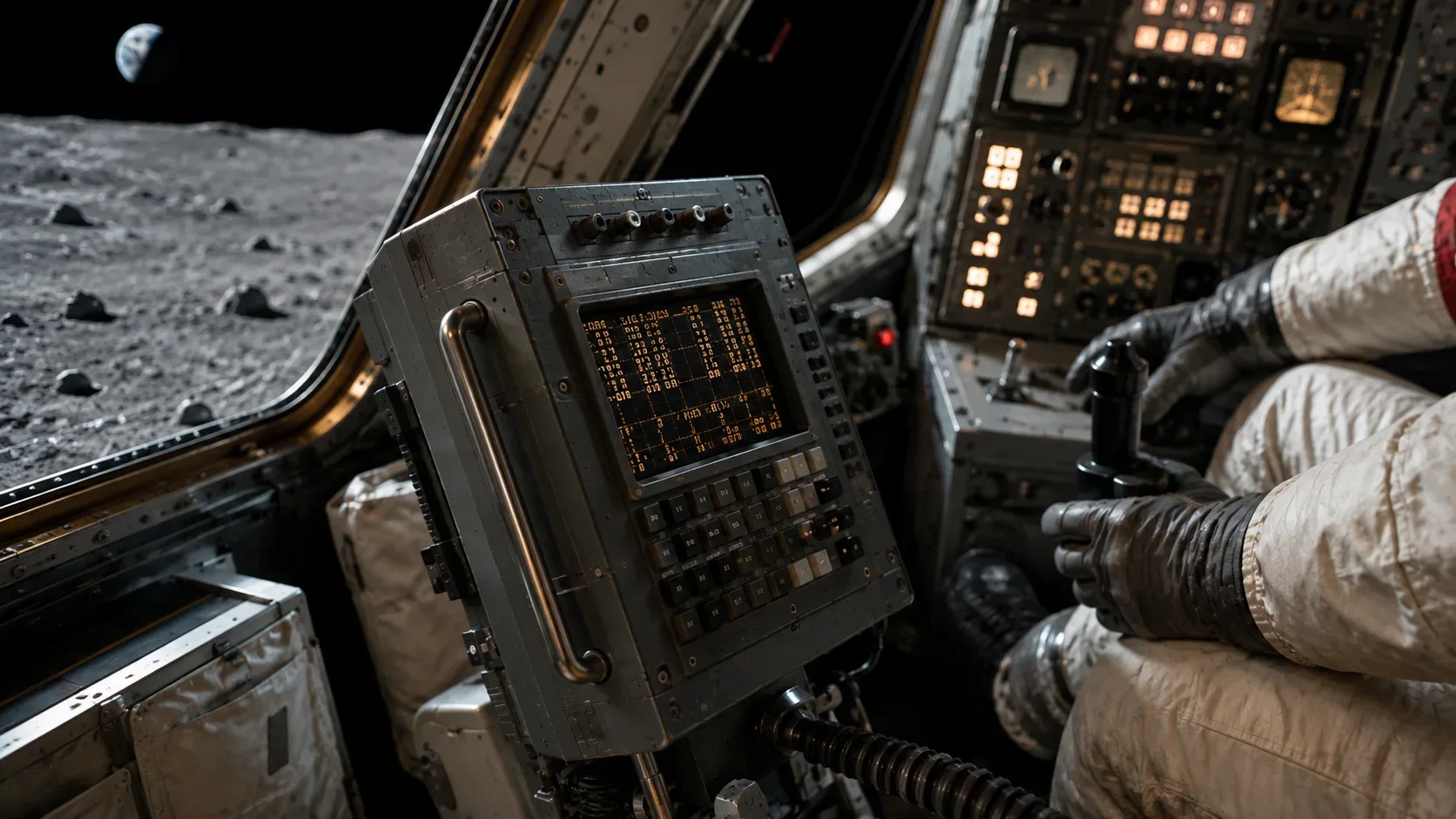
This combination of pilot and engineer would be especially relevant in the space program. A lunar capsule or module could not be operated solely by the pilot's physical sensation. It was necessary to interpret indicators, understand circuits and recognize when unexpected behavior pointed to a specific failure.
The X-15 flight that ended far from planned
On April 20, 1962, during his sixth flight in the X-15, Armstrong attempted to maintain a constant gravitational load upon reentry. The aircraft's attitude caused it to gain altitude again, as if it had bounced off the denser layers of the atmosphere.
The result was that the planned landing area was exceeded. Armstrong had to make a turn at high altitude and return towards the dry lake, reaching the runway with little margin. The flight lasted 12 minutes and 28 seconds, the longest flown by the X-15.
The episode is useful because it prevents an idealized reading of his career. Test pilots did not work in a world without errors, deviations, or imperfect calculations. Its value was also in quickly recognizing the new situation, preserving energy and finding a possible alternative before the options disappeared.
The experience accumulated on these flights did not provide a ready response for every future emergency. She created a method: observe, diagnose, choose an action and reevaluate the result.
NASA sought pilots who understood systems
On September 17, 1962, NASA announced its second class of astronauts. Nine men were chosen from 253 candidates. Armstrong and Elliot See were the two civilian pilots in the group, which became known as the “New Nine” or “Next Nine”.
The selection was directly linked to the Gemini Project. NASA needed crews to test techniques that would be essential for reaching the Moon, such as prolonged stay in orbit, rendezvous between vehicles, docking and extravehicular activity.
Armstrong fit into this program not only because he had many flying hours, but because he had worked with experimental aircraft, simulations and control systems. In Gemini, astronauts would not be passengers in an automatic capsule. They would have to execute precise orbital maneuvers and, in certain situations, take control in the face of failures not yet experienced in flight.
Gemini 8: the success that turned into an emergency
Armstrong's first space mission began on March 16, 1966. He commanded Gemini 8, accompanied by pilot David Scott. The plan called for a three-day mission, the first docking between two orbiting spacecraft, and a spacewalk by Scott.
After a sequence of nine orbital maneuvers, Gemini approached the Agena target vehicle. Armstrong inspected the equipment, reduced the relative speed and performed the coupling. At 5:14 pm East Coast time in the United States, the two vehicles were joined: it was the first spacecraft docking in space.
About 27 minutes later, the assembly began to rotate unexpectedly.
The first hypothesis was a failure in Agena. Scott shut down the target vehicle's thrusters while Armstrong attempted to regain control with the Gemini's thrusters. The rotation slowed for a few moments, but returned in several axes. Armstrong then noticed that the fuel in the capsule's own maneuvering system had dropped to approximately 30%. Consumption indicated that the fault was in the Gemini, not the Agena.
The crew uncoupled the vehicles. Without Agena's mass, however, Gemini began to spin even faster, approaching one rotation per second. Armstrong and Scott turned off the main maneuvering system and activated the 16 thrusters reserved to control reentry. The action stabilized the capsule, but consumed around 75% of the system's fuel.
The investigation identified the cause: rotation thruster number 8 had suffered a short circuit and remained activated continuously. Because the reentry control system had already been used, safety rules required the mission to end immediately. The spacewalk, other dockings and most of the experiments were cancelled.
Gemini 8 landed in the Pacific after 10 hours, 41 minutes and 26 seconds of mission. The flight accomplished a historic objective, but perhaps its most revealing result was demonstrating how a crew would handle a serious orbital emergency.
What the Gemini 8 decisions reveal
It’s tempting to sum up the episode by simply saying that Armstrong “kept his cool.” The expression, although convenient, explains little.
What the documented sequence shows is a technical process. The crew formulated a hypothesis, tested an action, observed that the problem returned, used fuel consumption to locate the fault and resorted to an independent system to stop the rotation.
There was also an essential decision: accepting the loss of the mission. After using the reentry thrusters, continuing to try to stick to the original plan would add risk without sufficient margin of safety.
The pattern that emerges is not that of someone indifferent to danger. It is that of a pilot capable of recognizing when the main objective ceased to be completing the experience and became preserving the crew and the vehicle.
Lunar training and the decision to eject
Armstrong's experience with extreme situations did not end with Gemini 8.
On May 6, 1968, he made his 22nd flight in the Lunar Landing Research Vehicle, the LLRV. The open and unconventional structure had been created to simulate, on Earth, part of the behavior of the lunar module during the final approach to the surface.
A downward-facing engine compensated for five-sixths of the vehicle's weight, roughly replicating lunar gravity. Small thrusters allowed the pilot to control pitch, roll and direction as they would during a moon landing.
After about five minutes of flight, the LLRV lost control. Armstrong tried to stabilize it, but the altitude was decreasing rapidly. At approximately 200 feet above the ground, about 61 meters, he activated the ejection seat. He descended by parachute without injury, while the vehicle fell and was destroyed.
The investigation concluded that a loss of helium pressure led to the depletion of hydrogen peroxide used by the reserve control thrusters. The instruments also did not provide adequate warning of the deteriorating situation. Before flights resumed, engineers modified the system.
The episode reinforces a less celebrated dimension of testing culture: survival did not depend on insisting indefinitely on saving a machine. It depended on recognizing the moment when recovery was no longer likely and using the emergency resource while there was still altitude.
What Apollo 11 received from this trajectory
When Armstrong was appointed commander of Apollo 11, NASA wasn't just choosing the astronaut who would appear first on the ladder.
I was choosing an engineer and pilot who had worked on new aircraft, participated in experimental programs, performed the first space docking and managed an emergency capable of causing a capsule to lose control. I would also choose someone who had already abandoned a training aircraft when the data and altitude showed that insisting was no longer a safe option.
This does not mean that past experience made the lunar landing predictable. The Eagle module, the Moon's environment, and the conditions of Apollo 11 formed a different problem. But there was continuity in the method: monitoring instruments, managing limited resources, piloting manually when necessary and preserving alternatives.
The moonwalk turned Armstrong into a symbol. Its previous trajectory shows how this symbol was built: not by a single moment of courage, but by years of study, tests, analyzed failures and decisions made under real constraints.
Chronology of Neil Armstrong before the Moon
| Data | Step |
|---|---|
| August 5, 1930 | Born in Wapakoneta, Ohio |
| 1947 | Enters aeronautical engineering at Purdue University |
| 1949 to 1952 | Serves as a naval aviator |
| 1951 to 1952 | Perform 78 missions during the Korean War |
| January 1955 | Completes a bachelor's degree in aeronautical engineering |
| 1955 | Joins NACA and transfers to the High Speed Flight Station at Edwards |
| December 1960 to July 1962 | Performs seven flights on the X-15 |
| September 17, 1962 | He is presented as a member of NASA's second class of astronauts |
| March 16, 1966 | Command Gemini 8 and perform the first space docking |
| May 6, 1968 | Ejects from an LLRV after loss of control |
| July 16, 1969 | Part as commander of Apollo 11 |
The story of Armstrong before the Moon reminds us that great technological achievements rarely begin the moment they become visible to the public. They are built in laboratories, classrooms, simulators and flights where every anomaly needs to be understood.
Follow new stories of science and invention to learn about the experiences, decisions and people that existed before the events that entered history.