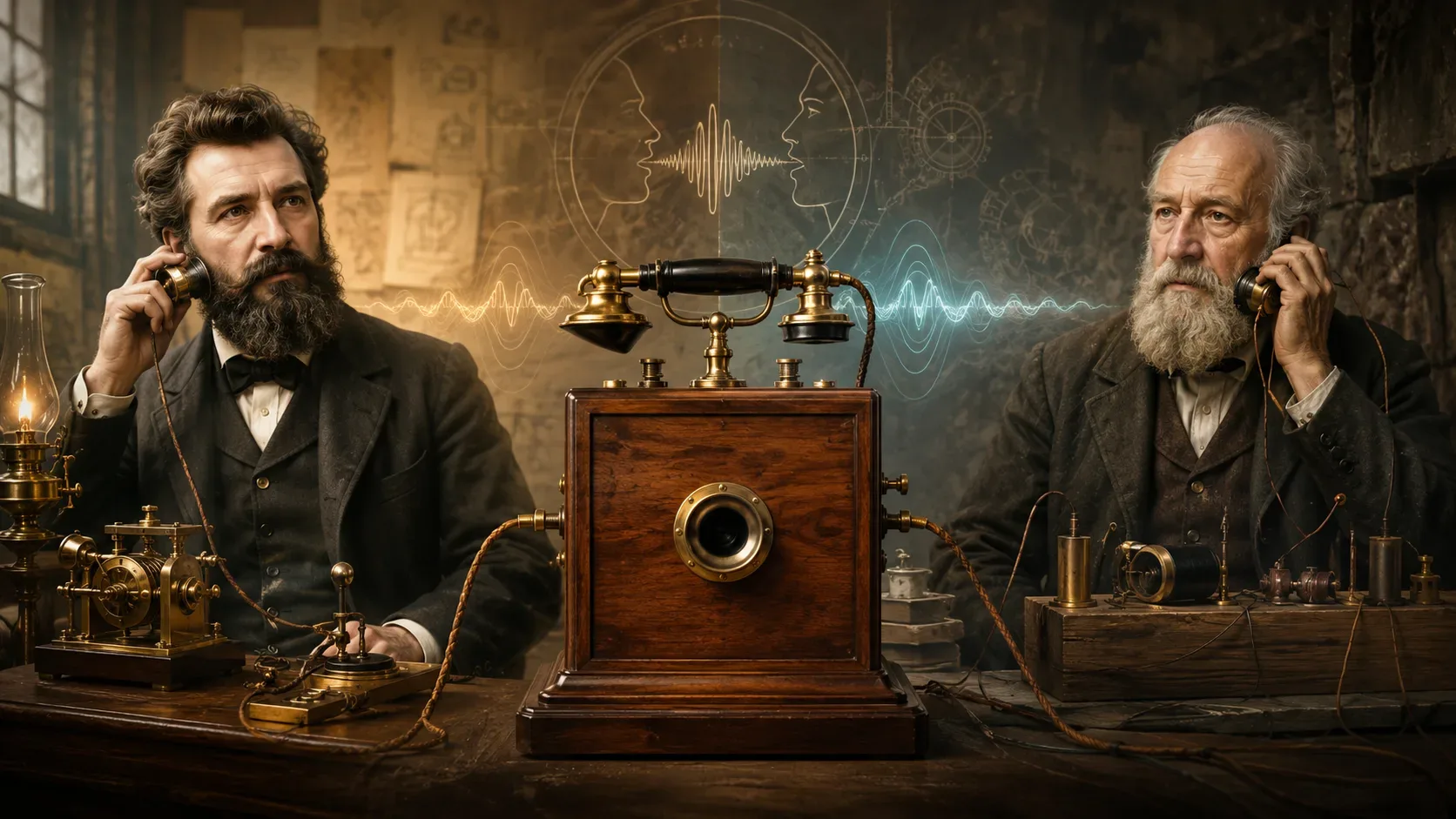
The answer depends on the criterion being used. Alexander Graham Bell is the name most often credited with inventing the telephone because, on March 7, 1876, he received U.S. Patent No. 174,465 for a system that transmitted vocal sounds and, three days later, documented an intelligible speech demonstration with Thomas Watson. Antonio Meucci, however, had conducted voice-communication experiments earlier and in 1871 filed a caveat — a renewable notice of intent to seek a patent — connected to his work. In 2002, the U.S. House of Representatives passed a resolution recognizing Meucci’s life, achievements, and work in the invention of the telephone.
So, who invented the telephone?
There is no single historically neutral answer that fits every definition of “invent.” If the question is “who obtained the first patent that became the legal and commercial reference point for the telephone?”, Bell is central to the answer. If the focus is “who conducted earlier experiments in electrical voice transmission?”, Meucci is one of the important names. If the criterion is “who left clear documentation of intelligible speech transmission in a device tied to a patent?”, Bell again has particularly strong evidence from March 1876.
| Criterion | Who stands out | Why |
|---|---|---|
| First U.S. telephone patent | Alexander Graham Bell | Patent No. 174,465 was issued on March 7, 1876. |
| Earlier experiments with electrical voice communication | Antonio Meucci, among other pioneers | Meucci worked on communication devices before Bell’s patent and filed a caveat in 1871. |
| Documented intelligible speech transmission in 1876 | Alexander Graham Bell | On March 10, 1876, Bell recorded that Watson heard his speech through the apparatus. |
| Later recognition of an overlooked contribution | Antonio Meucci | In 2002 the U.S. House passed a resolution recognizing his achievements and his work in the invention of the telephone. |
What Bell actually demonstrated in 1876
The Smithsonian records that on March 7, 1876, Bell received a patent for an “apparatus for transmitting vocal or other sounds telegraphically.” The Smithsonian collection also highlights the March 10 demonstration, when Bell and Watson succeeded in transmitting a spoken message intelligibly.
The Library of Congress places the two milestones side by side: the issuance of Patent No. 174,465 and, three days later, the first intelligible human speech heard over the telephone. A letter Bell wrote to his father on March 10 says that “articulate speech” had been transmitted intelligibly and describes the test with Watson in separate rooms.
These records help explain why Bell remains the standard attribution in many histories of technology: the case rests not only on an abstract idea, but on the combination of a patent, experimental documentation, and continued development.
Where Antonio Meucci fits into the story
Meucci is not merely a figure added to the dispute long afterward. House Resolution 269, passed by the U.S. House of Representatives on June 11, 2002, states that he worked on a communication project he called the teletrofono, set up rudimentary communication links in his Staten Island home, demonstrated his invention in 1860, and filed a caveat on December 28, 1871.
The same resolution says that Meucci was unable to maintain the caveat after 1874 and concludes that his life and achievements should be recognized and that his work in the invention of the telephone should be acknowledged. That wording matters: the text does not formally replace Bell’s patent or simply declare, as a legal judgment, that Meucci was the sole inventor of the telephone.
A caveat, a patent, and a prototype are not the same thing
Much of the confusion comes from combining different kinds of documents and evidence. The Meucci resolution itself describes the caveat as a renewable, one-year notice of an intended future patent application. That is not the same as a granted patent. An issued patent records a formal claim accepted by the competent office; the historical caveat system signaled that an inventor intended to file and could act as a notice of priority under certain circumstances.
Likewise, having a prototype or conducting an earlier experiment does not by itself settle every question. Historians may ask whether the device transmitted intelligible speech, what physical principle it used, how fully the system was documented, whether results were repeatable, and how closely the prototype related to a later patented or commercial system.
Why “first to transmit voice” also needs care
“Transmitting voice” can mean different things: producing recognizable vibrations, carrying partly understandable vocal sounds, or enabling clearly intelligible articulated speech over a distance. The strength of Bell’s March 1876 documentation is the contemporary record of words understood by Watson and Bell’s correspondence describing the test.
That does not erase earlier experiments. The Smithsonian’s own collection places Bell among other telephone inventors, including Elisha Gray and Thomas Edison, who approached the problem through different technical paths. The history of the telephone is therefore better understood as a research race with competing solutions than as a single isolated flash of inspiration.
What the 2002 resolution changed — and what it did not
The 2002 resolution gave explicit institutional recognition to Meucci’s role and helped correct a narrative that often left him out. It matters as a historical and political document about recognition of contribution. But its final language says that “his work in the invention of the telephone” should be acknowledged; it did not revoke Bell’s patent, retroactively rewrite the patent office’s action, or settle every historiographical debate about technical priority.
For that reason, saying only “Congress decided that Meucci invented the telephone” overstates the document. Saying “Bell invented it alone, with no predecessors or competitors” likewise overstates the technological context of the period.
How to read sources that give different answers
- If a source emphasizes patents: it will probably highlight Bell and Patent No. 174,465 of March 7, 1876.
- If it emphasizes earlier experiments: it may give more space to Meucci and other pioneers.
- If it requires documented intelligible speech: the Bell-Watson records from March 10, 1876 carry particular weight.
- If it discusses historical recognition: the 2002 Meucci resolution is relevant evidence, but its actual adopted wording matters.
- If it says “the inventor” without stating a criterion: check which definition of priority the source is using.
The most precise way to answer
For a short, balanced answer: Alexander Graham Bell is generally credited with inventing the telephone because he obtained the decisive 1876 patent and demonstrated a documented transmission of intelligible speech; Antonio Meucci conducted earlier experiments and had his work in the invention of the telephone formally recognized by the U.S. House in 2002. The apparent contradiction fades once patent, prototype, voice transmission, and historical recognition are treated as separate criteria.