The deadline is HR, but the data cuts across compensation, diversity, legal and leadership.
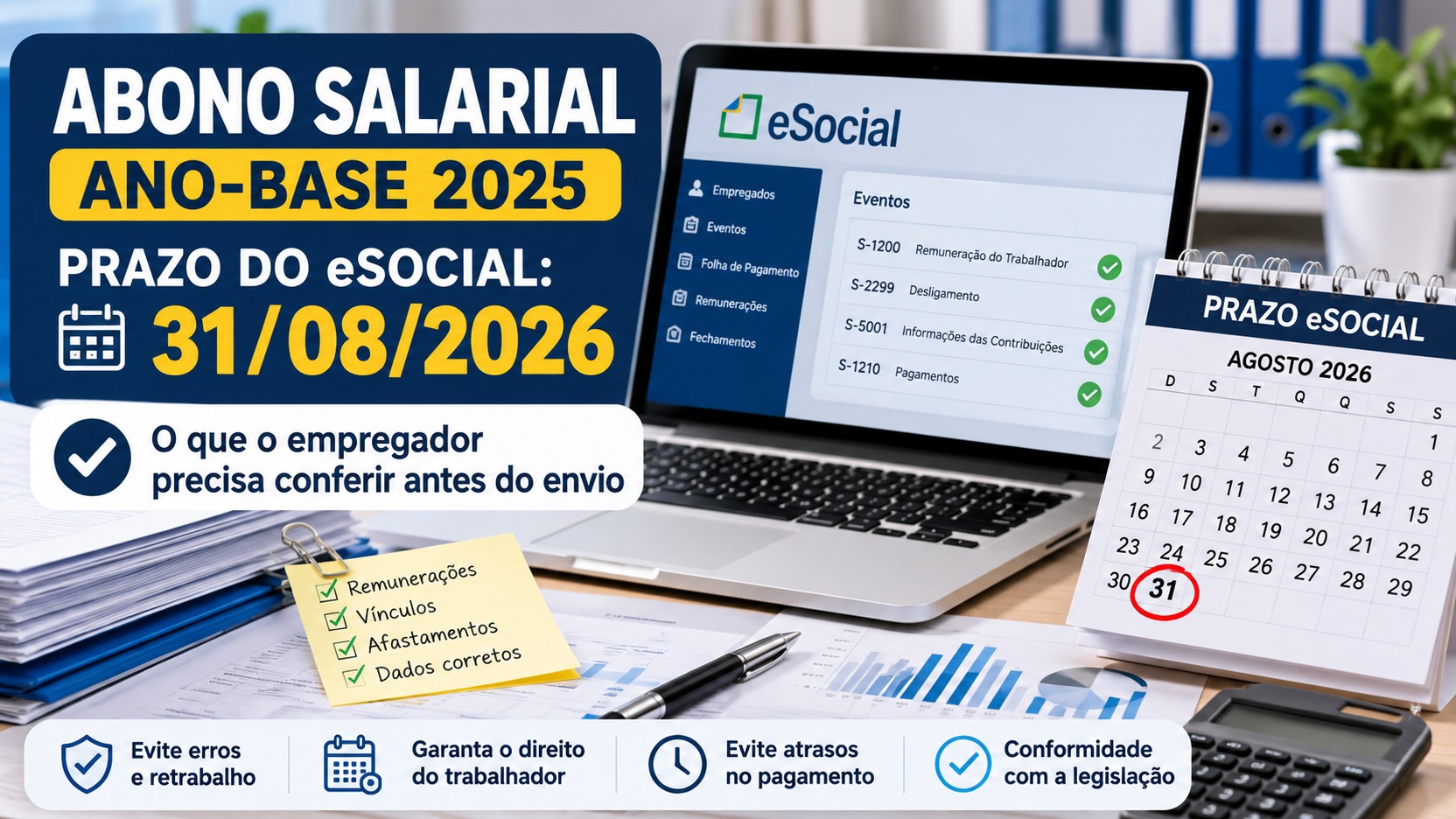
Between August 3 and 31, 2026, employers with 100 or more employees must update, in the employer area of the Emprega Brasil Portal, the information that will be used in the preparation of the 6th Report Salary and Remuneration Criteria Transparency. The Ministry of Labor and Employment announced that the update covers remuneration criteria, actions to promote diversity and initiatives to support family and parenting.
The measure should not be treated as simply filling out a form. The report combines two sources: the labor and remuneration data already transmitted to eSocial and the complementary responses provided by the company on the Emprega Brasil Portal. Therefore, a response that is formally sent, but is incompatible with the organization's policies, records or practices, may create problems with the publication of the report and eventual oversight.
The best approach is to organize the work into five fronts: scope, responsible parties, evidence, validation and audit trail.
Who is subject to the obligation
Law No. 14,611, of July 3, 2023, determines the biannual publication of the Salary Transparency and Remuneration Criteria Report by legal entities governed by private law with 100 or more employees. Decree No. 11,795/2023 applies transparency mechanisms to private legal entities with this number of employees that have headquarters, branches or representation in Brazil.
In operating the system, the MTE works with establishments and CNPJs identified as eligible. The regulations provide that the Emprega Brasil Portal itself informs the number of establishments qualified to fill out the form. The Ministry's frequently asked questions also advise that information be processed by full CNPJ.
This requires special attention from business groups with headquarters, branches or different legal entities. It is not prudent to conclude that the company is exempt just because an isolated CNPJ appears with fewer than 100 employees in an internal spreadsheet. The list presented by the portal, the corporate structure and the criteria applicable to the case must be checked by HR and labor law.
Initial scope check
Before answering the questionnaire:
- Access the employer's area and identify all establishments considered suitable by the system.
- Compare the CNPJs displayed with the current group structure.
- Record the number of employees used internally in the conference.
- Document recent incorporations, spin-offs, write-offs, transfers or registration changes.
- Submit questions about the framework to labor law, without waiting for the last few days of the deadline.
What needs to be updated on the Emprega Brasil Portal
GM/MTE Normative Instruction No. 6, of September 17, 2024, details the five groups of information in the complementary questionnaire:
- existence of a job and salary plan or career plan;
- policy to encourage the hiring of women, including from specific groups;
- policies for promoting women to management and management positions;
- initiatives or programs to support the sharing of family obligations;
- salary and remuneration criteria used for career progression.
Responses must reflect the reality of each establishment covered. A policy that exists only on paper, without approval, validity or demonstrable application, should not automatically be treated as an effectively implemented practice.
The form does not replace the eSocial conference
The company does not enter all salaries and payments for each employee in the questionnaire. The MTE uses information from eSocial to compose the quantitative part of the report.
Among the data considered are CNPJ, number of employees, gender, race or ethnicity, occupations classified by the CBO, contractual salary and remuneration. The regulations also include installments such as the 13th salary, bonuses, commissions, overtime, additional pay, third of vacation, paid weekly rest, tips and other amounts included in the remuneration.
Therefore, the August questionnaire must be accompanied by a review, at least on a sample basis, of:
- CBOs used;
- employee allocation by establishment;
- sex, race or color and other pertinent registration data;
- contractual salary;
- compensation funds transmitted;
- position changes, promotions and transfers;
- coherence between payroll, HR system and events sent to eSocial.
The MTE informs that corrections to eSocial can be made, but adopts cut-off dates to consolidate each report. A rectification made after this extraction may not modify the document in the ongoing cycle.
Who should be responsible for each set of information
Centralizing everything in a single HR person increases the risk of incomplete answers. The work can be distributed as follows:
| Theme to validate | Suggested responsible area | Main internal sources | Evidence to preserve |
|---|---|---|---|
| Career plan, positions and salaries | Compensation and HR | Current plan, salary tables, job architecture | Approved document, version and effective date |
| Progression and remuneration criteria | Compensation, HR and legal | Promotion policies, merit, seniority, bonuses and collective norms | Formalized criteria and application records |
| Hiring women | Recruitment, diversity and HR | Selection policy, affirmative programs and hiring indicators | Policy, campaigns, goals and available results |
| Promotion for management and direction | HR, leadership and diversity | Movements, succession, promotions and leadership composition | Reports and minutes of decisions, with data protection |
| Family and parenting support | Benefits, HR and legal | Licenses, flexibilities, daycare assistance and internal programs | Regulations, announcements and membership records |
| eSocial data | Payroll, personnel department and technology | Schedule, personnel registration, eSocial and CBO events | Reconciliation reports and list of inconsistencies |
| Final approval | Employment legal and qualified representative | Consolidated matrix of responses and evidence | Approval registered and version sent |
This division is a governance recommendation, not a replacement for the responsibilities provided for in legislation. The legal representative or duly qualified employee remains responsible for answering the questionnaire on the portal.
How to access the portal without discovering problems on the last day
The regulations provide that access to the equal pay tab is via the employer area of the Emprega Brasil Portal.
To qualify a collaborator, Normative Instruction No. 6 establishes, in summary, the following flow:
- enabling the employee profile on the Gov.br platform;
- use of digital certificate linked to the root CNPJ;
- linking, by the legal representative, of the CPF of the authorized person;
- access by legal representative or authorized collaborator;
- selection of establishments indicated by the system and filling out the questionnaire.
The company must test access in advance. Expired certificate, outdated representative, insufficient power of attorney or unrelated employee can take several days of correction.
Management checklist until August 31
1. Define who is responsible for the cycle
Appoint a coordinator, preferably in HR or compensation, and a legal approver. Record who collects, who validates, who approves and who transmits.
2. List the CNPJs and establishments covered
Make a capture or report of the relationship displayed by the Emprega Brasil Portal. Reconcile the list with corporate and personnel records.
3. Create a matrix of the five questions
For each establishment, record:
- portal question;
- proposed response;
- area that confirmed the answer;
- policy or base used;
- document effective date;
- responsible for validation;
- pending issues or reservations.
4. Check that the policies exist and are in force
Do not confuse informal practice with institutional policy. Confirm that the document has been approved, communicated, implemented and applied within the relevant period.
When there are different policies between headquarters and branches, record this difference. A uniform answer for the entire group can hide different realities.
5. Reconcile structured data
Request the personnel department and payroll to verify the main records that feed the report: establishment, CBO, contractual salary, remuneration, sex and race or color.
The conference should not alter records just to improve an indicator. The objective is to correct material errors and ensure that eSocial represents the contracts and payments actually made.
6. Critically review the answers
Ask for each “yes”:
- which document proves the answer?
- since when is the policy in effect?
- does the rule apply to the entire establishment?
- are there application records?
- Is the practice accessible to women and men under objective conditions?
- is there a contradiction with promotion, hiring or remuneration data?
The MTE admits that career plans, seniority and other objective criteria can help explain differences, as long as the criteria are valid and can be met by women and men. The characterization of a discriminatory practice, however, depends on all the evidence and any inspection procedure, and not just on an isolated percentage in the report.
7. Register legal-labor approval
Forward the final matrix, supporting documents and identified discrepancies. The legal team must especially evaluate:
- CNPJs framework;
- answers that depend on interpretation;
- non-formalized remuneration criteria;
- differences between policy and practice;
- possible CBO inconsistencies;
- impacts of collective agreements or conventions;
- need for corrections or preventative measures.
8. Transmit before the deadline
Avoid leaving shipping until August 31st. Early completion creates room for unavailability, access failure, or need for new validation.
9. Preserve the audit trail
Archive, with access control:
- list of establishments covered;
- response matrix;
- versions of policies used;
- approvals from responsible areas;
- relevant screenshots;
- protocol, receipt or final screen made available by the system;
- date, time and CPF of the person responsible for sending;
- inconsistencies found and measures taken;
- documents that prove possible rectification of data.
The trail must not concentrate personal data beyond what is necessary. The official report itself works with aggregated and anonymized data, without publishing names or information that allows individual identification.
Errors that increase company risk
Automatically reuse answers from the previous semester
Policies may have been created, closed, or modified. Changes in structure, benefits, career and leadership need to be incorporated.
Answer “yes” based on future intent
A project not yet approved or implemented does not necessarily equate to an existing policy. Record future initiatives in internal planning, but respond according to the actual situation.
Treat the report as the sole responsibility of the sheet
The payroll dominates remuneration data, but it does not alone control diversity, selection, promotion, succession or parenting programs.
Ignore the quality of CBOs
The comparison published by the MTE uses large occupational groups from the Brazilian Classification of Occupations. Classifications that are out of date or incompatible with the functions performed may reduce the quality of the analysis and require further clarification.
Confuse update with publication
The August submission is the stage for providing additional information. The MTE consolidates the report and makes it available in the September cycle. After that, it is up to the employer to publish the document on their website, social networks or similar instrument, in a visible and easily accessible location.
The official source consulted on August 4, 2026 has not yet informed, for the sixth cycle, a specific release date for the document or a deadline for publication within September. The company must follow MTE communications and the portal itself.
What happens after submission
The report prepared by the MTE will present aggregated data on the number of workers, remuneration, contractual salary, occupations and responses to policies informed by the company. The regulation prevents the disclosure of individual information and restricts results that could allow the identification of very small groups.
Once the document is made available, the organization must:
- download the report corresponding to each establishment;
- review document with HR, compensation and legal;
- prepare internal and external disclosure;
- publish the report in a visible location;
- preserve proof of publication;
- evaluate whether results require explanations, internal investigation, or corrective measures.
Normative Instruction No. 6 provides that the official report is not edited by the company. Additional information or explanatory notes may be published in a separate document.
Does the salary difference in the report mean discrimination?
Not necessarily.
The report works as an indicator and as a subsidy for the work of the Labor Tax Audit. The conclusion about an unjustified salary difference must consider functions actually performed, CBO, job plans, progression criteria, hiring and promotion policies, family initiatives and other elements presented during the inspection.
This does not authorize the company to ignore an unfavorable result. A material difference should trigger documented analysis, review of criteria and, where necessary, corrective measures.
When the Tax Audit finds unjustified salary inequality, the employer may be notified to present, within 90 days, an Action Plan to Mitigate Salary Inequality, with measures, goals and deadlines and participation of union representatives and employees.
Law No. 14,611/2023 also provides, for non-compliance with the publication obligation, an administrative fine of up to 3% of the payroll, limited to 100 minimum wages, without prejudice to other sanctions applicable to situations of discrimination. The concrete application depends on the administrative procedure and circumstances of the case.
Final checklist to forward to the responsible areas
Before considering the cycle complete, confirm:
- all CNPJs and establishments indicated by the portal were analyzed;
- the representative or collaborator's access is working;
- the five questions were distributed to the competent areas;
- each response has a source, person responsible and validation date;
- policies reported as existing are approved and in force;
- folio, personnel record, CBO and eSocial were checked;
- disagreements were submitted to labor law;
- the final version has been formally approved;
- transmission occurred before the deadline;
- evidence of submission has been archived;
- there is someone responsible for monitoring the release of the report in September;
- internal and external publishing plan is prepared.
The next step is to forward this checklist to compensation, personnel department, diversity, benefits, legal and leadership. Then, the qualified representative must open the employer's area on the Emprega Brasil Portal, confirm the establishments covered and begin validation — without leaving data governance until the last week of August.