
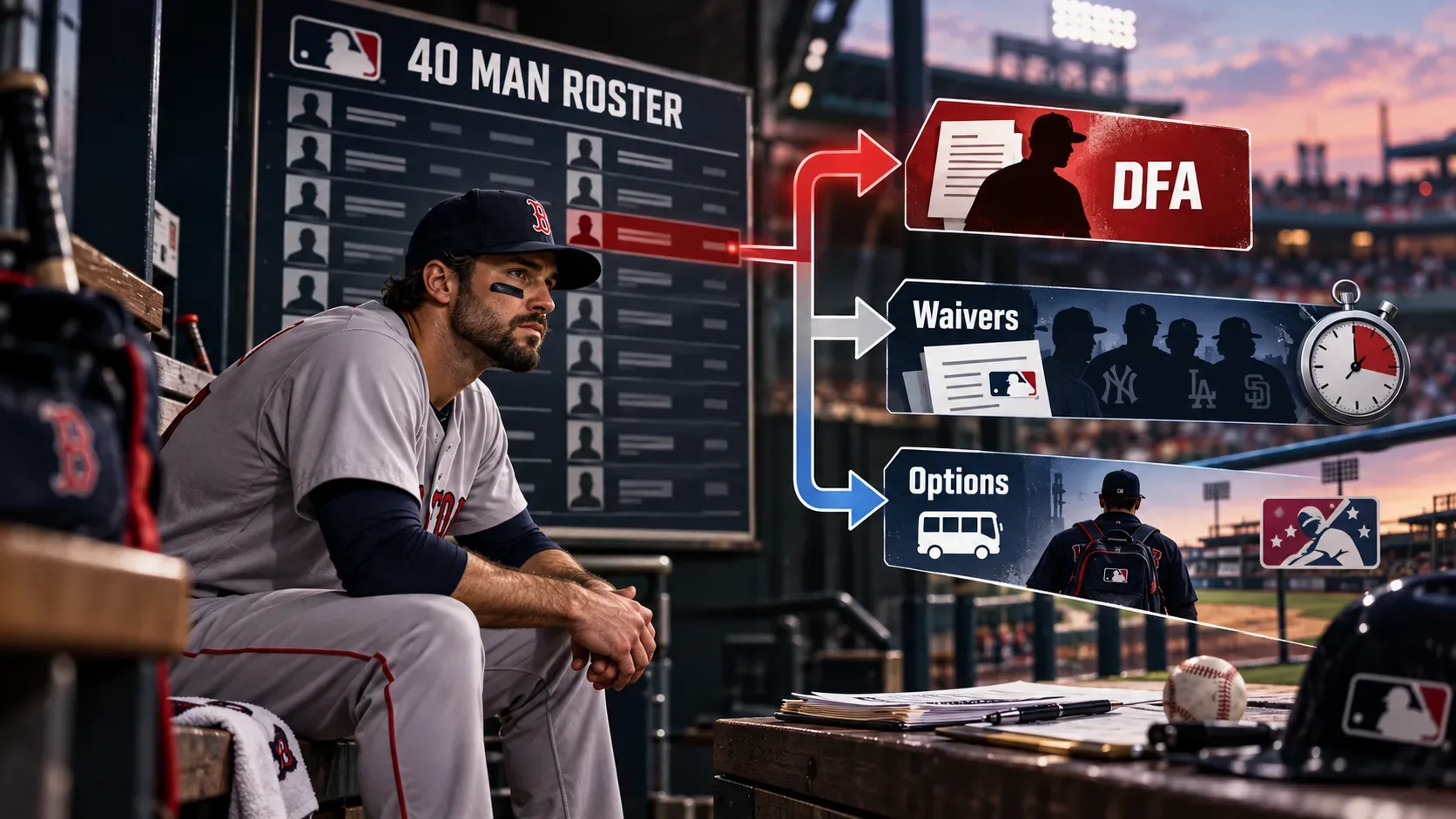
When an MLB transaction says a player was designated for assignment, placed on waivers, or sent to the Minor Leagues on an option, the terms may sound like different versions of the same event: the player lost a spot on the Major League team. In practice, they affect different roster layers. The key question is whether the player remains on the 40-man roster.
The most important distinction is this: an option does not remove a player from the 40-man roster. It allows a club to move an eligible player off the active 26-man roster and send him to the Minor Leagues. A DFA immediately removes the player from the 40-man roster and starts a process that must be resolved within seven days. The official definitions are available in MLB's 40-man roster glossary, DFA glossary, outright waivers glossary, and Minor League options glossary.
The 26-man roster and the 40-man roster are not the same thing
The active roster is the group available to play for the Major League club, normally 26 players for most of the regular season. The 40-man roster is broader. It includes the active roster, players on certain injured lists, and some protected Minor Leaguers.
A player must be on the 40-man roster before he can be added to the active roster. That is why a club with all 40 spots occupied may need to create space before promoting a prospect who is not yet on the 40-man roster. One way to do that is to designate another player's contract for assignment. A club may also trade or release a player, or transfer an eligible player to the 60-day injured list, depending on the applicable rules.
DFA: the player leaves the 40-man roster immediately
DFA means designated for assignment. Once a player's contract is designated, he is removed from the 40-man roster immediately. That creates the roster spot, but it does not by itself terminate the contract or determine the player's final destination.
After the DFA, the club has seven days to resolve the situation. During that period, it can trade the player or place him on the type of waivers that matches the intended transaction. A DFA is therefore best understood as an administrative step that creates 40-man roster space while the organization determines the next move.
What can happen after a DFA
- Trade: the club trades the player to another organization within the applicable window.
- Outright waivers: the other 29 clubs get a chance to claim him. If no club claims him, the original club can attempt to assign him outright to the Minor Leagues, subject to the player's rights.
- Release waivers: if the club intends to end the relationship, the player passes through release waivers before being formally released.
A DFA therefore does not automatically mean the player became a free agent or was sent to the Minor Leagues. It removes him from the 40-man roster and starts the resolution process.
Waivers: other clubs get a chance to claim the player
On outright waivers, the other 29 MLB clubs can claim the player. If a valid claim is awarded, the claiming club assumes the player and places him on its 40-man roster. Claiming priority follows MLB rules based on winning percentage and the league's tiebreak procedures.
After a claim, the player can join the new club's active roster or, if he still has Minor League options and the other rules permit it, be optioned to the Minor Leagues.
If no club claims the player, he clears waivers. The original club can then assign him outright to the Minor Leagues. Service time and transaction history matter, however. Players with more than five years of Major League service can reject an assignment to the Minor Leagues. Players with more than three years of service, or players who have previously been outrighted, may have the right to reject the outright assignment and elect free agency, under the rules described by MLB.
Options: the player goes to the Minors but stays on the 40-man roster
A Minor League option works differently. It allows a player on the 40-man roster to be sent to the Minor Leagues without first being exposed to waivers. The player leaves the active 26-man roster but remains on the 40-man roster.
Players generally receive three option years, although a fourth can be available in specific circumstances. An option year is used when a player spends at least 20 days in the Minor Leagues on optional assignment during a season. Only one option year is charged per season, even if the player moves between the Majors and Minors more than once.
Current rules also limit a player to five optional assignments in a single season. After that, another assignment to the Minor Leagues requires outright assignment waivers. That seasonal assignment limit is different from the number of option years a player has over his career.
What if the player is out of options?
A player who is out of options cannot simply be removed from the active roster and sent to the Minor Leagues through the normal option process. To send him to the Minors, the club must remove him from the 40-man roster, usually by designating him for assignment, and then pass him through outright waivers.
That is why out-of-options players often appear in DFA news when they lose an active roster spot. The club no longer has the direct option route, and exposing the player to waivers also creates the risk that another organization will claim him.
Quick comparison: DFA, waivers, and options
| Move | Leaves active roster? | Leaves 40-man roster? | Can other clubs claim him? | Typical result |
|---|---|---|---|---|
| DFA | Yes, if active | Yes, immediately | Not through the DFA itself; that happens at the waiver stage | Creates up to seven days for a trade or waivers |
| Outright waivers | Depends on the previous transaction | The player may already be off the 40-man roster after a DFA | Yes | Claim by another club or, if he clears, a possible outright assignment to the Minors |
| Minor League option | Yes | No | No before a normal option assignment | Goes to the Minors and remains protected on the 40-man roster |
A simple flow for reading a transaction
- Is the player still on the 40-man roster? If he was optioned, yes. If he was DFA'd, no.
- Were waivers involved? If so, other clubs had an opportunity to claim him under the relevant waiver rules.
- Does the player have options remaining? That determines whether he can be sent to the Minors without first going through waivers.
- Did he clear waivers? If he clears outright waivers, the club can attempt an outright assignment to the Minors, but refusal or free agency rights may apply.
- Does the announcement mention a release? Then the path involves release waivers and can end with the player free to sign with another club.
The most common mistake: treating DFA and option as synonyms
A DFA and an option can both occur when a club wants a player off the Major League team, but they do not have the same roster effect. An option keeps the player's 40-man roster spot and moves him between the Majors and Minors. A DFA opens the 40-man roster spot and exposes the player to a sequence of decisions that can end in a trade, a waiver claim, an outright assignment to the Minors, or a release.
When reading a transaction report, the most useful question is: does the player still occupy one of the 40 spots? That answer quickly separates an internal roster move from a process that can send the player to another organization or into free agency.