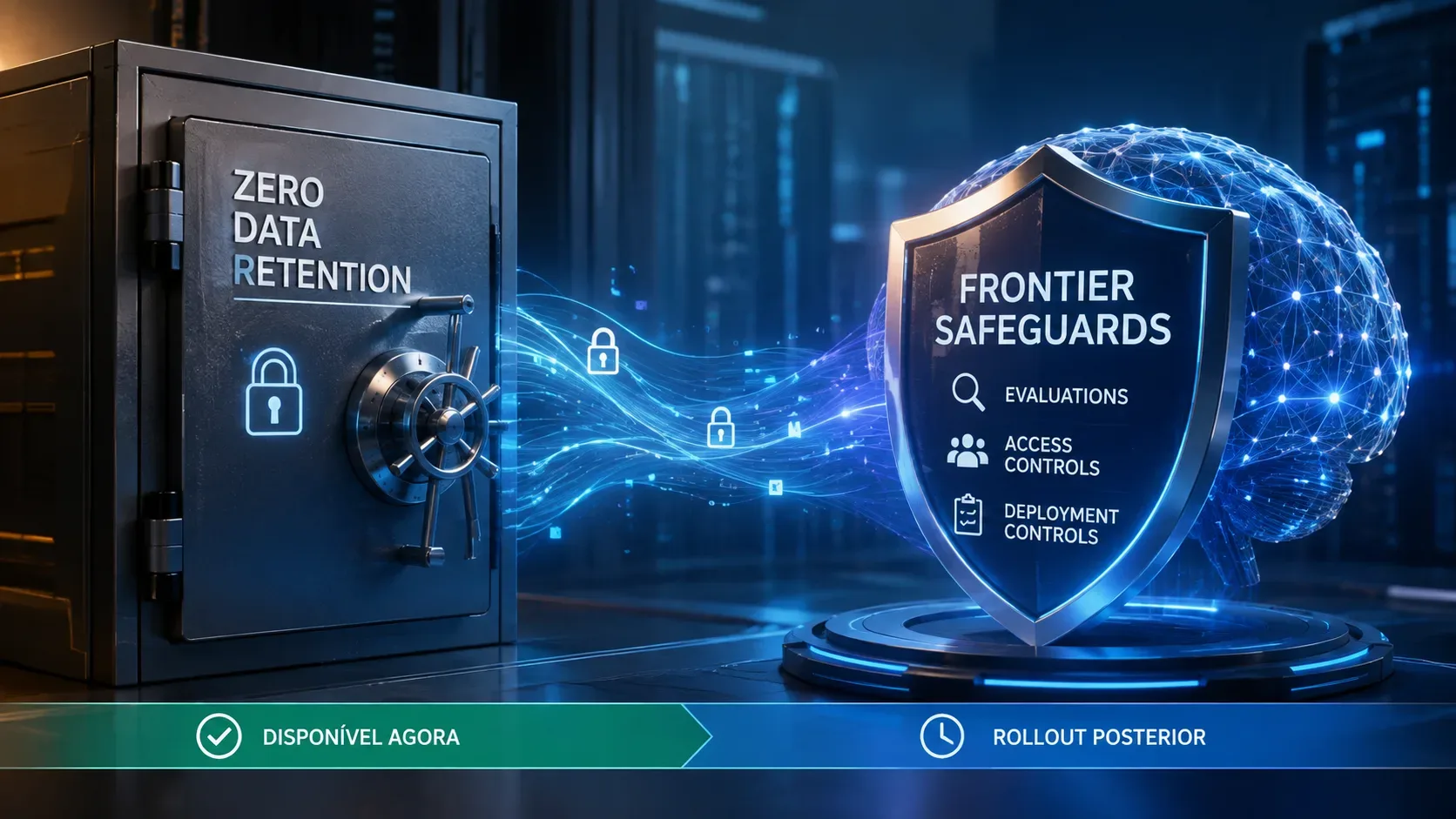
Enterprise Frontier Safeguards (EFS), announced by Anthropic on September 1, 2026, is designed to address a common enterprise tension: using frontier models with abuse monitoring without requiring the company to hand the provider custody of the logs needed for that monitoring. The proposal combines zero data retention (ZDR) on Anthropic's side with retention of activity data in infrastructure controlled by the customer.
That distinction matters. In Anthropic's design, ZDR does not mean every record must disappear instantly. The company argues that sophisticated misuse can require correlation across sessions and accounts over a period of time. What changes with EFS is who stores and governs that data: monitoring activity can remain in the customer's cloud environment, under its keys, access policies, and audit trails, while Anthropic operates automated detection.
What Anthropic announced
According to the official Enterprise Frontier Safeguards announcement, EFS was developed with input from more than 100 customers across financial services, healthcare, manufacturing, telecommunications, law, retail, and the public sector, as well as cloud partners Amazon Web Services, Google Cloud, and Microsoft Azure.
The architecture was presented as a way to reconcile two requirements that can conflict: security controls able to recognize misuse patterns over time and enterprise requirements for confidentiality, data residency, access, and governance.
ZDR in EFS is not the same as “no retention at all”
The key point for security and compliance teams is to separate zero data retention by the provider from the complete absence of operational retention. Anthropic says more sophisticated abuse may be distributed across multiple tasks, sessions, and accounts, limiting approaches that analyze each interaction independently and immediately discard the data.
With EFS, data used for monitoring can be stored in the customer's cloud account, such as Amazon S3, Azure Blob Storage, or Google Cloud Storage. This lets the organization retain custody of the material that needs to be correlated while automated systems look for signals of serious misuse.
This framing avoids overstating ZDR. The promised benefit is not “operate with no persistent data whatsoever,” but rather avoid having Anthropic act as the repository for those monitoring records when the customer opts into the corresponding architecture.
How the architecture works at a high level
- Customer-controlled storage: activity data can remain in the organization's own cloud infrastructure.
- Customer-managed keys and policies: the customer can apply its own encryption keys, access policies, and audit mechanisms.
- Automated monitoring: systems analyze a rolling window of traffic for signals of serious misuse, including attempts related to offensive cyber or biological capabilities and indications of stolen or leaked credentials.
- Flags routed to the customer: when a pattern needs attention, the signal is sent to the organization for review.
- No required Anthropic human review: the announcement says Anthropic employee review is not required; the customer's own team can handle human review of alerts.
This creates a division of responsibilities: the enterprise retains control over storage and human review, while Anthropic provides the automated detection layer. The design may be especially relevant to organizations subject to strict rules about who can access privileged material, non-public information, or other sensitive data.
What is available now and what comes later
| Status as of September 3, 2026 | What is confirmed |
|---|---|
| Available now | EFS has been announced and Anthropic has opened access requests. Eligible customers receive ZDR on Fable 5 and Fable 5.1 while they wait for EFS. |
| Later rollout | EFS will roll out in phases starting later in fall 2026, with a goal of broad availability later that fall. |
| Announced support | Anthropic says EFS will be supported on Claude Code, Claude Enterprise, the Claude Platform, Amazon Bedrock, Claude Platform on AWS, Google's Agent Platform, and Microsoft Foundry. |
It is therefore inaccurate to treat every EFS control as universally available from the announcement date. The temporary ZDR policy for eligible Fable 5 and Fable 5.1 customers acts as a bridge until EFS is ready. The Claude Fable page likewise states that eligible enterprise customers can use Fable 5.1 with ZDR until EFS becomes available.
Which controls are optional
Anthropic says three components are opt-in: customer-owned storage, Customer-Managed Encryption Keys, and fully automated review. Organizations enable the components they need. According to the announcement, these options do not change model behavior, API pricing, or rate limits.
Anthropic does not charge an additional fee for EFS itself. If a company chooses to store activity in its own cloud account, its cloud provider charges for storage, reads, writes, and any data egress in the same way it charges for other resources.
What EFS does not guarantee on its own
The announcement describes a privacy and monitoring architecture, not an absolute guarantee against incidents, data exposure, or misuse. “Safeguards” should be understood as controls intended to reduce risk and improve detection, not proof that a system cannot fail.
It is also important not to confuse data custody with the absence of processing. For automated detection to work, systems must analyze the activity defined by the architecture. Enterprise review should consider where that processing occurs, which data enters the monitoring window, what identities and metadata are involved, how long the customer decides to retain records, and how alerts enter the incident-response workflow.
What security and compliance teams should verify
- which products, models, and regions are covered in the organization's access phase;
- which configuration actually provides ZDR and whether any operational exceptions apply;
- where activity data is stored and under which encryption keys;
- who inside the organization can access logs, signals, and alerts;
- what retention window is selected to enable correlation across sessions and accounts;
- how false positives and confirmed incidents will be triaged and escalated;
- what cloud costs will result from storage and data movement;
- how the architecture fits internal, contractual, regulatory, and data-residency requirements.
Why the design matters for regulated enterprises
EFS's contribution is architectural: it attempts to move custody of monitoring data into an environment the enterprise already controls instead of requiring the model provider to retain those records. That may reduce governance barriers for sectors with strict confidentiality controls, although each organization remains responsible for validating whether its concrete implementation meets its obligations.
In short, the proposed combination is: ZDR with respect to Anthropic's retention, activity retention under customer control, and automated monitoring that can observe patterns over time. As of September 3, 2026, the operational distinction is the timeline: the ZDR bridge for eligible customers has been announced, while the full EFS offering still depends on a phased rollout.