There is no public-source benchmark, among the materials consulted through August 28, 2026, that places ChatGPT Images 2.0, Nano Banana 2 and Ideogram 4.0 under the same prompts and conditions in Brazilian Portuguese and supports declaring a winner without caveats. All three models began highlighting text, localization and design assets as product capabilities, but the published evidence is not directly comparable.
That changes the practical answer. Instead of trusting lists of the "best AI," anyone who needs to produce a poster, banner, thumbnail or card with the correct price should measure two things: how many characters match the reference exactly and how many attempts are needed to reach usable artwork. The second metric is often as important as the first, because a model that gets the text right only after four regenerations still creates review costs.
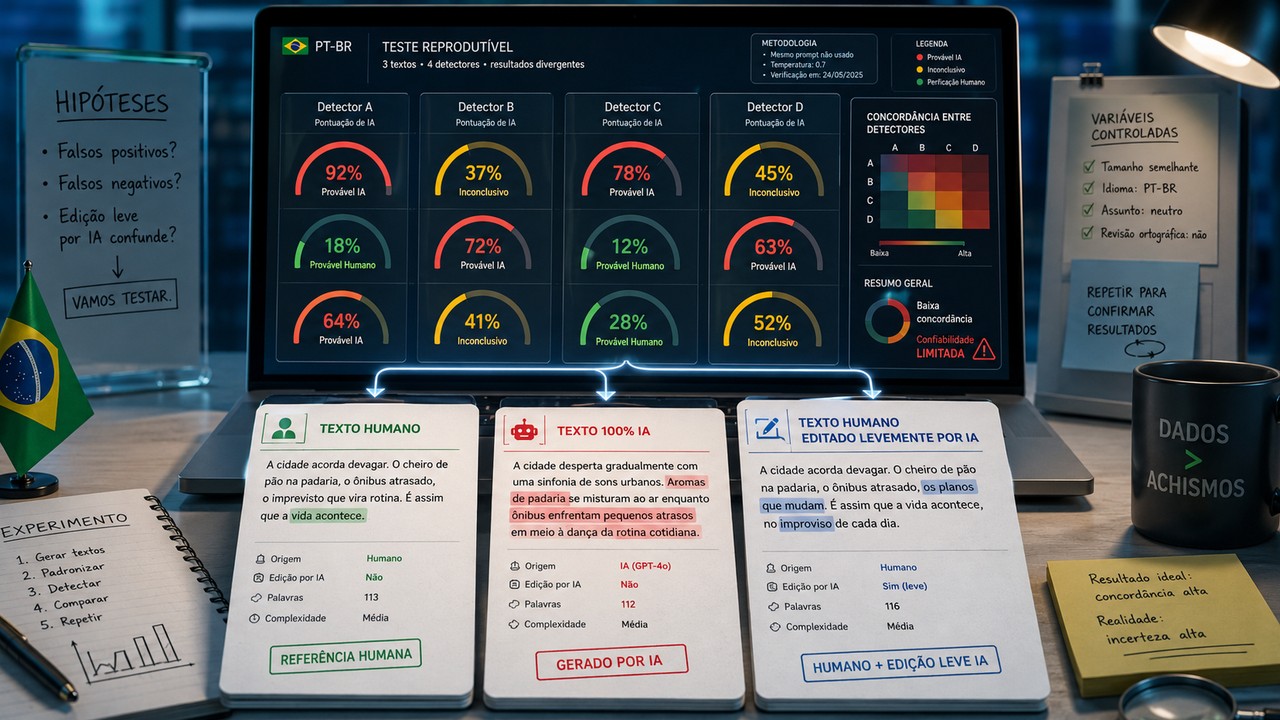
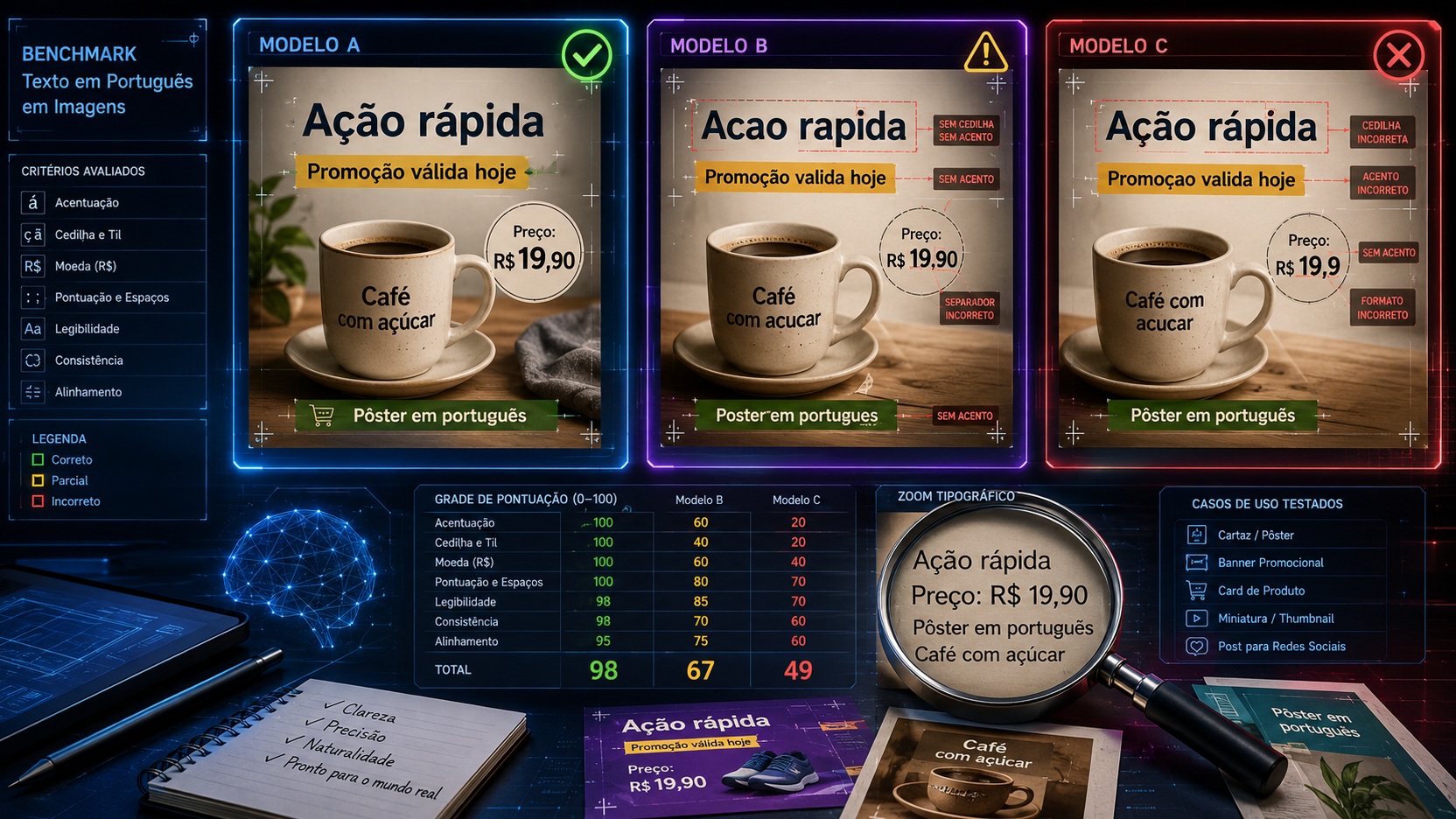
The cover of this article is a conceptual illustration. The labels "Modelo A," "Modelo B" and "Modelo C," and the visual scores shown there, are not measured results for the three products compared.
What changed in the three models in 2026
ChatGPT Images 2.0 and the gpt-image-2 model
OpenAI introduced ChatGPT Images 2.0 on April 21, 2026. In the API, the corresponding model appears as gpt-image-2. The launch documentation highlights improved text rendering, stronger layouts and more reliable multilingual text, while also positioning the model for structured assets such as diagrams, infographics, posters and ads.
OpenAI's prompting guide is especially useful for people who work with copy inside images. It recommends putting literal text in quotation marks or all caps, asking for verbatim rendering, describing font, size, color and position, and using medium or high quality when the image contains small or dense text. The guide itself also suggests iterating when typographic fidelity is not perfect in the first output.
That detail matters: the documentation does not promise zero errors. It describes a production workflow in which text can be much better but still needs verification. For PT-BR, that means checking not only whether a word looks legible, but whether "ação" did not become "acao," whether "preço" kept the cedilla, and whether "R$ 19,90" was not converted to a decimal point or lost a digit.
Nano Banana 2, the Gemini 3.1 Flash Image
Google launched Nano Banana 2 on February 26, 2026. The technical name used in the API is Gemini 3.1 Flash Image, identified as gemini-3.1-flash-image. Current Gemini documentation treats it as the family's general-purpose model for balancing speed, quality, high-resolution generation and reliable text rendering.
In the official announcement, Google describes precise text rendering and translation, with generation of legible text for marketing prototypes and the ability to localize the content of an image into another language. That places the model directly in this comparison: banners, promotional cards, infographics and other assets in which the copy needs to be part of the visual composition itself.
The promised operational advantage is Flash-model speed without giving up the line's more sophisticated generation features. For a team that needs to produce many variations, that combination can reduce iteration time. Even so, "reliable text" in the documentation is not the same as a known accuracy rate for Brazilian Portuguese.
Ideogram 4.0 and explicit typography control
Ideogram 4.0 was launched on June 3, 2026 as a 9.3-billion-parameter open-weight model. The company presents it as design-oriented, with multilingual text, precise layout control and output up to 2K. The most distinctive point for assets with copy is its structured prompt mechanism: the model accepts text elements in which the literal string is separated from the visual description and can position them using bounding boxes.
In practice, that design gives the user a more explicit way to say "this text must appear here" than a purely narrative prompt. Ideogram's technical material also reports 0.97 OCR accuracy in English on the X-Omni benchmark for text rendering. It is a relevant figure, but it has two limitations for this topic: the evaluation was published by the vendor itself and it measures English, not PT-BR.
For that reason, Ideogram 4.0 may be the most interesting candidate when the central requirement is typographic control and positioning, but that attribute alone does not prove that it will make fewer mistakes with accents, cedilla, currency and punctuation in Brazilian Portuguese.
Why an English benchmark does not settle Brazilian Portuguese
Brazilian Portuguese adds traps that a generic OCR score may not capture. "Ação," "promoção," "coração," "não" and "informação" require the model to preserve accents, the cedilla and the tilde. A retail asset may also combine those features with "R$," a decimal comma, a percentage sign, a date and abbreviations such as "2ª unidade."
There is also a difference between legibility and fidelity. A word can look visually attractive and be perfectly recognizable while still containing the wrong character. For advertising, e-commerce or institutional material, that type of mistake is more serious than a less elegant kerning choice. A "R$ 199,90" turned into "R$ 19,90" is legible and, at the same time, wrong.
Another problem is variability. Image-generation models do not always produce the same output. A perfect example on a launch page does not reveal how many attempts failed before it, nor how the same model will behave with a larger block of text, another aspect ratio or a combination of less frequent words.
What a truly verifiable PT-BR benchmark should look like
Accents and cedilla test
A first prompt could request a simple poster with the phrases "Ação rápida," "Café com açúcar" and "Coração e emoção." The goal is not to judge beauty, but to check character by character whether the diacritics survived and whether the model changed letters, duplicated words or introduced extra marks.
Price, percentage and ordinal test
A second prompt should simulate a promotional asset containing "Promoção válida hoje," "Preço: R$ 19,90" and "2ª unidade com 50%." This set forces the model to handle a cedilla, accent, currency symbol, decimal comma, ordinal indicator and percentage sign in the same artwork.
Small text and multiple lines test
A third scenario should use denser copy, such as "Entrega grátis para compras acima de R$ 149,90. Válido até 31/08. Não cumulativo." This is where the difficulty that often undermines strong headline results appears: smaller text, varied punctuation and more opportunities for omission or repetition.
Visual hierarchy test
Another prompt could request a large headline, a medium subtitle and a small note while preserving the supplied content exactly. This separates two skills: writing correctly and obeying the layout hierarchy. A model can get every word right and still make critical information too small or place it in an unsuitable position.
Repeatability test
Each prompt needs to be generated more than once. A simple and already useful design would produce three outputs per prompt and record both first-attempt performance and performance after regenerations. This prevents the benchmark from rewarding only the best hand-picked image; it also measures consistency.
What to score without turning the test into opinion
The main score should come from the textual reference. Each output can be reviewed for character substitutions, omissions and insertions, as well as spacing, punctuation and duplicated-word errors.
First-generation accuracy deserves to be kept separate from accuracy after additional attempts.
OCR can help automate the check, but it should not be the only judge. OCR itself can misread a correct image, especially with decorative typography. The ideal approach is to use OCR for triage and then perform human review of the text shown in the asset.
It is also useful to record legibility and layout fidelity on separate axes. That way, a model does not receive a high score merely because it produced attractive artwork, and another is not penalized excessively for an aesthetic choice when the text is technically perfect.
Which one to choose today for posters, banners and thumbnails
If the priority is explicit control over text blocks and their position, Ideogram 4.0 deserves to be the first candidate to test. Its typed text elements and layout boxes are a concrete interface and architecture difference for structured design work. That is a control advantage, not a PT-BR score already proven.
If the workflow depends on editing an existing asset, translating or localizing text without rebuilding the entire layout, and iterating conversationally, gpt-image-2 has detailed official guidance for that kind of work. OpenAI recommends the model for workflows involving text in images and asks for literal copy, typographic constraints and higher quality in dense cases.
If the operation prioritizes speed, high volume and integration with the Gemini ecosystem, Nano Banana 2 is Google's natural candidate. The documentation positions it precisely as a balance between speed and quality and highlights legible text and localization as central capabilities.
The safest choice, therefore, is not "which brand won a general ranking," but which model has the lowest error rate and the lowest correction cost on your real set of assets. For a store, that may be price and promotion. For a video channel, it may be a short title in a thumbnail. For an event, it may be date, time and address.
The metric that matters most: rework
For commercial use, the best model is not necessarily the one that produces the most attractive image in the first visual comparison. It is the one that reaches correct text, an acceptable layout and usable artwork with fewer regenerations and less manual editing.
This "correction tax" can be measured in time: how many minutes a designer spends reviewing text, fixing a word, regenerating the asset or exporting again. When two models have similar visual quality, this operational difference often determines which one actually scales.
Conclusion: there is still no demonstrated PT-BR winner
ChatGPT Images 2.0, Nano Banana 2 and Ideogram 4.0 reached 2026 with explicit advances in text inside images. OpenAI emphasizes multilingual rendering and production workflows with exact copy. Google highlights precise, legible and localizable text at Flash speed. Ideogram focuses on multilingual typography and structured text and layout controls.
What is missing is precisely the test that matters to Brazilian users: the same prompts, the same reference text, multiple generations and an objective count of errors in PT-BR. Without that, any definitive ranking mixes marketing, selected examples and benchmarks in other languages.
Until a controlled test produces that scorecard, the practical recommendation is to choose two or three candidates, apply your own set of critical phrases and measure first-try accuracy, number of regenerations and correction time. For text inside an image, the "best" AI is the one that reduces rework without changing a single letter of what needed to be published.
Sources and limits of this comparison
The factual basis of this article was formed from official materials published by OpenAI about ChatGPT Images 2.0 and gpt-image-2, OpenAI's image-model prompting guide, Gemini API documentation and Google's Nano Banana 2 announcement, as well as Ideogram 4.0's announcement and technical material. The pages were consulted on August 28, 2026.
These sources are suitable for confirming names, dates, stated features and control mechanisms, but they do not replace an independent benchmark in Brazilian Portuguese. The OCR figure cited by Ideogram measures English and was disclosed by the vendor itself. For that reason, it was not converted into a PT-BR ranking or used to name a winner.