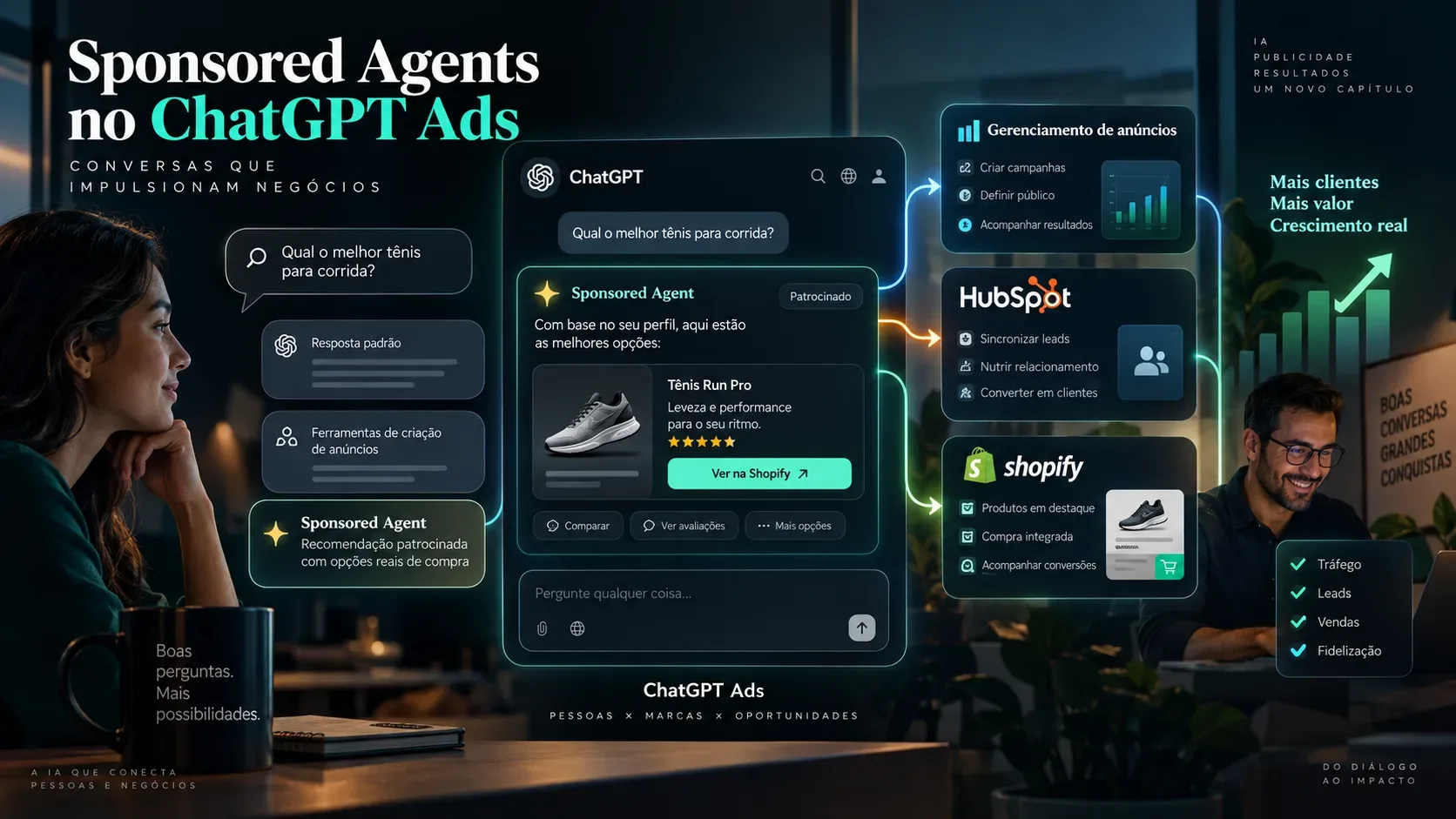
On September 16, 2026, OpenAI introduced a new stage of ChatGPT Ads with four connected initiatives: Sponsored Agents, campaign creation and analysis through natural language in ChatGPT with the Ads Manager plugin, AI assistance inside Ads Manager, and integrations with HubSpot and Shopify. The most important point is that these pieces do not serve the same function. An ad remains a sponsored unit displayed separately from a ChatGPT answer. A Sponsored Agent is an optional conversation with a business-funded agent that starts from an ad. A normal ChatGPT answer remains independent from advertisers.
OpenAI describes this structure in its September 16 announcement and in support pages for Sponsored Agents, HubSpot, and Shopify. The distinction matters because the new format brings advertising closer to conversation without turning every ChatGPT answer into sponsored content.
What changed in ChatGPT Ads
The basic ChatGPT Ads model already resembled other digital advertising channels: an advertiser creates a campaign, sets a budget and objective, provides creative assets, and tracks metrics such as impressions, clicks, and conversions. Ads appear below ChatGPT answers and are identified as sponsored content. Selection considers signals such as relevance, the current conversation context, ad information, and bidding, according to the ChatGPT Ads basics documentation.
The September announcement adds a conversational layer and an operational layer. On the user side, Sponsored Agents let people continue with an AI representative of a business. On the advertiser side, new tools reduce manual work involved in building, reviewing, and analyzing campaigns. HubSpot and Shopify connect the advertising channel with systems businesses already use to manage customers, products, and sales.
Flow from an ad to a Sponsored Agent
- The user talks to ChatGPT normally. The model's answer is generated independently from advertising.
- A relevant ad may appear below the answer. It is labeled as sponsored and visually separated from the main response.
- If the ad offers a Sponsored Agent, the user can choose to start that conversation. It is not an automatic continuation of the normal ChatGPT answer.
- The new conversation is clearly identified as sponsored. The user can ask questions about the business, its products, or its services.
- When appropriate, the agent can direct the user to the business website. OpenAI presents the format as a way to help people evaluate an offer before taking a next step.
At this stage, Sponsored Agents are in a limited alpha test with selected advertisers. OpenAI's Help Center page says the format is not available to all advertisers and that there is no general early-access application open at this time.
Ads, Sponsored Agents, and normal answers are different things
| Element | Who produces or controls it | How it appears | Main purpose |
|---|---|---|---|
| Normal ChatGPT answer | ChatGPT, independently from advertisers | In the main conversation flow | Respond to the user's request |
| ChatGPT Ads ad | Advertiser through the advertising platform | Below the answer, separated and labeled as sponsored | Present a relevant offer, product, service, or destination |
| Sponsored Agent | Sponsoring business within an advertising format tested by OpenAI | A separate conversation started by the user from an ad | Answer questions about the business, its products, or services |
This separation also applies to editorial influence. OpenAI states on its Ads in ChatGPT page that advertisers cannot influence, rank, or alter ChatGPT's answers. Seeing an ad also does not mean OpenAI endorses the advertiser.
Where ChatGPT Work and the Ads Manager plugin fit
For businesses, one major change is the ability to use natural language to work with campaigns. According to OpenAI's announcement, advertisers can create, update, and analyze campaigns directly in ChatGPT with the Ads Manager plugin. In practice, this moves part of campaign configuration from traditional interfaces into plain-language instructions.
- Turn a website or brief into a campaign: the advertiser can provide context and request an initial campaign structure.
- Update campaigns: changes can be requested through prompts, reducing operational steps.
- Analyze performance: the system can help interpret results and recommend next actions.
- Create assets in Ads Manager: the platform can suggest copy and imagery based on the landing page and campaign objective.
- Use AI-powered text customization: advertisers can opt in to adapt existing headlines and descriptions to conversational context and automatically translate ad copy to the user's preferred language.
OpenAI says advertisers remain in control of creative suggestions. Suggested copy and images can be reviewed and edited before an advertiser decides whether to add them to a campaign. Automation therefore does not mean unrestricted publishing without review.
Where HubSpot fits
HubSpot is presented as the first CRM partner for ChatGPT Ads. The integration connects a ChatGPT Ads account to HubSpot and lets businesses create campaigns, add new leads directly to the CRM, trigger follow-up workflows, and view performance alongside other advertising channels.
In the ChatGPT Ads in HubSpot setup documentation, OpenAI says the integration is available to HubSpot customers where ChatGPT Ads is available. Campaign creation takes place in HubSpot's Marketing and Ads area, with ad, targeting, budget, and scheduling fields. Reporting can include impressions, clicks, contacts, customers, and cost, bringing media performance closer to the sales funnel.
In practical terms, HubSpot's role is to bring ChatGPT Ads into a CRM workflow. It does not make HubSpot responsible for ChatGPT's answers, and it does not turn every lead into a Sponsored Agent. It is an integration for campaign creation, follow-up, and attribution.
Where Shopify fits
Shopify is the first ecommerce partner announced for the channel. The ChatGPT Ads for Shopify app connects a merchant's product catalog and commerce events to Ads Manager. This reduces manual work required to keep products, inventory, and measurement aligned between the store and the advertising platform.
According to the ChatGPT Ads for Shopify setup page, the app syncs catalog and inventory information, store updates, and commerce events through the OpenAI Pixel for Shopify. A merchant can create campaigns for all products, a single product, or a website, select products, review the ad, and launch the campaign.
At the September 16 launch, the integration became available to Shopify merchants in the United States. OpenAI's announcement said international availability in markets where ChatGPT Ads is available would begin on September 23, 2026. The support documentation also notes that some more granular controls remain available directly in Ads Manager.
Feature, audience, and availability
| Feature | Who it is for | What it does | Announced availability |
|---|---|---|---|
| Sponsored Agents | Users and selected advertisers | Opens a sponsored conversation with a business agent from an ad | Limited alpha with selected advertisers, initially in the United States |
| Ads Manager plugin in ChatGPT | Advertisers | Creates, updates, and analyzes campaigns with natural-language prompts | Rolling out as part of the tools announced on September 16 |
| Creative assistance in Ads Manager | Advertisers | Suggests copy and imagery based on the landing page and campaign objective | Rolling out in Ads Manager |
| HubSpot + ChatGPT Ads | Businesses using HubSpot | Creates campaigns, sends leads to the CRM, triggers follow-up, and measures performance | Available where ChatGPT Ads is available, subject to account requirements |
| Shopify + ChatGPT Ads | Shopify merchants | Syncs catalog and commerce events, creates campaigns, and tracks performance | United States at launch; expansion announced for other eligible markets starting September 23 |
What changes for users
The main change is that an ad can become more than a card with a link. It can be the entry point to a sponsored conversation. That can be useful when a decision depends on specific questions about compatibility, dimensions, features, or service conditions.
Users still need to pay attention to labeling and context. A Sponsored Agent conversation represents the sponsoring business and should not be confused with an independent ChatGPT answer. OpenAI says the sponsored conversation is distinct from ChatGPT's normal answers and separate from the user's original conversation.
On privacy, OpenAI's general advertising documentation says advertisers do not receive users' ChatGPT conversations, chat history, memories, or personal data. If a person chooses to message an advertiser through an ad, the advertiser can see only the messages sent directly to it in that interaction. OpenAI also provides controls for ad personalization, hiding, and reporting, depending on region and eligibility.
What changes for businesses
For advertisers, this is more than a new ad format. The package reduces the distance between three steps that often lived in separate systems: campaign creation, conversation with a prospective customer, and performance follow-up.
- Brands can deepen intent: a click can lead to a sponsored conversation before the user visits a website.
- Marketing teams can operate campaigns through prompts: creation, updates, and analysis gain a conversational interface.
- CRM and media move closer together: HubSpot can bring leads and attribution into an existing commercial workflow.
- Catalog and media move closer together: Shopify can feed product data and commerce events directly into advertising operations.
- Measurement still matters: creative automation does not eliminate budgeting, targeting, attribution, conversion tracking, or performance review.
What is still in testing or may change
Not every announced capability should be treated as universal. Sponsored Agents remain in limited alpha. ChatGPT Ads availability varies by country and account type. The Shopify integration has its own international rollout schedule, and OpenAI's documentation may change as the platform develops.
There is also no basis to say that Sponsored Agents replace normal ChatGPT answers, websites, customer-service teams, or CRMs. What OpenAI announced is an optional advertising layer that connects an ad, a sponsored conversation, and marketing systems. For availability and policy changes, the safest references are OpenAI's official announcement and its Ads in ChatGPT Help Center page.
How to read the new flow without mixing the layers
A simple way to understand the system is to separate three questions. First: is this a ChatGPT answer or paid content? The normal answer remains independent, and the ad appears separately. Second: am I entering a conversation with a business? If it is a Sponsored Agent, the conversation is sponsored and labeled accordingly. Third: where does the business manage the operation? It can use Ads Manager directly or connect it to tools such as HubSpot and Shopify.
This separation captures what actually changed in September 2026. ChatGPT Ads now combines media, AI automation, sponsored conversation, and business integrations, but those layers have different roles and rules. For users, the critical point is recognizing when an interaction is sponsored. For businesses, the potential benefit is shortening the path between campaign creation, intent handling, and measurement.