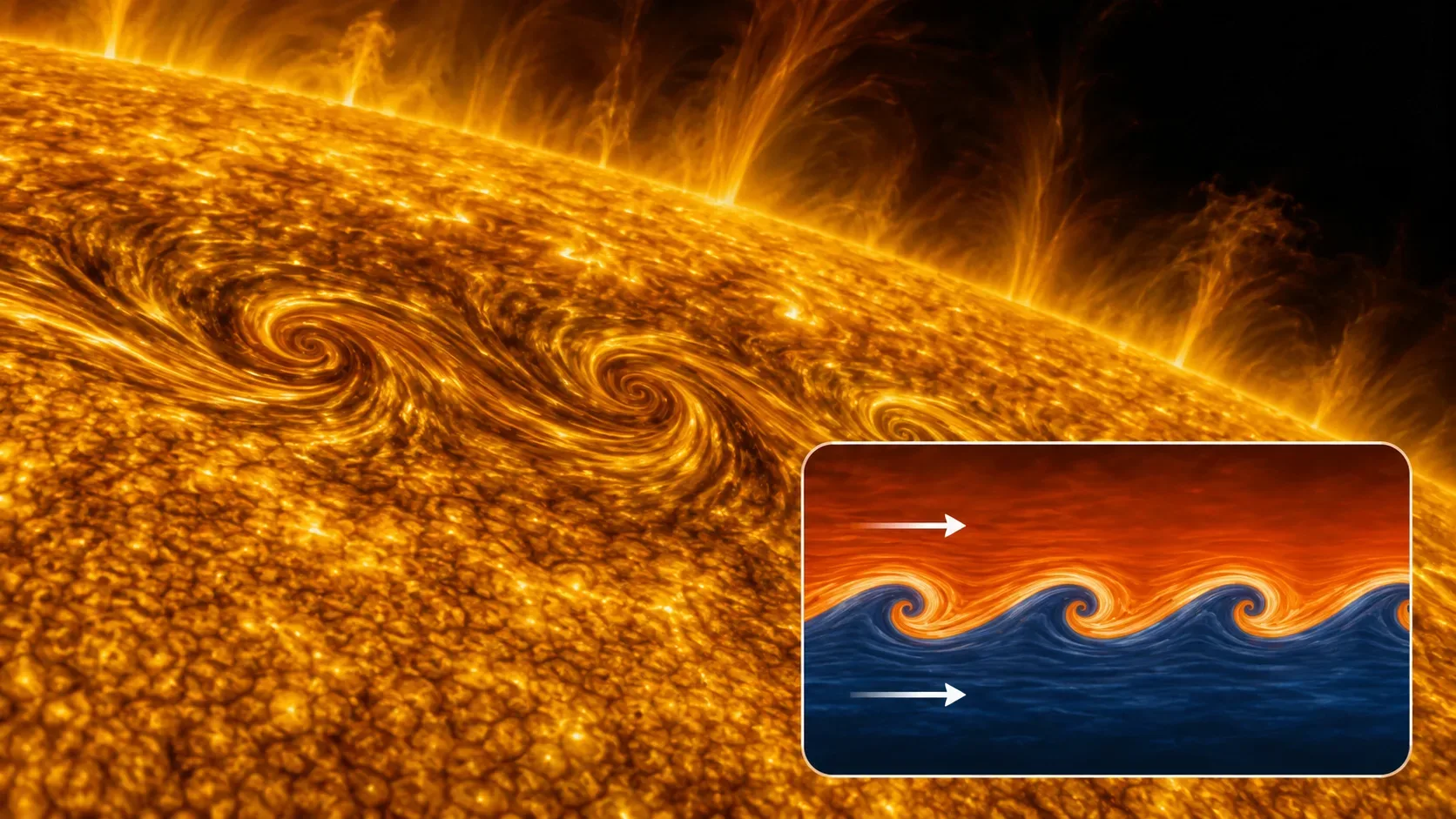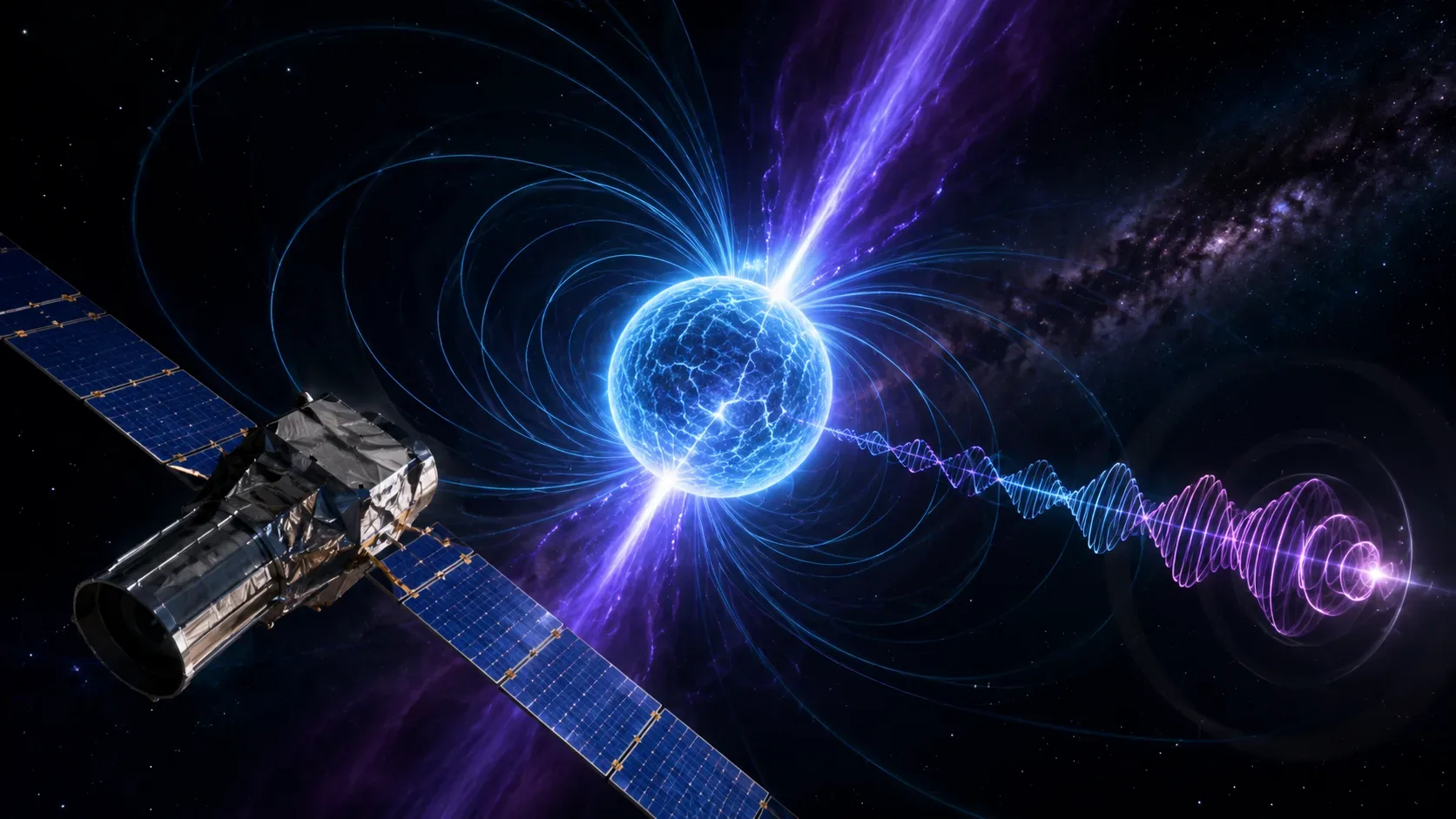
Yes, the vacuum can behave optically in a similar way to a birefringent material when crossed by extreme magnetic fields. This does not mean that empty space literally turns into a crystal. The comparison describes an effect predicted by quantum electrodynamics (QED): different polarization states of light encounter slightly different indices of refraction in the magnetized vacuum.
A study published in Nature on August 5, 2026 found in the magnetar 1E 1547.0−5408 a polarization pattern that was difficult to reproduce, within the models tested by the authors, without including this so-called vacuum birefringence. It is some of the strongest astrophysical evidence ever obtained for the phenomenon. Still, the paper itself describes birefringence as a long-standing prediction that remains without definitive confirmation and calls for new observational and theoretical studies.
Why the comparison with a crystal makes sense
In a birefringent material, the propagation of light depends on its polarization. QED predicts something analogous in very intense magnetic fields: the field modifies the effective optical properties of the vacuum, causing two polarization modes to propagate in slightly different ways. The work describes this phenomenon as the emergence of distinct refractive indices for different polarization modes.
It is in this sense that the vacuum “looks like a crystal”. Atoms organized in a crystalline network do not appear, nor does space become matter. The similarity is in the behavior of light.
Magnetars are especially interesting for this test because they are neutron stars with surface magnetic fields above 10¹⁴ gauss. The magnetar studied, 1E 1547.0−5408, rotates approximately once every 2.1 seconds and is unusual in producing both persistent X-ray emission and detectable radio pulses.
What IXPE actually measured
The team coordinated observations from IXPE, which measures polarization in X-rays, with the NICER telescope and the Murriyang/Parkes radio telescope. The campaign took place between March 26 and April 5, 2025. NASA describes the observation as the first coordinated radio and X-ray polarization measurement of a magnetar.
The most striking data was the intensity of polarization. In the independent analysis by energy bands, IXPE measured an average degree of polarization of about 46% between 2 and 8 keV. In the softest range, from 2 to 3 keV, the value reached 59 ± 5%. In continuous spectropolarimetric modeling, the estimate reached 65 ± 8% at 2 keV.
This is why different numbers appear in summaries about the discovery: 59% is the average measurement in the 2–3 keV range; 65% corresponds to the modeled value at 2 keV. These are not contradictory results.
When the researchers divided the observation by the magnetar's rotation phases, the polarization became even greater. In the 2–3 keV band, it reached 82 ± 15% in certain phases. Even as the radio beam passed through our line of sight, it remained at around 40% or more.
A strong dependence on energy also appeared: polarization dropped from 59 ± 5% between 2 and 3 keV to 37 ± 5% between 3 and 4 keV. Above this, uncertainties increase, and the researchers themselves state that deeper observations will be necessary to clarify the behavior of polarization at higher energies.
Radio made the test more demanding
A very high polarization alone is not enough to demonstrate vacuum birefringence. It is necessary to know how the axes of rotation and the star's magnetic field are oriented in relation to the observer.
This is precisely where radio data becomes important. The polarization angle pattern of the pulses allowed us to constrain the magnetar's geometry independently of the X-rays. The analysis favors a nearly aligned configuration, seen relatively close to the axis of rotation.
With these geometric constraints in hand, the team simulated the emission from the surface and the propagation of X-rays through the magnetic field. When vacuum birefringence was included, the models were able to preserve a high polarization and reproduce the observed behavior much better. When the effect was turned off, strong variations in the Stokes parameters appeared that did not match the data, and some solutions that worked best for X-rays conflicted with the geometry determined by radio.
This combination is the main gain of the new work. It is not just about observing “a lot of polarization”, but about simultaneously comparing intensity, polarization, rotation phase and geometry determined at another wavelength.
So why isn't it definitive proof yet?
There are good reasons to be cautious about language:
- Interpretation still depends on models. Observation measures polarization; Attributing this polarization to vacuum birefringence requires comparing the data with models of the magnetar's surface, atmosphere, and magnetosphere.
- The model does not yet contain all the relevant physics of the atmosphere. The authors explicitly say that the simulation used does not include mode conversion in the so-called vacuum resonance in deeper atmospheric regions. A more comprehensive demonstration would need to incorporate this process.
- Part of the data still has limited statistics. At higher energies and in certain rotation phases, uncertainties are greater. The article states that IXPE observations with better signal-to-noise ratio will be necessary to reach a definitive conclusion.
- The geometry has already produced different interpretations of the same target. An independent analysis of the approximately 500-kilosecond IXPE observation, presented by Roberto Taverna and collaborators and accepted for publication in the Astrophysical Journal, inferred another geometry and concluded that the high polarization, under these conditions, could not by itself be considered convincing evidence of magnetospheric birefringence.
This last point is especially useful for understanding how science works in this case. The new paper does not directly measure a “vacuum refractive index” with an instrument placed next to the magnetar. It combines observations with predictions from physical models and sees which scenario best explains the signals received on Earth.
The Nature team argues that simultaneous radio constraints favor a nearly aligned geometry and make birefringence necessary within the analyzed model space. The previous analysis obtained a different geometry and reached a more cautious conclusion about the strength of the evidence. New data can reduce precisely this dependence on geometric hypotheses.
What would be needed to strengthen confirmation
More observation time of 1E 1547.0−5408 itself would help reduce uncertainties by spin phase and energy. The study also points to the need for models that more fully incorporate the effects of vacuum resonance in the atmosphere and for data with a greater energetic range.
There is also a broader test: checking whether equivalent predictions appear consistently in other magnetars, using sufficiently precise polarimetry and independent constraints on their geometries. NASA says additional observations of this and other magnetars will be important to confirm the signal.
For now, the formulation most faithful to the data is this: IXPE found a signal that behaves as QED predicts vacuum birefringence should behave, and models have difficulty reproducing it without this effect. This is strong evidence, not a final and independent confirmation of all hypotheses.
The headline that “the vacuum became a crystal” oversimplifies it. But the physics behind the analogy is even more interesting: near one of the most extreme magnetic fields known, seemingly empty space can acquire optical properties that depend on the polarization of light. The new data brings this nearly 90-year-old prediction closer to a decisive observational test, without yet putting an end to the issue.