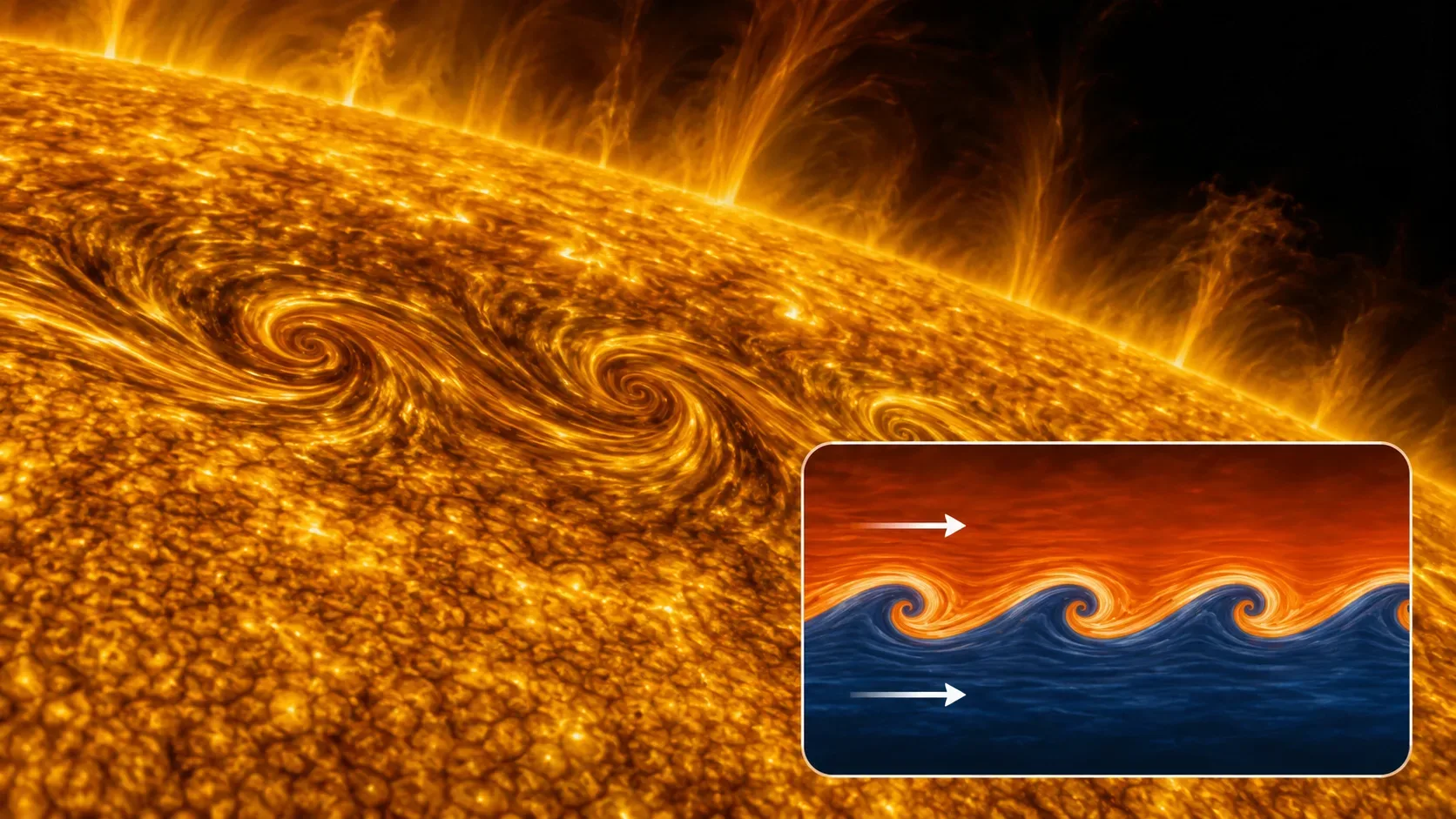
The news is not just an image of the Sun with impressive details. For the first time, researchers were able to observe directly in the photosphere, the visible surface of the star, structures compatible with the Kelvin–Helmholtz instability on scales of just tens of kilometers.
The study was published in Nature on August 5, 2026. The observations, however, were not made now: the analyzed data was recorded on April 14, 2025 by the Daniel K. Inouye Solar Telescope, in Hawaii. On August 6, 2026, NASA highlighted one of the images in the Astronomy Picture of the Day, expanding circulation of the discovery.
The result helps to understand how very small plasma movements interact with magnetic fields on the solar surface. There is a possible connection with the way magnetic energy is transported and dissipated in the Sun's atmosphere. This, however, is different from demonstrating that these eddies explain the heating of the solar corona.
What changed was the scale at which the telescope could see
Inouye observed the photosphere in light at a wavelength of 416 nanometers, in the blue region of the spectrum, achieving approximately 19 kilometers of spatial resolution. The researchers analyzed 47 whirlpool-like structures in the observed field. Characteristic sizes were between approximately 25 and 170 kilometers, with a typical separation of approximately 65 kilometers between the vortices.
To put this into perspective, the granules that make up the familiar “cell” aspect of the solar surface are typically hundreds to thousands of kilometers across. The new details appear at its edges, along with concentrations of magnetic field, such as much smaller ripples and curves.
The main numbers help you understand why these structures spent so long hidden:
- resolution of the best images: approximately 19 km;
- structures analyzed: 47 eddies in the observed field;
- measured sizes: approximately 25 to 170 km;
- characteristic spatial length between structures: about 65 km.
This does not mean that every curved spot in the image is a “solar tornado”. What appears in the observation is the signature, projected onto the photosphere, of plasma and magnetic field dynamics. Three-dimensional simulations are needed to investigate the physical structure behind the pattern seen by the telescope.
The image on three levels: observe, interpret and investigate
What we see directly
The images show solar granulation and, at the edges of magnetic concentrations, sequences of small curved and striated structures that grow and change over time.
The image released by Astronomy Picture of the Day appears in yellow, but this is not the color in which the data was originally recorded. The observation used in the study was made in the deep blue, around 416 nanometers. According to NASA, the version highlighted in APOD is a false color representation and corresponds to the highest resolution image released so far of the solar surface in visible light.
This detail matters because a scientific image should not be read only by the colors presented to the public. In this case, the relevant data is in the shapes, scales and temporal changes of the structures.
What the authors infer
The team identifies these patterns as magnetized manifestations of Kelvin–Helmholtz instability.
The phenomenon arises when neighboring regions of a fluid move at different speeds. Shear at the boundary can amplify small disturbances until they produce coiled waves and vortices. It is the same general type of instability that can generate wavy shapes in clouds or at the interface between fluid streams, although on the Sun the material is plasma also subjected to magnetic fields.
Interpretation does not depend solely on visual similarity. The researchers compared the observations with high-resolution magnetohydrodynamic simulations. The simulations produced similar structures, with scales, velocities and behavior compatible with the Kelvin–Helmholtz instability theory.
The work is particularly relevant because the research itself records that these instabilities were already theoretically predicted in the photosphere, but had not been directly observed there. There are previous Kelvin–Helmholtz studies on other regions and phenomena in the solar atmosphere, so the discovery should not be described as the first occurrence of the instability ever found on the Sun.
What remains open
The as-yet-unproven step is to turn this observation into a quantitative explanation of the warming of the solar atmosphere.
Simulations indicate that vortices can favor turbulence, mixing between magnetized and less magnetized plasma and continuous deformations of magnetic field structures. The authors also discuss the possibility that these movements contribute to the so-called magnetic flux braiding, the intertwining of field lines that can store free energy for later dissipation.
But the study does not directly measure how much of this energy reaches the corona, does not show an increase in coronal temperature caused by the eddies, and does not establish that Kelvin–Helmholtz is the main mechanism responsible for the well-known problem of coronal heating.
It is precisely this difference between a physically plausible connection and a proven explanation that the discovery needs to be read.
Why were these structures only visible now
The article itself points to resolution as a likely reason for the absence of previous observations of the photosphere. Characteristic scales are difficult to access with solar telescopes with an aperture of less than two meters. Inouye has a four meter main mirror, the largest on a solar telescope of its type.
The larger the aperture of a telescope, the smaller the detail can be separated by the optical system, as long as the atmosphere, instruments and processing allow us to take advantage of this capacity.
In the analyzed set, the team combined Inouye's large aperture with optical correction, extremely fast exposures and computational reconstruction of the images. The final resolution was close to the expected diffraction limit for the telescope at 416 nanometers.
Therefore, “sharper image” does not just mean producing a photograph with more pixels. The scientific gain appears when physical resolution crosses an important limit: structures that previously blended into an apparently smooth border begin to be separated individually.
What Kelvin–Helmholtz might have to do with the Sun's energy
Magnetic fields traverse the photosphere and extend through the upper layers of the solar atmosphere. Movements at the base of these structures can deform field lines and store magnetic energy.
In the study, the eddies continually disturb the boundaries of magnetic concentrations. In simulations, instability also favors turbulence and plasma mixing. These processes offer new ingredients for models that attempt to explain how energy is redistributed from the surface to higher regions.
The connection with the crown comes from there. The same reserve of magnetic energy generated and reorganized by movements in the photosphere is involved in phenomena such as magnetic reconnection, eruptions and atmospheric heating. The authors propose that small vortices can participate in this chain by promoting deformations and intertwining of the field.
NASA adopted a similarly cautious formulation when presenting the image on August 6: Future research could investigate how the instability transports energy and magnetic fields and whether it contributes to the corona's heating.
So the discovery adds a possible piece to the problem, not its final solution.
The image shows more than a turbulent surface
There is an important difference between saying “the Sun has swirls” and describing the results of the study.
What was detected are extremely small-scale structures, located at the interfaces between the granulation and magnetic concentrations of the photosphere, whose evolution and properties are consistent with a known instability of fluid and plasma dynamics.
The resolution of approximately 19 kilometers made observable a band of phenomena that previously remained blurred. This allows you to test physics predictions directly on solar data and improve models on plasma mixing, turbulence and magnetic field evolution.
The question about how much of this dynamic participates in the transport of energy to the crown remains open. It is this uncertainty, and not a failure of the result, that defines the next stage of the research.
To continue following how telescopes and missions transform images into physical evidence, also explore the contents of Earth and Universe dedicated to astronomical observation and the interpretation of scientific images.