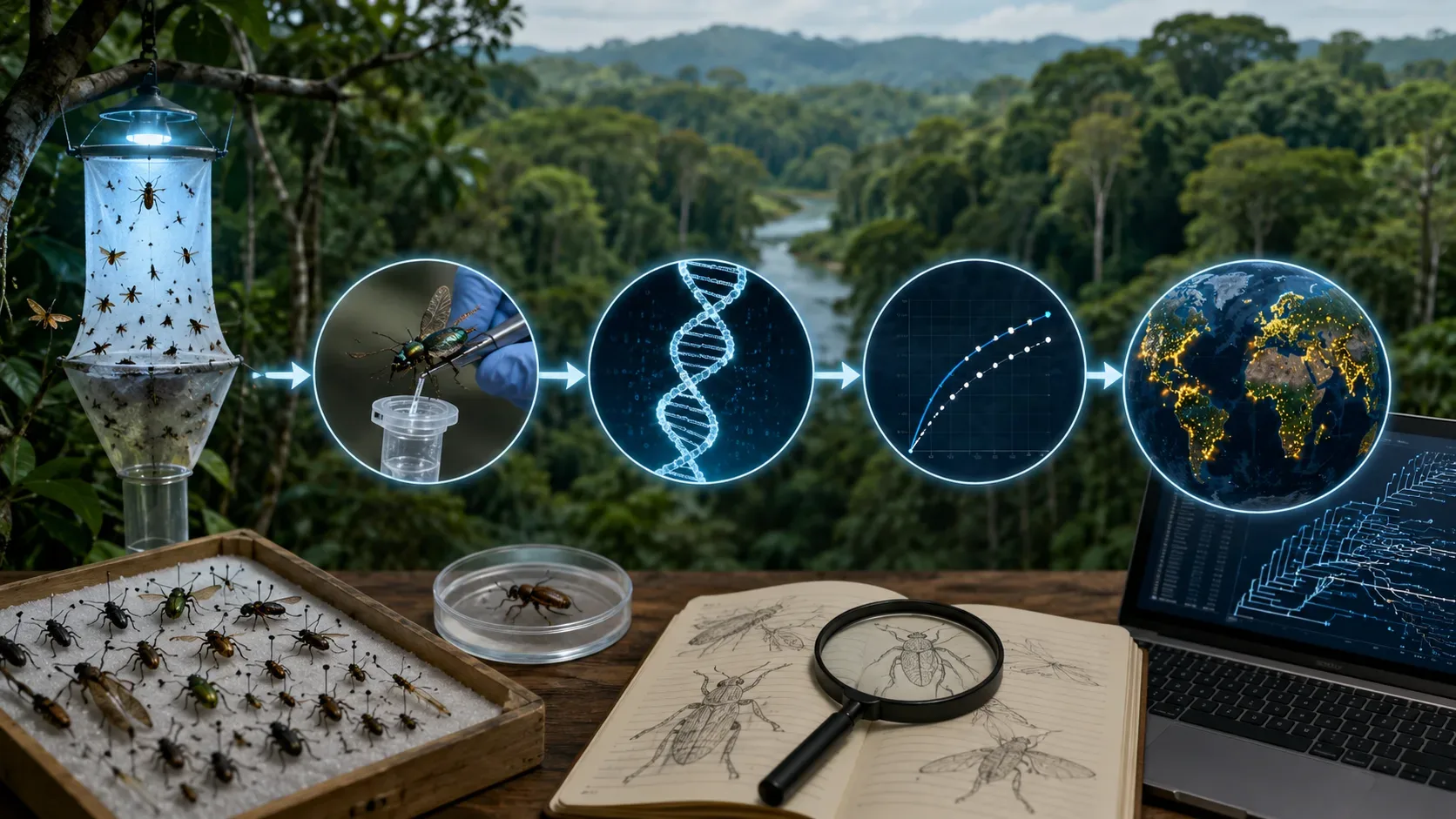
There is no team that goes through every forest, island, cave or stretch of ocean before declaring a species extinct. In practice, science asks a more precise question: if this species still existed, what would be the chance of having already found any sign of it in the searches carried out?
It is this change of question that transforms absence of observation into evidence. A species is not considered extinct simply because no one has seen it for a few years. The conclusion depends on where you looked, when, with what method, for how long, how easy the organism would be to detect, and what happened to its populations and habitats.
This principle formally appears on the Red List of the International Union for Conservation of Nature (IUCN). According to the currently current guidelines, version 16, March 2024, a taxon is considered Extinct when there is no reasonable doubt that the last individual has died. To presume extinction, exhaustive surveys must have failed to record individuals in known or expected habitat, at suitable periods and throughout their historical range, for an interval compatible with their life cycle.
“I didn’t find it” doesn’t mean “it doesn’t exist”
Imagine two animals that are not observed in five expeditions.
The first is large, active during the day, lives in a small area and is usually easily identified when present. The second is tiny, nocturnal, lives hidden underground and occupies an extensive forest.
Five negative searches do not have the same weight in both cases.
Ecologists call this problem imperfect detection. Even when a species is present, there is a chance that the search will not find it. Occupation methods were developed precisely to separate two possibilities that seem the same in the field: the organism really is not in that location or it was there, but went unnoticed. Repeated surveys help estimate this probability of detection.
A simplified example shows why. Assume that each independent survey has a 50% chance of detecting a species if it is present. The chance of failing five times in a row would be about 3.1%. If the chance of detection in each search were just 20%, however, the probability of five consecutive searches failing would rise to approximately 32.8%.
In nature, the math is more complex: weather, season, behavior, observer, equipment, and location can alter detectability. But the logic remains. An absence is much more informative when the search had a high probability of finding the organism.
Where to look if no one knows all the hiding places?
Scientists don't choose locations randomly. They start with what is already known about the species.
Historical records, museum specimens, photographs, vocalizations, remains, environmental characteristics and knowledge about similar organisms help to reconstruct their distribution. From there, researchers identify known areas and also habitats where it would be reasonable to expect surviving populations to be present. The IUCN definition itself speaks of searches in “known and/or expected” habitat, and not of literally examining the entire surface of the planet.
This also avoids an obvious problem: looking too hard in the wrong place doesn't produce strong evidence. A hundred days of surveying in unsuitable environments may say less than a few well-planned searches in the last patches of compatible habitat.
The timing of the search also matters. An adult insect that appears only for a few weeks, a plant that flowers seasonally, or a nocturnal animal require different methods and periods. Therefore, the IUCN guidelines explicitly mention appropriate times, seasons and years for the organism evaluated.
The history of the species is also included
The decision does not start on the day of the last shipment. Researchers look at the entire sequence of evidence.
Factors that can increase or decrease confidence in an extinction hypothesis include:
- the date and reliability of the last records;
- the extent of the area actually researched;
- the chance of detecting the species with the methods used;
- the quantity and quality of subsequent surveys;
- the loss or retention of suitable habitat;
- the intensity, duration and scope of threats capable of eliminating populations.
Studies dedicated to inferring extinctions combine records, surveys and threats. There are models capable of updating the probability of persistence as reliable observations appear or, conversely, as suitable searches continue without success.
Threats help because they provide an independent line of evidence. If a species occupied only a small area and that area underwent a transformation capable of eliminating all necessary habitat, this weighs differently than a case in which large suitable regions remain intact and little researched. Structured methods recommend assessing both whether the threat was severe and prolonged enough to cause local extinctions and whether it was widespread enough to eliminate all populations.
The last sighting is not the date of extinction
This is another important detail. If the last confirmed individual was seen in 1980, this does not mean that the species disappeared in 1980.
It may have survived for years or decades unobserved. The IUCN itself distinguishes the date of the last record from the date of extinction: when the death of the last individual is not witnessed, there is necessarily an interval of uncertainty.
That's why researchers have also developed statistical methods based on the distribution of sightings over time. A record that was once frequent and then disappears may provide different information than a species that has always had very few records. More recent models can also consider the reliability of observations and differences in sampling effort. A review published in 2024 brings together different methods created to infer extinctions from these histories.
What about when the evidence is strong, but there is still doubt?
Conservation science tries to avoid two mistakes.
The first is to continue searching indefinitely for a species that has in fact disappeared, consuming resources that could be used in other actions. The second is more dangerous: declaring a species extinct when individuals still exist and, as a consequence, interrupting searches and measures that could save it.
This second problem is known in conservation literature as “Romeo’s error.” Because of this asymmetry, the formal declaration of extinction tends to be conservative.
The IUCN also has the Critically Endangered (Possibly Extinct) marking for situations in which the body of evidence indicates that the species has probably disappeared, but there is still enough doubt not to classify it as Extinct. The organization itself emphasizes that “Possibly Extinct” functions as a label within Critically Endangered, and not as an independent category on the Red List.
This allows the uncertainty to remain explicit rather than being hidden behind a binary answer.
So there is never absolute certainty?
In many cases, not in the 100% mathematical sense.
The requirement is to reach a level of evidence strong enough so that there is no reasonable doubt about the survival of the species. This conclusion may result from very intensive surveys, probabilistic models, habitat destruction, threat history, and a prolonged lack of reliable records — usually several of these lines of evidence together.
And the conclusion can be revised. Species reported missing or considered possibly extinct have already been rediscovered after long periods without records. These rediscoveries do not render scientific inference useless; show why uncertainty needs to be part of it and why classification should not rely solely on the number of years since the last sighting.
The same logic used to infer what we cannot count
There is an interesting connection with another common question: how do scientists estimate how many species there are when no one has counted them all one by one?
In both cases, the center point is the same. Science does not need to observe every element of a system to make an inference about it. It needs to know the sampling process and measure how much of what has not been observed may still be hidden.
In studies of species richness, models take into account the fact that some species present do not appear in the samples. In extinction research, the problem is almost the opposite: after successive absences, we try to estimate whether it is still plausible that a surviving species continues to escape detection.
Therefore, a well-founded declaration of extinction does not mean “we looked everywhere and there was nothing”. It means something more careful: we look for where the species should be, in the way and at the time in which we should be able to detect it, we consider its history and its threats, and the hypothesis that it still exists is no longer reasonable given the available evidence.