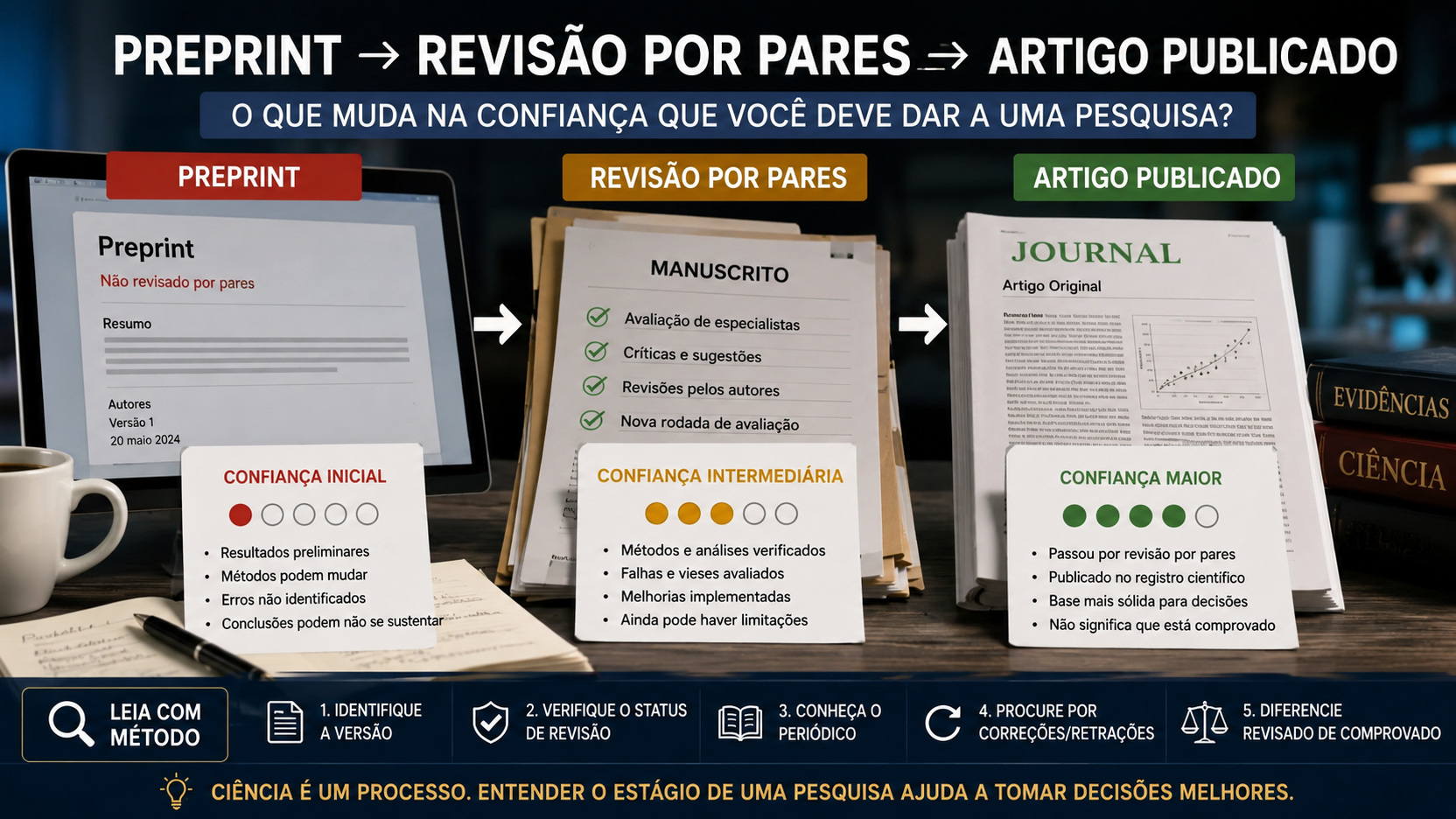
A scientific result can look the same in three different places: on a preprint server, on a journal website after peer review, and in the final published version. But editorial status changes what has already happened to that manuscript, who reviewed it, what version is in front of you, and what mechanisms exist to correct the record later. It does not, by itself, create an automatic scale of "truth."
The most useful rule is this: preprint does not mean fake research, and peer-reviewed article does not mean proven conclusion. The editorial stage is important information about the process. Confidence in the conclusion remains dependent on study design, data quality, analysis, limitations, and the existence of independent evidence.
What is a preprint, actually
The National Library of Medicine, in the NIH preprint program, defines preprints as complete, public versions of scientific works that have not yet been certified by peer review. They exist to speed the circulation of results, establish priority and allow comments before formal publication.
The practical consequence is simple: any relevant part can change. Methods can be better described, analyzes can be redone, results can gain another interpretation and conclusions can be softened or even abandoned. Responsible servers make it clear that the document is a preprint and maintain version history.
This does not mean that the text was placed on the internet without any filter. Servers can screen for scope, ethics, plagiarism or inappropriate content. This screening, however, should not be confused with the critical assessment of scientific merit carried out by journal reviewers.
What peer review adds
The ICMJE describes peer review as the critical evaluation of manuscripts by experts who, in general, are not part of the editorial team. In practice, reviewers can point out methodological flaws, request additional analyses, question interpretations, suggest better description of the data and help the editor decide whether the work is suitable for the journal.
This process increases the amount of scrutiny before publication, but is not a universal audit or independent replication of the study. Journals vary in the number of reviewers, the openness or anonymity of the process, access to data and protocols and even the way they use opinions. The final decision is editorial, not a binding scientific vote.
Therefore, "passed peer review" should be read as "was subjected to a formal critical evaluation stage". Not like "all data has been verified by third parties" or "the conclusion has been demonstrated without room for error."
Accepted article, ahead of print and published version are not exactly the same thing
Between the preprint and the final version there may be intermediate states. Crossref differentiates, among others, between the manuscript accepted by the journal, the advance publication and the registration version. An accepted manuscript has already gone through the editorial process required by the journal, but may not yet have received the editing, pagination or final form of publication.
The version of record is the version formally published and maintained by the journal. It functions as a stable citation point and becomes part of an academic record maintenance system: corrections, updates and retractions can be linked to it in a traceable way.
For anyone who reads news or receives a PDF, this matters because different files from the same study can circulate at the same time. A PDF saved months ago may be an old preprint while the journal page already shows a revised and published version.
Published does not mean closed
Science continues after publication. The ICMJE itself treats honest errors as part of the scientific and editorial process and recommends that corrections be published when necessary. Errors capable of invalidating results and conclusions may require retraction.
Crossref maintains versioning mechanisms and Crossmark to indicate corrections, retractions and other relevant updates. When this kind of information is available, checking the PDF alone is not enough: it is better to open the article's current page or its persistent record and check the latest status.
This is one of the reasons not to use "published" as a synonym for "immutable". An article can be strong and remain valid for decades. You may also receive a small correction, an expression of concern, or a retraction. The current status is part of the critical reading.
A reading method in six checks
1. Identify which version you are reading
Look for words like preprint, submitted manuscript, accepted manuscript, ahead of print, early view or version of record. If the document is on a preprint server, check for later versions and a link to the published article.
The date alone doesn't solve it. A preprint from yesterday may represent a methodologically excellent study, while a paper published years ago may have known problems. The purpose of this first check is to discover the stage of the document, not to assign an automatic grade to it.
2. Confirm whether there has been peer review and how it works in that journal
The name of the periodical alone is not sufficient proof. Serious journals describe their review policy, and some publish opinions, author responses or editorial histories. The ICMJE recommends transparency precisely because processes vary between journals.
When information about peer review is vague, contradictory or difficult to locate, this should reduce your confidence in the editorial seal. It is also a sign to investigate whether the journal has recognizable academic practices and clear correction and retraction policies.
3. Read the method before letting yourself be convinced by the status
The editorial stage does not automatically correct for small sample size, lack of comparison group, poorly defined outcomes, inadequate analysis, or a difference between correlation and causation. The central question remains: is the study design capable of supporting the conclusion that the authors present?
In quantitative topics, observe sample size and selection, definition of outcomes, uncertainty of estimates and analytical decisions. In observational studies, look for possible confounding factors. In experiments, examine controls, randomization, blinding when relevant, and loss of participants. The type of study determines what can be completed.
4. Compare the conclusion of the text with the headline that reached you
Preprints tend to circulate quickly on social networks, releases and news. Along these lines, a cautious phrase can become a categorical statement. The same can happen with published articles.
Return to the summary and, where possible, the results and limitations section. See if the verb in the headline is stronger than the verb used by the authors themselves. "Is associated", "has been observed" and "may" communicate something different from "cause", "proof" and "works".
5. Look for corrections, expressions of concern, and retractions
On the journal page, check for update notices. When there is Crossmark, it can show status changes. It is also worth checking that the preprint page points to the published version and that the published version received subsequent corrections.
A small correction does not automatically make a study useless. Likewise, a retraction requires attention to the reason: the problem may involve a serious error, unreliable data, integrity issues, or other situations that affect interpretation. The point is not to treat an old copy as if it represented the current state of the record.
6. Ask if the conclusion depends on a single study
The editorial stage helps evaluate an article, but robust scientific confidence is usually born from convergence. Replications, independent studies, different methods, and evidence syntheses can strengthen or weaken a conclusion over time.
This principle explains why peer-reviewed research can still be challenged and why a preprint can correctly anticipate a result that will later be confirmed. Editorial status is one layer of the review, not the entire review.
How to calibrate language when sharing a survey
If you are looking at a preprint, say that the results have not yet been peer reviewed by a journal and could change. This does not disqualify the study; it just tells the reader where they are in the process.
If the work has already been reviewed and published, you can say that it is a study published in a peer-reviewed journal, as long as this status is confirmed. Still, choose verbs compatible with the design: "suggests", "found", "estimated", "observed" or "tested" are often more accurate than "proven".
When several independent surveys point in the same direction, the formulation can be firmer. Even so, the strength of the language must match the strength of the body of evidence, not just the prestige of a journal or the presence of the expression "peer reviewed".
The difference between "reviewed" and "proven"
Peer review is a filter and a criticism stage. Publication is also an act of recording, editing and maintaining a formal version. Neither eliminates the possibility of error, bias, misinterpretation, or later discovery.
The more mature question, therefore, is not "can I trust it because it was published?". It's "what has already been examined, which version am I reading, does the method support the conclusion, and is the record still valid today?" When these four questions are answered, the label preprint or published article stops functioning as a shortcut and starts to be used for what it really is: a clue about the stage of the evidence.