
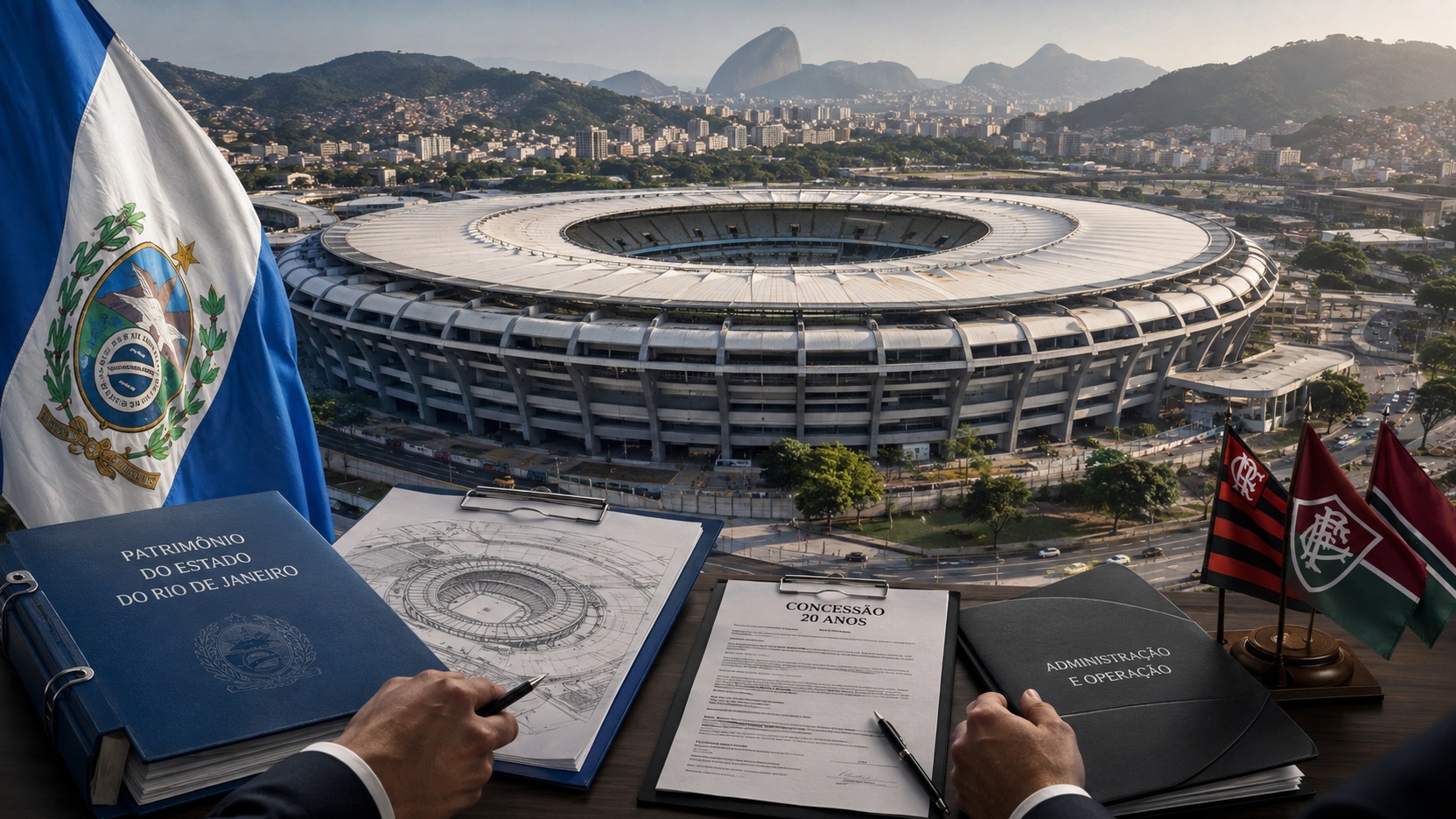
In August 2026, the most accurate answer is this: Maracanã is a public asset of the State of Rio de Janeiro; Fla-Flu Serviços S.A. is the concessionaire that received the right to use and economically explore the Maracanã Complex for 20 years; and Flamengo and Fluminense are shareholders in this company, with 65% and 35% stakes, respectively. The clubs manage the stadium through the SPE, but have not received ownership of the property.
This distinction resolves much of the confusion. When someone says that “Flamengo has 65% of Maracanã”, they are mixing the club's participation in the concessionary company with ownership of the public asset. The 65% belongs to the capital of Fla-Flu Serviços. They do not mean that Flamengo owns 65% of the stands, the land or the structure of the stadium. The same goes for Fluminense's 35%.
The short answer: the State is the owner and the SPE is the concessionaire
The document that organizes the current relationship is not a deed of purchase and sale. It is SECC Contract No. 033/2024, officially described as an onerous concession of the right to use public property for the management, exploration, operation and maintenance of the Maracanã Complex. The contract was signed on September 27, 2024, after the Fla-Flu Consortium won the public tender.
In practice, the State remains at the patrimonial and institutional level as the granting power of public goods. Fla-Flu Serviços remains at the operational and economic level, with the right to manage, operate, maintain and explore the complex within the rules of the contract. The State Secretariat of the Civil House is responsible for monitoring and supervising compliance with these obligations.
The bidding modeling itself helps to visualize the difference. The bidding documents deal with the delivery of the public asset granted to the concessionaire for possession and use during the contractual term and also provide for a return procedure at the end of the concession. This design is incompatible with the idea that the stadium was sold to the clubs.
What exactly went into the concession
The central object of the concession is the Maracanã Complex formed by the Jornalista Mário Filho Stadium, Maracanã, and the Gilberto Cardoso Gymnasium, Maracanãzinho. In the official responses to the notice's doubts, the State clarified that areas such as the Júlio Delamare Water Park, the municipal school located nearby and the former Indian Museum do not form part of the public good granted in this model.
This is important because “Maracanã Complex” can appear in the news as if it meant the entire area around the stadium. For the concession contract, the relevant scope is delimited. The concessionaire receives responsibilities for the equipment provided for in the notice, and not a generic domain over the entire Maracanã region.
Who is Fla-Flu Serviços and why does it exist
The winner of the bid was the Consórcio Fla-Flu, formed by Flamengo and Fluminense. The modeling, however, required the winner to establish a Specific Purpose Company, an SPE, to sign and execute the contract. This is how Fla-Flu Serviços S.A. came about.
The difference is not just bureaucratic. Legally, the concessionaire is SPE. It is what concentrates the execution of the contract, operating obligations, financial commitments and the economic exploitation of the complex. Flamengo and Fluminense appear as shareholders of the company and exercise their participation through the company's corporate structure.
Flamengo's financial statements for the second quarter of 2026 record 65% of the club's shareholding in Fla-Flu Serviços and 35% in Fluminense. This proportion represents the division of the concessionaire’s capital. It may have economic and governance effects within the SPE, but it does not change the public nature of Maracanã.
Who decides what on a daily basis
At the property and contract level, the State defines the conditions of the concession and monitors their compliance. He did not hand over the stadium without rules nor did he give up the patrimonial link with the property. The Civil House monitors the execution of services and commitments set out in the notice and contract.
On an operational level, Fla-Flu Serviços manages the complex. It is the concessionaire that organizes the daily operation, maintenance, economic exploitation of spaces and the execution of the obligations assumed. This gives the company real management margin, but within contractual, regulatory and security limits.
On a corporate level, Flamengo and Fluminense influence the concessionaire as shareholders. This is the layer where the 65% and 35% split matters. It does not transform each club into co-owner of the property and also does not eliminate the SPE's own legal personality.
Therefore, news that says that “Flamengo and Fluminense manage Maracanã” may be correct in an operational sense. The phrase becomes misleading when it is used as a synonym for “Flamengo and Fluminense own the stadium”. Management and ownership are different things.
The grant: what the concessionaire pays to the State
The winning proposal offered an annual grant of R$ 20,060,874.12. This value is not a purchase price for Maracanã. It is an economic obligation linked to the right of exploration granted by the State.
Flamengo's financial statements published in 2026 help to see the commitment on a contract scale. They record that the total nominal amount payable to the granting authority for the
obtaining the grant was approximately R$401.218 million. The same report informs that the schedule provides for quarterly installments until November 2044, corrected by the IPCA accumulated in the 12 months prior to each payment.
The bill brings together the two ways of presenting the obligation: the annual offer of just over R$20 million for 20 years forms a nominal commitment of around R$401 million before the effects of the expected corrections. The central point is that this money remunerates the concession of use and exploration. Do not buy the property.
Grant and investment are not the same obligation
In addition to the grant, the concession brings maintenance and investment commitments. The Civil House informed, at the opening of the tender and again at the signing of the contract, that the notice provided for around R$186 million in investments throughout the concession period.
Among the interventions announced for Maracanã are recovery of water systems, escalators, elevators, air conditioning and exhaust, modernization of electronic systems and revitalization of the Football Museum. For Maracanãzinho, repairs to the roof, new audiovisual and acoustic system, requalification of hospitality areas, lighting and accessibility were mentioned.
This creates two different conceptual boxes. The grant is the payment linked to the granted right. Investments and maintenance are obligations related to the operation, conservation and modernization of equipment. One thing should not be treated as a substitute for another.
What the concession gives to clubs
Through Fla-Flu Serviços, the clubs now have a long-term structure to manage and economically exploit Maracanã and Maracanãzinho. This is much broader than a simple temporary authorization to play matches. The SPE assumes the operation of the complex, develops revenues compatible with the contract and plans interventions over two decades.
The 20-year term also changes the management logic. Instead of a provisional permission renewed at short intervals, the concessionaire works with a sufficient horizon to organize investments, commercial contracts, maintenance and exploration of spaces. This stability is precisely one of the economic functions of a long concession.
Still, the power of the dealership is not unlimited. Licenses, authorizations, safety standards, sporting rules, contractual obligations and public oversight continue to exist. The concession is a broad right of use and exploitation, but it is a conditioned right.
What the concession doesn't give
The concession does not transfer ownership of Maracanã to Flamengo, Fluminense or Fla-Flu Serviços. It also does not transform the 65% and 35% of the SPE into real estate fractions of the stadium. The concessionaire will no longer be able to sell the public asset as if it were a private asset of the clubs.
The modeling documents themselves distinguish the public good from the rights that arise from the concession. In a point about guarantees for financing, the State allows, subject to conditions and agreement from the granting authority, the use of rights arising from the concession. The logic is revealing: what can be negotiated or given as a guarantee are the concessionaire's contractual rights, and not Maracanã as private property.
There is also no automatic right to stay after the deadline. The modeling foresees the termination of the concession and the return of the public asset granted. Possible hypotheses of extension, early termination or other changes depend on the contractual rules and the
applicable order, not the isolated will of the clubs.
“Why don’t you sell Maracanã to Flamengo?” is another legal question
The current concession is not an informal purchasing stage. To transfer ownership of the stadium, another type of decision and another legal procedure would be necessary, subject to the public goods regime and property protections applicable to Maracanã. This does not happen by simply converting the concession contract into a deed of sale.
For this reason, the debate on a possible alienation must be separated from the debate on the current concession. In August 2026, the documentary relationship that is being executed is the onerous concession for the use of public property. The State is the granting power; Fla-Flu Serviços is the concessionaire; Flamengo and Fluminense are the shareholders of SPE.
How to read upcoming news without confusing ownership, management and participation
When a news article talks about “the owner of Maracanã”, the first test is to find out whether it is talking about ownership of the property or operational control. Today, public ownership and granted management are in different hands.
When the news mentions “Fla-Flu”, it is worth identifying whether the subject is the former consortium that won the bid or Fla-Flu Serviços S.A., which is the company created to execute the contract. To understand current obligations, revenues and liabilities, the SPE is the centerpiece.
When the division of 65% for Flamengo and 35% for Fluminense appears, read these percentages as equity participation in the concessionaire. They help to understand the economic relationship between the clubs within the company, but they do not answer who owns the stadium.
And when values appear, separate the investment grant. The grant remunerates the right granted and was offered at just over R$20 million per year. Investments are commitments to intervene and improve the complex. Mixing the two numbers produces a flawed view of the cost and responsibilities of the grant.
The current portrait of Maracanã
The documentary map is simpler than the word dispute suggests. Maracanã continues to be a state public asset. The administration, operation, maintenance and economic exploitation of the stadium and Maracanãzinho were granted for 20 years to Fla-Flu Serviços S.A. Flamengo holds 65% of the concessionaire and Fluminense, 35%. The Civil House monitors compliance with the contract, and the company assumes granting, operating and investment commitments.
So, “who owns it?” and “who is in charge of the day to day life?” have different answers. The State remains linked to property and the granting power. Fla-Flu Serviços carries out contractual management. Flamengo and Fluminense economically control the SPE in proportion to their shares, but did not acquire Maracanã. It is this separation between heritage, concession and business society that avoids almost all confusion about the stadium today.