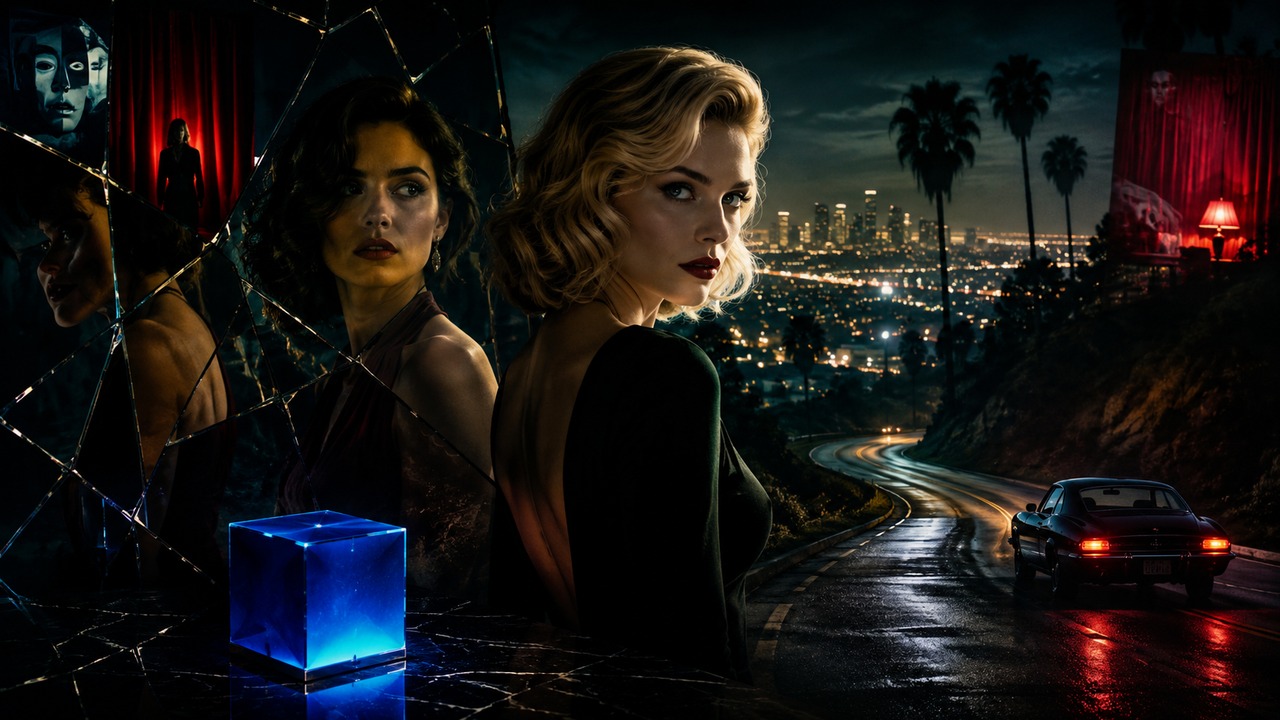
This text contains spoilers for City of Dreams (Mulholland Dr., 2001) from beginning to end. The short answer is: the stronger reading is that the long story of Betty and Rita functions as a fantasy or dream of Diane Selwyn, while the part after the blue box brings us closer to Diane's life, her memories, her guilt, and her death. But David Lynch never declared this formula to be the “official solution.” He confirmed that his ten clues are real and, in another interview, stated that the film contains visual and sound clues and that its threads are closed, at the same time that he refused to explain to the public what conclusion he should draw.
This changes the safest way to “explain” City of Dreams. Instead of transforming a theory into fact, it is worth separating three levels: what the montage shows without depending on interpretation; the way the ten clues bring characters, objects and scenes together; and the dream/reality reading, which organizes a lot of things with great explanatory power, but does not eliminate all abstract elements. In 2026, when the film turns 25, this opening remains central to its reputation as a puzzle.
What changes when the blue box is opened
Before the box, we follow Betty Elms, an aspiring actress recently arrived in Los Angeles, and Rita, the amnesiac woman who survives an accident on Mulholland Drive. Their investigation into Rita's identity leads them both to the name Diane Selwyn, to a dead body in an apartment, to Club Silencio, and finally to the blue box that matches the key found in Rita's purse.
At the decisive moment, Betty is no longer in the apartment. Rita opens the box; the image plunges into the dark void; the box falls to the floor. After this rupture, the film presents us with Diane Selwyn, played by Naomi Watts, waking up in the same apartment associated with the corpse. The woman we knew as Rita reappears as Camilla Rhodes, played by Laura Harring. From then on, fragmented scenes reveal a loving relationship between Diane and Camilla, Camilla's greatest success in Hollywood, her closeness with director Adam Kesher, Diane's humiliation at a party on Mulholland Drive and, finally, the hiring of an assassin to kill Camilla. The killer explains that a blue key will serve as a sign that the job has been completed.
This is what the film confirms most firmly: after the box, names, roles and relationships are reconfigured; Diane is linked to hiring the hitman; the blue key is linked to the outcome of the crime; and Diane ends up haunted by visions before killing herself. The additional leap - asserting that everything
what came before was a dream produced by Diane - it is interpretation, albeit an exceptionally well-supported interpretation.
Betty is Diane and Rita is Camilla?
In terms of casting and editing, the link is unequivocal: Naomi Watts plays Betty and Diane; Laura Harring plays Rita and Camilla. The film doesn't include a caption saying “Betty is the dream version of Diane,” but it constructs too many correspondences so that the pairs can be treated as completely independent characters without further explanation.
The most common reading understands Betty as the idealized version of Diane. Betty arrives in Hollywood full of confidence, finds a perfect hosting opportunity, demonstrates extraordinary talent in her first big audition, and becomes the person who protects Rita. Diane, in contrast, appears isolated, professionally frustrated, and emotionally devastated.. Rita, in turn, is vulnerable, amnesiac and dependent on Betty; Camilla is autonomous, successful and capable of abandoning Diane.
This inversion produces a very precise corrective fantasy. The woman who, in Diane's life, holds emotional and professional power becomes, in Betty's story, someone who needs her for everything. Director Adam, associated with Camilla's success and new relationship, becomes a man surrounded by dark forces that limit his choices. Professional rivalry is also redistributed. Fantasy does not erase suffering; she rearranges it so that Diane can take the heroine's place.
David Lynch's 10 clues, one by one
Lynch prepared the ten leads for a European edition of the film. In an interview originally published in 2018, he confirmed that they were true clues, created to give the viewer things to think about when rewatching the film. They do not form a template. They work best as an attention map.
Clue 1: look carefully at what appears before the credits
Before the main narrative begins, we see a jitterbug sequence in which a young blonde is celebrated, and then a camera movement towards a pillow and a bed, accompanied by breathing. Later, Diane says that a victory in a jitterbug contest was linked to her going to Hollywood.
The strongest connection is simple: the film presents the memory of the competition and immediately places us in front of someone lying down or falling asleep. This supports the hypothesis that Betty's story begins in a dream state. Still, the film does not verbally identify the person on the pillow at that moment. The track guides the eye; the conclusion about who dreams comes from the whole.
Clue 2: notice the red lampshade
The red lamp appears next to a telephone in scenes that appear, at first, to be part of a mysterious network of calls. Later, a phone next to a red lamp is linked to Diane's space and a call from Camilla.
In the dream/reality reading, this object helps to show how fantasy recycles elements of Diane's experience. A domestic detail associated with an affectionate memory reappears transformed into a piece of conspiracy. The track is strong as a visual connection. What it does not prove is that each phone call in the first part can be translated, one by one, into a “real” event.
Clue 3: What movie is Adam casting in and where does that title return?
Adam is choosing the protagonist of The Sylvia North Story. The title reappears in Diane's part when she explains that she met Camilla in the context of that same film and that Camilla got the main role she wanted.
This repetition is one of the clearest seams between the two layers. In Betty's story, the choice of an actress named Camilla Rhodes is forced on Adam by threatening men. In Diane's story, the
real Camilla Rhodes won the professional contest in which Diane failed. The fantasy turns a painful defeat into an external explanation: it wouldn't be Betty's lack of talent that would stop her, but a rigged system.
Clue 4: the accident is terrible; watch where it happens
Rita's accident happens on Mulholland Drive. Later, Diane also takes a limousine up Mulholland Drive to go to Adam and Camilla's party, in a sequence that deliberately echoes the trip at the beginning.
The coincidence of place links threat and humiliation. In fantasy, the woman equivalent to Camilla is at risk of being killed on that road and escapes by chance. In Diane's memory, the same road leads her to the encounter in which her romantic and professional failure becomes impossible to deny. It is plausible to read the accident as a rewriting of Diane's trauma: the path to the party becomes, in the dream, the path on which Camilla should be the victim.
Clue 5: Who hands over a key and why?
In Diane's part, the killer shows a blue key and explains that it will be the sign that Camilla has been killed. In Betty and Rita's part, a differently shaped blue key appears in Rita's bag and is used to open the blue box.
The relationship between key and death is one of the strongest bridges in the film. The fantasy takes a sign that, to Diane, means “the crime happened” and turns it into a literal key to a mysterious object. When the box is opened, the fantasy collapses. Saying that the box “contains the truth” or “contains the guilt” is already symbolic language, not a material fact shown on the screen. But the montage encourages exactly this kind of association.
Clue 6: notice the robe, the ashtray and the coffee cup
These objects help to realize that Diane's part is not a linear and objective block. The neighbor shows up to collect belongings, including a piano-shaped ashtray. In other scenes related to Diane and Camilla's relationship, the presence or absence of objects, clothes and drinks changes.
The effect is chronological: the film moves us between Diane's present, previous memories and hallucinations without “flashback” signs. The domestic detail functions as a marker of time. Therefore, calling everything after the box simply “reality” is inaccurate. It is better to speak of the waking layer: it contains memories, time jumps and images that are not realistic in the conventional sense.
Track 7: what do you feel and perceive at Club Silencio?
At Club Silencio, the master of ceremonies insists that there is no band and demonstrates that the sound can continue even without the source that seems to produce it. Rebekah Del Rio sings a version of Crying in Spanish, falls on stage and, still, the voice continues. Betty and Rita cry. Soon after, the blue box decisively enters the story.
The scene offers a key reading for the entire film: a performance can be false in its mechanism and true in its effect. The feeling does not disappear when the illusion is revealed. This goes for cinema, for acting, for memory and for Diane's dream. Silence doesn’t just say “nothing is real”. It shows something more uncomfortable: knowing that a fabrication exists does not eliminate the emotion it produces.
It is also the point at which fantasy seems to acquire self-awareness. Betty trembles; they both cry; the box appears; the idealized narrative is about to collapse. Therefore, Club Silencio is less a verbal response than a practical demonstration of how the film wants to be read.
Clue 8: Did talent alone help Camilla?
In fantasy, Adam is forced by threatening figures to choose an actress named Camilla Rhodes. In Diane's layer, Camilla is the actress who got the lead role in The Sylvia North Story and later appears closely linked to Adam.
The temptation is to conclude that the film confirms that Camilla rose in her career due to favoritism or a relationship. This goes beyond what the screen establishes. Lynch's question is more thoughtful than this accusation. She draws attention to the way Diane can interpret Camilla's success and how her fantasy transforms resentment and suspicion into explicit conspiracy.
This distinction matters. City of Dreams shows an opaque power system and presents the fantasy of manipulated choice; does not provide objective proof that Diane's layer Camilla only succeeded through personal influence. The clue serves to understand Diane's perspective, not to transform jealousy into fact.
Clue 9: Watch what happens around the man behind Winkie's
In the beginning, a man named Dan reports a nightmare in which there is a terrifying figure behind Winkie's restaurant. When he goes to the place, the figure appears. Later, Winkie's is the place where Diane hires Camilla's killer. Towards the end, the creature associated with the background of the restaurant reappears linked to the blue box and the irruption of elderly figures that chase Diane.
The spatial connection is unmistakable: the restaurant in the scene of fear is also the restaurant of the commissioned crime. The strongest reading is that Dan's nightmare displaces a terror that belongs to Diane onto another character. What exactly the creature “is” remains open. Guilt, repressed truth, abjection, fear of discovery and the rotten side of the Hollywood dream are possible readings. None of them are named by the film as official translations.
Clue 10: Where is Aunt Ruth?
In Betty's story, Aunt Ruth provides the perfect apartment and is conveniently away because she is working in Canada. After the box collapses, it reappears in the empty apartment. In Diane's part, Diane talks about a deceased aunt who left her some money and who is connected to her arrival in Hollywood.
It is natural to bring this aunt closer to Ruth, but it is worth keeping a small margin: the film does not make a didactic identification in that dialogue. Still, the structure matches the overall pattern. Fantasy preserves a protective figure as a living, useful and absent presence at the right moment; Diane's layer presents loss and inheritance. Once again, painful reality is rewritten as ideal opportunity.
What the dream/reality interpretation explains best
When the ten clues are viewed together, Diane's dream hypothesis gains strength because it explains not only the name change but also the direction of the changes.
Diane becomes Betty, a younger, confident and talented version of herself. Camilla becomes Rita, a woman with no past who needs to be saved. Camilla’s success reappears as the choice of another “Camilla Rhodes” by a system of coercion. Adam, who in Diane's life occupies the position of love rival and successful director, becomes someone humiliated, betrayed and professionally controlled. The road that takes Diane to the painful party becomes the road on which Rita is almost murdered. The sign of murder, the blue key, returns as a key to the box that dissolves the fantasy.
The dream is also not a stable fantasy. At first, he grants wishes: Betty is welcomed, talented and necessary. Then, repressed elements invade the plot. The name Diane Selwyn comes up. A dead body appears on the bed. Rita visually transforms to look more like Betty. Silence denounces the artifice. The box arrives. The protection mechanism can no longer keep the story intact.
In this reading, the blue box does not need to “contain” something specific. Its narrative function is more important than its literal content. She connects the key to the passage from one layer to another and interrupts the version of the world in which Diane can still imagine herself as Betty.
Why “first it’s a dream, then it’s reality” is still a simplification
The formula is useful, but it doesn't resolve the entire film. After Diane wakes up, the montage continues breaking time. Camilla appears as a vision. Memories are linked by sensory associations. The Winkie's creature and the miniature elderly couple enter into a clearly unrealistic logic. After the suicide, there are still images of Betty and Rita and the return to Club Silencio.
For this reason, the second part does not function as a neutral police report of the events. It is a closer layer to Diane's biography and contains information that reorders the first part, but is still filtered by memory, desire, guilt and hallucination. The final scene itself prevents the opposition between “false dream” and “objective reality” from being completely clear.
There is also no need to choose between “the film has a readable structure” and “the film is open”. The two things can coexist. In an interview with Criterion, Lynch said that the threads of City of Dreams are tied together and that the film is full of clues. In the same conversation, he rejected the idea of telling the audience what they should conclude, because experience includes that which remains abstract and needs to be felt as well as explained.
What remains without a single solution
The symbolic identity of the creature behind Winkie's remains open. His connection with fear, crime and the box is strong; its exact definition, no. The same goes for the blue box. It has a clear structural function, but does not come with a single confirmed meaning.
The elderly couple can be associated with Diane's initial hope, the pressure of success, guilt or internalized parental figures, but the film does not conclude the equivalence. The network of men that controls Adam can be understood as a caricature of Hollywood power, as a dramatization of Diane's resentment or as an autonomous part of fantastic logic. The blue-haired woman in Silencio ends the film with a word that emphasizes the end of the performance, but does not explain the metaphysics of the story.
There is also a question about the status of what we see after Diane's death. If the protagonist died, whose point of view is the final images? One possible answer is to treat them as an abstract coda to the film, not as a character's literal experience. Another is to think about a dying consciousness or a remnant of fantasy. None are mandatory.
Origin as a TV pilot helps, but does not replace interpretation
Cidade dos Sonhos was born as a pilot for a series for ABC. After the project was rejected, StudioCanal financed its transformation into a feature film. New scenes were filmed and previous material was reassembled; the Club Silencio sequence and much of the closure belong to this stage of transformation.
This background explains why some characters and paths seem, at first, to promise bigger stories. But reducing ambiguities to “leftovers from a canceled pilot” is also insufficient. Lynch later stated that, when turning the project into a film, the elements fell into place and the threads were closed. The production process explains the form; does not eliminate the intent of the final form.
So what's the ending of City of Dreams?
The most consistent explanation is this: Diane Selwyn, an actress frustrated and emotionally destroyed by the end of her relationship with Camilla Rhodes, hires an assassin to kill her ex-lover. The blue key works as confirmation that the crime has been completed. Around this guilt, the film builds a long fantasy in which Diane becomes Betty, an idealized version of herself, while Camilla becomes Rita, vulnerable and dependent. People, objects and places in Diane's life are redistributed in this dream to alleviate, reverse or displace her defeats.
The fantasy, however, begins to fail. The corpse, the name Diane, Club Silencio, the key and the box make the repressed reality enter the dream. Opening the box ends this organization. Diane wakes up to a life in which Camilla has been lost, the murder seems accomplished, and the guilt can no longer be kept at bay. His memories show how desire, professional failure, jealousy and humiliation led to the decision to kill. The final hallucinations culminate in his suicide.
This explains the backbone of the film without pretending to explain everything. What is confirmed is the network of repetitions and events that the montage gives us. What remains interpretation is to call the first part, in the absolute sense, a single dream of Diane's, to attribute an exclusive meaning to the creature or the box, or to transform every detail into code for a secret solution.
Lynch's ten clues do not yield a password. They show you where to look. And, when we look at the places indicated, the dream/reality reading stops seeming like an arbitrary guess and becomes the best organizing hypothesis available - strong enough to make the ending understandable, open enough not to reduce City of Dreams to a puzzle with a single answer.