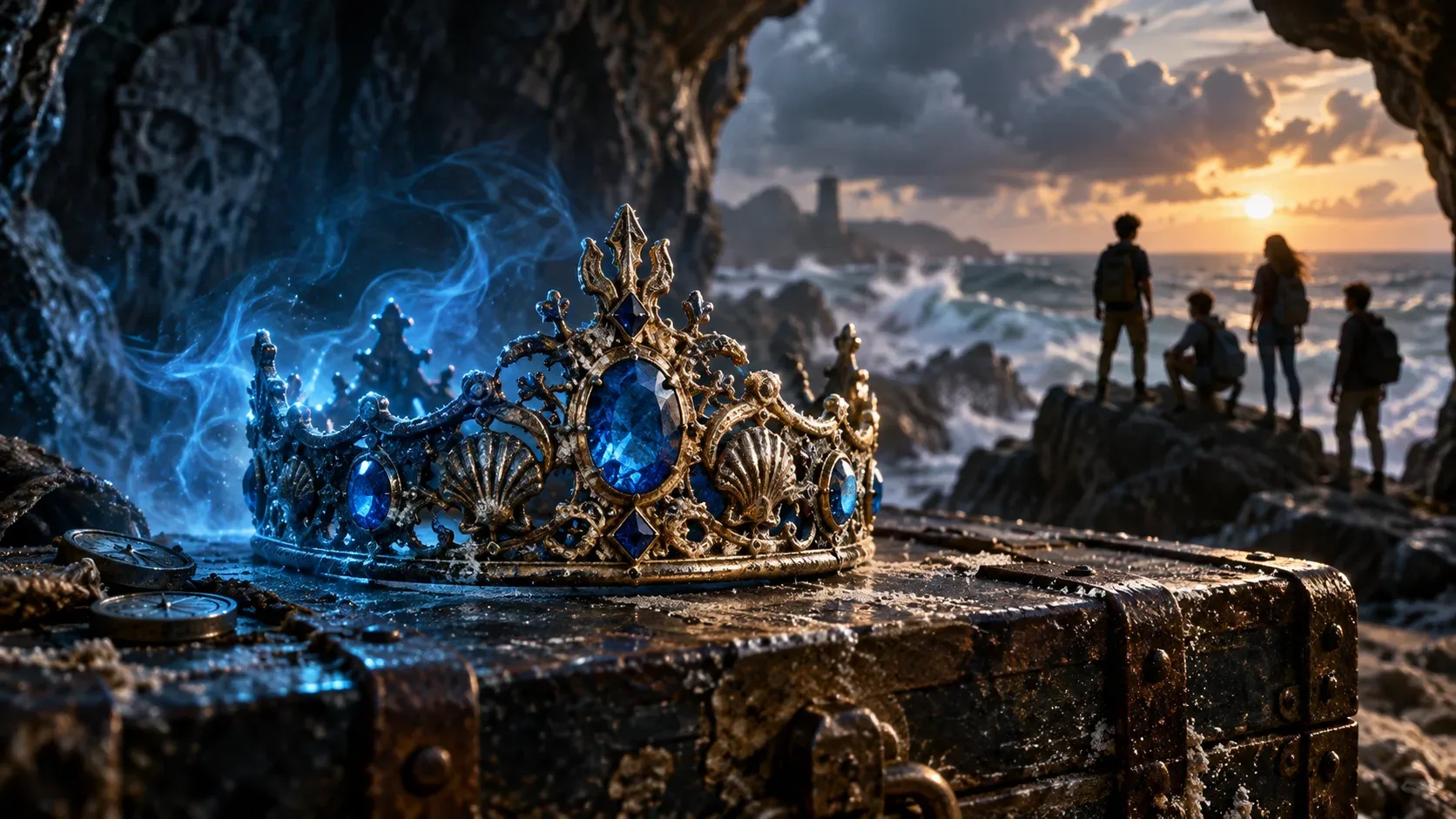
Spoiler warning: this article discusses the Blue Crown scene in Episode 9 of Season 5 and what Episode 10 confirms about JJ's fate.
The Blue Crown is not objectively confirmed to be magical at the end of Outer Banks. Episode 9 is built to support two readings at once: a supernatural one, in which the artifact really triggers an extraordinary experience, and a symbolic one, in which the meteors, light, and memories represent the moment Kiara begins to accept JJ's death. Netflix's own ending explainer says the creators do not settle the issue: Jonas Pate reads the scene without magic, while Shannon Burke allows for the possibility that something magical happened.
The short answer: the Crown does not bring JJ back, but the scene leaves magic open
The key is to separate two questions. First: Does JJ come back to life? No. Second: Does the Blue Crown produce any supernatural effect? The series does not give a definitive answer.
In Netflix Tudum's official ending explainer, Kiara takes the Blue Crown from Finch and runs to the prophesied lake in Azerbaijan. During the meteor shower, she recites the Crown's incantation and asks for JJ to return. At first, nothing happens. Then a shooting star appears to draw closer, white light washes over her, and a montage of memories of JJ begins.
That sequence is the center of the ambiguity. There is an extraordinary visual event, but the concrete result is not a resurrected body: it is an experience of memory and grief.
What Episode 9 actually shows, step by step
- Kiara gets the Blue Crown after confronting Finch, the leader of the Corsairs.
- She reaches the lake tied to the prophecy and waits for the meteor shower.
- Kiara repeats the Crown's invocation and asks JJ to come back to life.
- For a moment, nothing happens, making the attempt appear to have failed.
- A shooting star becomes intensely bright and Kiara is bathed in white light.
- The scene shifts into memories of JJ, including moments from childhood and his recent life with the Pogues.
- Within those memories, the idea of letting go of painful things repeats and leads Kiara toward an emotional shift.
- JJ does not reappear physically. Finch and the Corsairs later recover the Crown.
The montage does not prove that the Crown is merely an ordinary object, but it also does not show the kind of miracle Kiara was seeking. She wanted JJ back literally; what she receives is an experience that helps her say goodbye.
Supernatural reading: what supports the idea that magic happened
The supernatural interpretation rests mainly on the timing between the ritual and what follows. The light appears immediately after the invocation, at the location specified by the prophecy and during the expected celestial event. Dramatically, the series links cause and effect strongly enough to make the viewer wonder whether the Crown answered.
The nature of the memories is another clue. The montage is not presented as Kiara casually thinking about JJ; it arrives at the peak of the ritual and carries a very specific emotional message, almost as if the experience gives Kiara what she needs even though it is not what she asked for.
The Crown's mythology also has always been built around extraordinary rumors and beliefs. In Netflix's official pre-Season 5 recap, the artifact is associated with stories about wishes and invincibility; in the final arc, there is also a belief that it can bring back the dead. The show therefore prepares the object to be read as something that may go beyond the material.
Under this reading, the magic may have worked indirectly: not by restoring JJ's body, but by giving Kiara a kind of encounter, revelation, or catharsis. That is an interpretation, not a fact confirmed by the episode.
Symbolic reading: why the scene also works without magic
The symbolic reading has equally strong narrative support. The meteor shower already provides a natural explanation for the intense light, and the montage can be understood as Kiara's mind organizing memories at a moment of extreme emotion, expectation, and disappointment.
The memories themselves also point toward grief rather than a supernatural rule of the Crown. The focus is not on revealing a secret about the artifact or showing JJ acting in the present. The focus is on Kiara reinterpreting what she lived through with him and accepting that those experiences still matter even though she cannot bring him back.
The creators' explanation reinforces that emotional axis. Burke describes the scene as a progression in Kiara's mourning: JJ does not return in physical form, and what changes is how Kiara carries the loss. The broader ending likewise treats JJ's death as a real and lasting loss. Nothing in the finale therefore requires the viewer to accept magic in order to understand Kiara's transformation.
Two readings of the same clues
| Element in the scene | Supernatural reading | Symbolic reading |
|---|---|---|
| Ritual at the lake and meteor shower | The prophecy's conditions are fulfilled and activate the Crown. | The ritual creates the emotional context; the celestial event was already expected. |
| White light after the invocation | It may be the manifestation of a supernatural response. | It may be meteor light heightened by the show's visual language. |
| Memories of JJ | The Crown allows an experience of contact or revelation. | Kiara accesses memories that help her process grief. |
| JJ does not return physically | Magic may have worked differently, offering peace instead of resurrection. | It is the strongest evidence that the Crown's literal promise is not fulfilled. |
| Creators disagree | The story is intentionally open to a supernatural possibility. | The ambiguity prevents magic from becoming confirmed canon. |
Why the creators leave the answer open
The disagreement between Shannon Burke and Jonas Pate matters because it shows the ambiguity is not simply a fan theory. It is built into the scene itself. According to Netflix Tudum, Jonas Pate would take the view that there is no magic, while Burke would say there was.
That choice protects two functions at once. First, it keeps the Crown mysterious. A mechanical answer — “it works” or “it does not” — would reduce the artifact to a fantasy rule. Second, it preserves the emotional consequence of JJ's death. If the series truly resurrected him, the grief driving Kiara and the Pogues would lose weight.
The scene therefore moves right up to the edge of the supernatural without crossing it in a verifiable way. Viewers can believe the Crown caused something real, or they can read the experience as a visual representation of Kiara's acceptance.
What Episode 10 resolves — and what remains unanswered
Episode 10 rules out the idea that the Crown accomplished the literal resurrection Kiara asked for. JJ does not return to life, and the story continues to treat his death as final. Kiara is able to move forward, and the ending places her on a path toward marine biology, signaling that her arc is no longer dominated by trying to recover what she lost.
What remains open is the source of the experience at the lake. The episode offers no external proof that the Crown caused the light or the memories, but it also offers no proof that everything happened only inside Kiara's mind. Because Finch takes the artifact away, the series also avoids a repeatable test that could turn the legend into a confirmed rule.
So was the Blue Crown magical at the end of Outer Banks?
The most precise answer is: the series leaves the possibility of magic open, but does not confirm it as fact. Episode 9 shows an extraordinary event immediately after the ritual, yet the effect that is narratively proven is Kiara's change in relation to grief. JJ does not come back, and the creators themselves allow different interpretations.
If you adopt the supernatural reading, the Crown may have granted Kiara not the literal wish she made, but what she needed in order to move forward. If you prefer the symbolic reading, the same scene works as a poetic representation of memory, farewell, and acceptance. Both readings fit what the series shows — and that is precisely the margin of ambiguity the ending preserves.