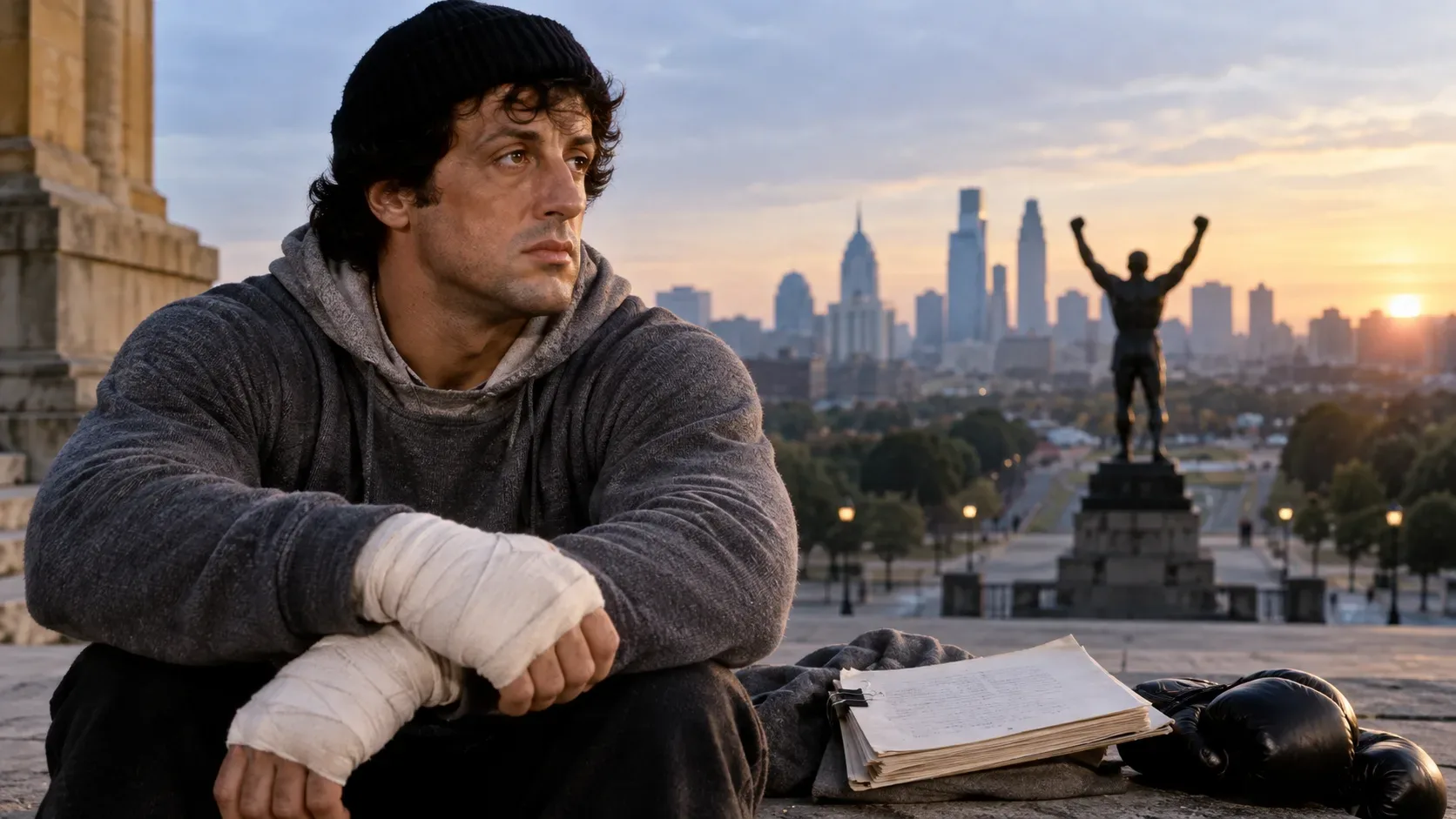
Short answer: Sylvester Stallone really did make the sale of Rocky conditional on being allowed to play the lead, and he turned down six-figure offers when buyers wanted the script without him as the star. But the story was not one giant ultimatum followed by an instant studio surrender. The deal moved forward because producers Irwin Winkler and Robert Chartoff backed Stallone, restructured the project as a low-budget film, and took on contractual risk to keep the unknown actor in the lead role.
I Play Rocky, directed by Peter Farrelly and starring Anthony Ippolito as a young Stallone, dramatizes that period. The film premiered at the Toronto International Film Festival in September 2026 and is scheduled for a U.S. theatrical release by Amazon MGM Studios beginning in November. Its premise is true, but some negotiation details, characters, and scenes have been compressed or created for storytelling. That distinction matters because the episode has circulated for decades in versions with different dollar figures and dialogue.
What is well documented about Stallone's refusal
The historical core is solid. The AFI Catalog, drawing on contemporary reports and later accounts, records that Stallone was determined to play Rocky Balboa and that United Artists and other companies were interested in the screenplay. The problem was not a lack of buyers: it was resistance to putting a little-known actor at the center of the movie.
- AFI cites a 1976 report saying offers reached $275,000 for the rights, and Stallone refused because he required the lead role.
- In a retrospective written by the producers themselves for Vanity Fair, Winkler and Chartoff recalled a $250,000 offer that would have put another actor in the film.
- An account published in 1977 reproduced Stallone's memory of proposals moving through $100,000 and $180,000 and of an outside offer close to $300,000.
Those differences are a useful warning: the safe conclusion is that Stallone rejected substantial six-figure proposals to preserve the condition that he star. Treating one dollar amount as definitive requires caution.
Timeline: from the idea to the film that got made
| Period | What happened | Why it matters |
|---|---|---|
| March 24, 1975 | Muhammad Ali fought Chuck Wepner. In a 1976 interview cited by AFI, Stallone connected the bout to ideas about frustrated ambition and opportunity that fed into the screenplay. | The fight belongs to one historical version of Rocky's origin, although Stallone gave different accounts in later years. |
| 1975 | Stallone developed the screenplay. AFI records that an initial draft was written in about three and a half days and was followed by additional versions. | The famous “three and a half days” refers to the first draft, not necessarily the final shooting script. |
| 1975 | Winkler and Chartoff became interested in the material, while United Artists preferred an established star for the lead. | The conflict was not “nobody wants Rocky”; it was “we want Rocky, but not with Stallone as the star.” |
| Late 1975 | Stallone held to his demand to play Rocky while the financial offers rose. | The screenplay negotiation became a negotiation over casting and creative control as well. |
| Early 1976 | Winkler and Chartoff made the project workable as a roughly $1 million production and guaranteed completion, preserving Stallone in the role. | The decisive compromise was to reduce and contain the financial risk, not to convince the studio that Stallone had suddenly become a safe bet. |
| 1976 | The movie was shot quickly; the producers later recalled a 28-day shoot. | The tight budget and schedule were part of the price of keeping the desired creative configuration. |
| 1977 | Rocky won Academy Awards for Best Picture, Directing, and Film Editing. Stallone was also nominated as an actor and screenwriter. | The later success turned a risky negotiation into one of Hollywood's best-known stories of creative conviction. |
How the United Artists deal actually became possible
A detail often lost in shortened versions is the producers' contract. According to the AFI production record, Winkler and Chartoff had a provision in their United Artists deal that allowed them to make a project of their choice under a specified budget ceiling. When the studio proposed a higher budget, the producers countered with a plan of about $1 million and agreed to guarantee the film's completion.
That mechanism explains why “Stallone refused the money until the studio gave in” is incomplete. His insistence was necessary, but it was not sufficient. Winkler and Chartoff had to turn that insistence into a production structure that limited United Artists' financial exposure. Director John G. Avildsen was also hired in part because of his ability to work within the budget and accepted Stallone as the lead.
In other words, Stallone won the argument over the role by accepting, with the producers, that Rocky would be treated as a cheap, tightly controlled gamble rather than a major studio vehicle.
What I Play Rocky simplifies or dramatizes
| Point | Historical record | How to read it in the new film |
|---|---|---|
| Highest offer for the screenplay | Reliable sources differ: $250,000, $275,000, and accounts close to $300,000 appear in different records. | The escalation to $350,000 described in coverage of the film is better treated as dramatization than as a settled historical figure. |
| How the script reaches the producers | Winkler and Chartoff recalled Stallone telling them his fighter idea and asking for a promise that they would read the script once he wrote it. | A scene in which he quietly slips the script into a reading pile compresses and visualizes a less cinematic process. |
| The studio executive | The negotiation involved multiple United Artists executives and interests. | Variety identifies “Sandy Maddox” as a composite character based on executives from the period. |
| Chuck Wepner as the direct inspiration | AFI cites a 1976 interview in which Stallone connected the Ali-Wepner fight to the birth of the screenplay; later statements attributed to him disputed such a direct link. | The movie selects a clear, dramatic version of an origin story that Stallone himself described differently over time. |
| “Stallone versus Hollywood” | Stallone resisted, but he had crucial allies in Winkler and Chartoff, who negotiated the financial structure and guaranteed completion. | Making it an individual battle simplifies the story but hides part of the mechanism that actually got the movie made. |
Four myths worth avoiding
- “Nobody wanted the screenplay.” There was interest. The main dispute was whether Stallone would be accepted as the star.
- “There is one uncontested dollar amount that he rejected.” There is not. The records vary, although they consistently support six-figure offers.
- “After one refusal, the studio simply gave in.” The solution involved a lower budget, the producers' contractual provision, and a completion guarantee.
- “Stallone financed Rocky by himself.” He did not. Winkler and Chartoff produced the film within their relationship with United Artists; the added risk came from the producers' completion guarantee, not from Stallone bankrolling the entire movie.
Why the Wepner story needs extra care
The March 24, 1975 fight between Muhammad Ali and Chuck Wepner became a central part of the Rocky origin mythology. AFI reproduces a 1976 New York Times interview in which Stallone described the fight as a trigger for thinking about stifled ambition and broken dreams. Decades later, however, Stallone disputed accounts that present Wepner as Rocky Balboa's direct inspiration.
That does not allow one statement simply to erase the other. The most precise formulation is that there is contemporary documentation linking the fight to the creative process, while Stallone's later characterization of the influence changed. I Play Rocky turns that ambiguity into a clean origin scene—an understandable choice for a biographical drama, but not definitive historical proof.
What the new film gets right at the core
Even with compression, the central line of I Play Rocky matches the main records: Stallone was an actor without the market power of the names the studio considered; he wrote a screenplay that attracted interest; he tied the sale to the demand that he play Rocky; he turned down meaningful money; and production became possible only because the producers found a way to reduce the financial risk.
Reuters, covering the new film's TIFF premiere, summarized the same core point: Stallone would not sell the screenplay if he could not take the lead. The official Amazon MGM Studios page presents the movie as the story of an unknown actor who insists on writing and starring in Rocky. That is a fair summary of the central fact as long as viewers do not mistake every negotiation scene for a literal transcript.
Conclusion: what really happened
Stallone staked his professional breakthrough on the condition that he play Rocky Balboa. He rejected financially tempting proposals because selling only the screenplay would defeat the purpose that had led him to write it. But the outcome depended on more than stubbornness: Winkler and Chartoff used their contractual position, accepted a reduced budget, and guaranteed completion to make the risk acceptable to United Artists.
That is where the real story becomes more interesting than the myth. It was not simply “an unknown actor said no to a fortune and won.” It was a negotiation in which creative conviction, the right allies, a budget ceiling, and risk transfer combined. I Play Rocky turns that process into a cinematic story; the historical record shows why it worked.
Main sources
- AFI Catalog — Rocky: compiles contemporary and retrospective records on the screenplay, offers, casting, and production.
- Vanity Fair — Robert Chartoff and Irwin Winkler's account: the producers' version of meeting Stallone, the offer, and the completion guarantee.
- Academy Awards — 1977 ceremony: confirms Rocky's wins and Stallone's nominations.
- Reuters — I Play Rocky at TIFF: current context on the film and its historical premise.
- Amazon MGM Studios — official I Play Rocky page: synopsis, cast, and release window.