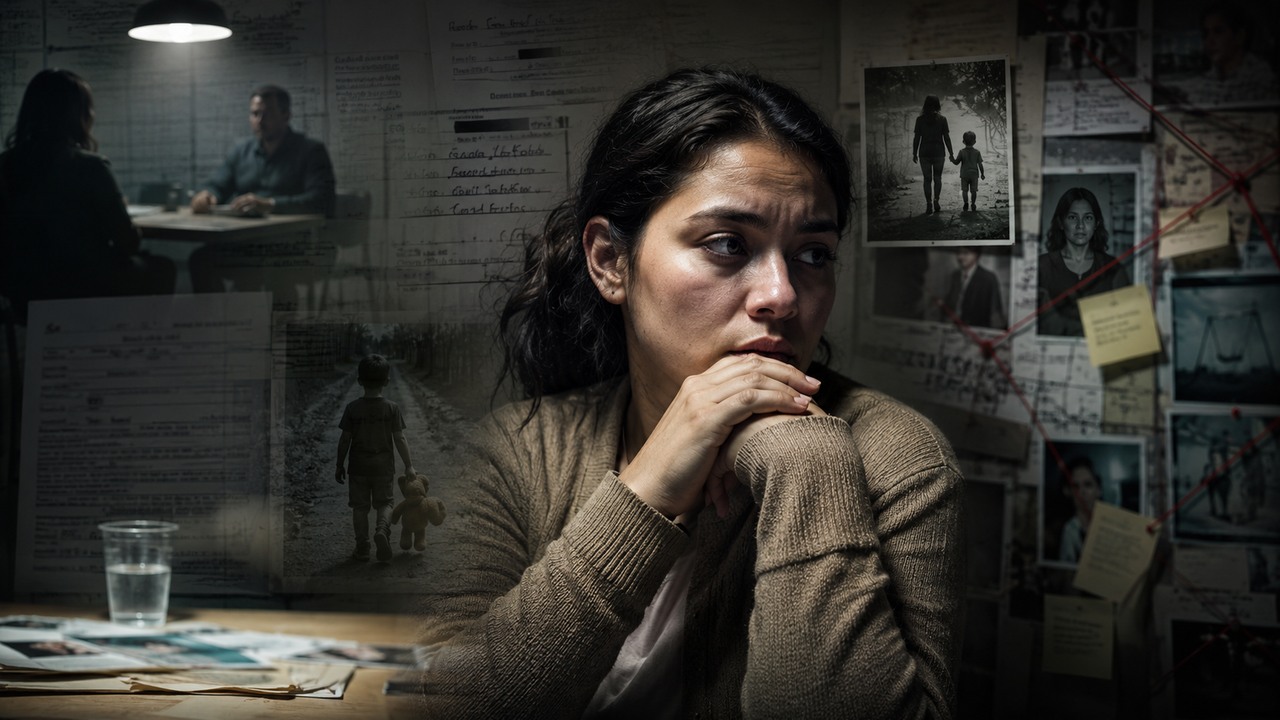
This text contains spoilers for My Own Son. The main key to understanding the documentary is realizing that it does not present all the evidence at once. In the first half, the viewer follows a staged reconstruction of the story as Eleonor Alejandra Marín Mendoza told it to director Maite Alberdi. Only then do real people, archive images, case records and versions that contradict important points of the initial report come into play.
This structure changes the question. It's not enough to know if the case happened: it happened. The question is to separate what is documented, what depends on Alejandra's testimony and what was created by the film to give visual form to the subjective experience she says she lived.
The core of the 2009 case is well documented
On June 17, 2009, Alejandra was 26 years old and worked at the Hospital General de México, in Mexico City. A report published by El Universal two days later noted that she had been an employee of the hospital since 2002 and had previously worked in obstetrics. That day, he entered the hospital and left hours later carrying a newborn baby who was not his daughter.
The same contemporary report described images from the internal circuit. Alejandra was recorded entering in the morning with a department store bag and reappeared later in the afternoon carrying the same bag. The investigation concluded that the baby was inside her. The child had disappeared while the mother was away for a short time.
The location was also not restricted to the memory of those involved. Authorities arrived at a hotel after tracing phone contacts linked to Alejandra's family. She and her husband, Arturo Calderón Gamiño, were found at dawn, and the newborn was recovered alive and returned to her parents.
This set is important because it delimits what does not depend on the interpretation of the documentary. There was a false pregnancy sustained for months, a newborn was removed from the hospital, there was a police search, location a few hours later and return of the child to the family.
Alejandra's version begins before the baby's delivery
My Own Son goes back several years in Alejandra's life because the director wants to explain how she herself organized the story. The film presents successive pregnancy losses, the desire to be a mother and the pressure she said she felt from her husband and his family. After a new loss, Alejandra did not say that the pregnancy had ended and began to maintain the appearance that she was still pregnant.
The existence of fake pregnancy is not an invention of the film. It already appeared in reports from 2009. What belongs mainly to the field of testimony are the internal reasons, the degree of family pressure, the way Alejandra describes her own mental state and the intimate sequence of decisions that, according to her, made the lie increasingly difficult to interrupt.
This is precisely where the documentary chooses not to begin as a traditional investigation. Instead of opening with the police, the victim or the press archive, he enacts the reality that Alejandra said she saw. Ana Celeste Montalvo plays Alejandra, Armando Espitia plays Arturo and the narrative takes on an appearance of drama, almost as if the camera were inside the protagonist's memory.
The supposed agreement with Mayra is the biggest divergence
The most important breaking point is the relationship between Alejandra and Mayra Navarro Vega, the newborn's biological mother. Alejandra stated since 2009 that she had met Mayra months before and that there was an understanding for her to keep the baby after birth.
This version was recorded in the contemporary coverage of El Universal. At the time, Alejandra said that she had spoken to the pregnant woman approximately five months earlier and that the woman had expressed her intention not to keep the child. The baby's family denied this story from the beginning.
In the documentary, Mayra also rejects the existence of any agreement. According to her report, she did not previously know Alejandra in the way she described. Mayra states that she found Alejandra in the hospital after giving birth, believing she was an employee, and that she left for a short time; When he returned, his daughter had already disappeared.
This conflict is not a peripheral detail. If there was a previous agreement, Alejandra's narrative about how she reached the moment of withdrawal changes profoundly. If there wasn't, the scene stops being the chaotic outcome of an informal promise and becomes a subtraction planned without the mother's consent. The documentary does not hide this difference: it places it at the center of the second half.
Why the first half looks like a fiction film
Netflix itself describes My Own Son as a documentary that uses a hybrid form. In editorial material about the launch, Maite Alberdi explains that the staged scenes were not designed to reconstruct neutral facts. The intention was to reconstruct a point of view.
This helps you understand why the first half can seem so convincing. The script relies mainly on Alejandra's interviews, and the direction transforms this report into images, environments and situations interpreted by actors. The viewer first receives an organized, emotionally continuous and visually seductive version. Only later do you discover which parts of this continuity are contested.
The effect is deliberate, but it does not mean that everything shown before is false. The film mixes corroborated elements, personal memories and scenes constructed to represent emotions or situations that no camera recorded. The trap for the public is to treat all of these levels as if they had the same probative value.
The moment when documentaries change their rules
In the second half, the language changes. Enter the real Alejandra, Arturo, Mayra, professionals linked to the case, archive images and documents. Netflix reports that the film now features court records and testimony that challenge parts of the story the viewer has just seen dramatized.
The change works almost like a revision of the act of watching itself. The scene that seemed like a memory might just be one person's version. An apparently decisive dialogue may represent something that only one of those involved claims to have happened. The presence of actors is no longer invisible and becomes part of the film's argument about memory, narrative and truth.
Reuters summarized this cartoon by noting that the work begins with actors playing Alejandra, Arturo and their families and then switches to the real people and the facts of the case. Alberdi told the agency that what interested her was not just the kidnapping reported in 2009, but the previous question: why would a person sustain the false appearance of a pregnancy for months.
What can be treated as documented fact
As a documented fact, it is possible to state that Alejandra was an employee at the Hospital General de México, faked a pregnancy, was at the hospital on June 17, 2009 and left carrying a newborn baby who was not her daughter. The internal circuit helped identify her. The baby was located a few hours later in a hotel, was alive and returned to her parents.
It is also established that Alejandra was prosecuted and remained in prison for more than 13 years. Official Netflix material reports a sentence served of approximately 13 years and four months. The film was made during the last years of this period and records Alejandra herself talking about the case.
Another documentable point is that the allegation of an agreement with the baby's mother did not only appear many years later. She was already part of Alejandra's public defense right after her arrest, and Mayra was already denying her at that moment. The conflict, therefore, was not created to give suspense to the 2026 film.
What remains in the field of testimony
The intensity of family pressure, specific phrases attributed to relatives, the way Alejandra interpreted pregnancy losses and the way she describes the progression of the lie are elements that depend mainly on testimonies. They can be relevant and coherent without automatically becoming independent facts.
The same goes for the statement that Mayra agreed to hand over the child. This is an allegation made by Alejandra, contested by Mayra herself and not treated by the documentary as a point resolved in favor of the protagonist.
Arturo's position also requires care. He maintains that he did not know the pregnancy was false before Alejandra appeared with the newborn. Current reports about the film record that he was detained during the investigation and later acquitted of participation. This does not automatically turn your every memory into evidence of other episodes, but it differentiates your legal situation from Alejandra's.
What is dramatization
Dramatization is the staging with actors of what the film wants to make visible. The wedding, everyday family life, private conversations, the baby shower and several moments of the supposed negotiation surrounding the child appear as complete scenes because they were reconstructed for the camera.
These scenes may have been inspired by testimonies and verifiable elements, but they are not documentary images of the events. The distinction seems obvious when you know the method, but the film works precisely so that, for a while, this boundary becomes emotionally less clear.
This is not about accusing the documentary of inventing a crime or a character. It is about recognizing that the first part is a cinematic way of making Alejandra's subjectivity convincing before showing why this subjectivity is not enough to establish what happened between all the people involved.
What the work supports and what it fails to prove
My Own Son strongly maintains that the case does not fit into the sensationalist summary of a woman who pretended to be pregnant and left a hospital with a baby. The previous trajectory, the losses, the expectation of motherhood and the social environment help to explain why Alberdi decided to look beyond the moment of the crime.
But explaining context is not proving causality. The documentary fails to demonstrate that family pressure alone was the cause of Alejandra's decision. It also does not transform personal suffering into consent from the child's mother, nor does it replace the case records with a later psychological reading.
This is an essential difference to watch the second half without falling into the opposite extreme. When the film reveals contradictions, the response need not be to conclude that the entire first part was a useless lie. It was the story according to Alejandra, dramatized so that the audience felt the strength of this version. The problem only begins when point of view is confused with proof.
The best way to read the ending of My Own Son
After the documentary turns, three layers become easier to separate. There are events confirmed by records from the time and by investigation. There are testimonies from people who experienced the case and who disagree with each other. And there is a cinematic construction created to flesh out these memories, even when they cannot be independently verified.
The biggest divergence continues to be the supposed agreement with Mayra. The existence of the false pregnancy and the removal of the baby are facts. The justification that the child would be handed over voluntarily is an allegation by Alejandra that Mayra denies. The film places this collision before the viewer and does not offer a document that definitively eliminates the difference between the two accounts.
Therefore, My Own Son's gain is less in revealing a secret fact and more in showing how a narrative can seem complete when we listen to just one person. The first half asks for empathy; the second requires verification. Together, they remind us that understanding the pressures and humanity of those who committed a crime does not force the public to accept every part of their version as true, nor to remove the victim from the story.