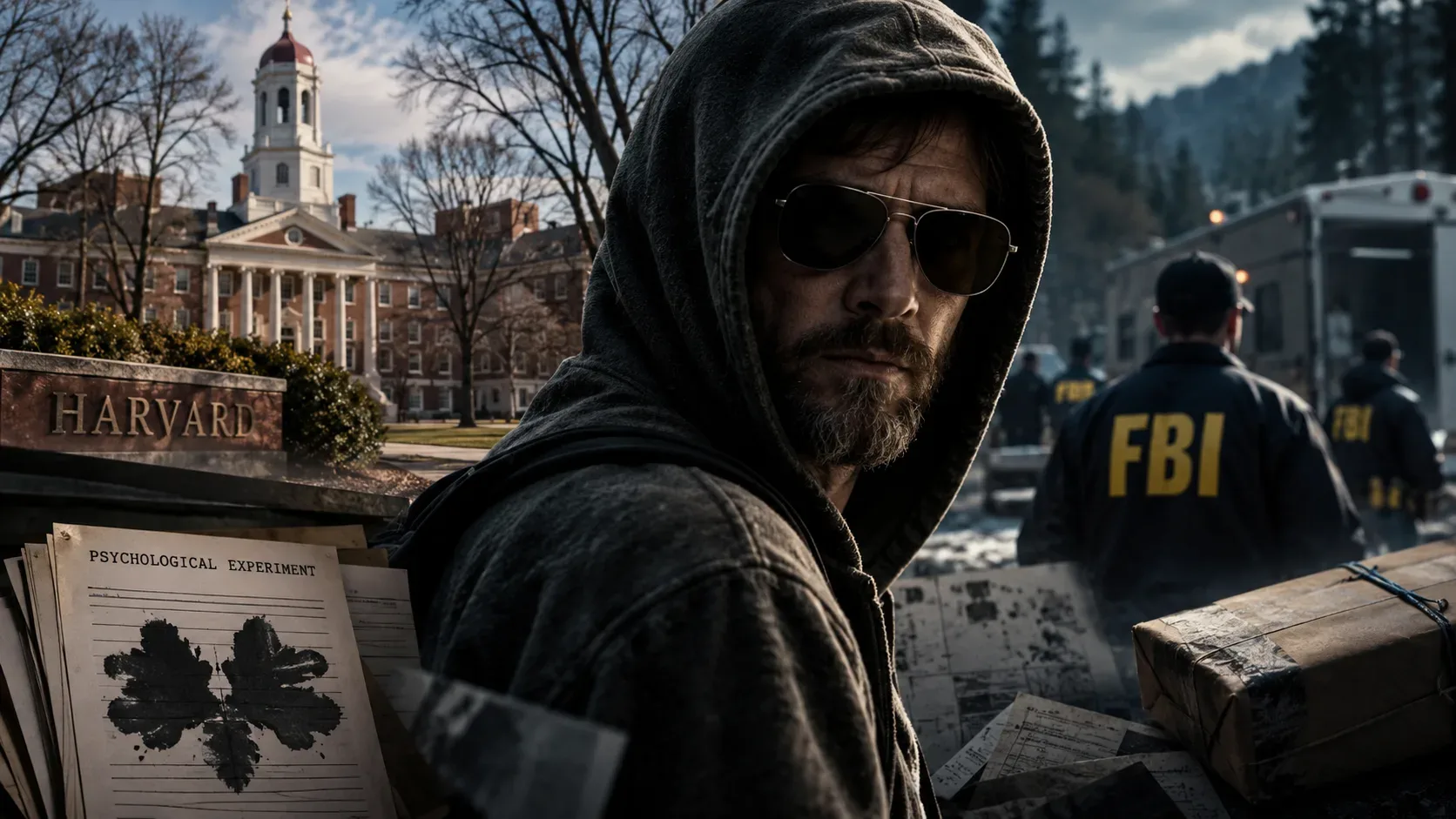
UNABOMBER, Netflix’s new drama inspired by true events, arrives on September 25, 2026 with a structure that alternates between two periods: Ted Kaczynski’s youth at Harvard and the investigation that, decades later, led to the Unabomber’s identification and arrest. That structure draws on documented history, but it should not be mistaken for a literal reconstruction. Netflix’s own promotional material describes the film as “inspired by true events,” not as a documentary.
The most sensitive issue is the relationship between Kaczynski and the experiments conducted by psychologist Henry A. Murray. The young student’s participation in those studies is documented. The idea that the tests explain or caused his later transformation into a terrorist, however, remains an interpretation without an established causal basis. The FBI storyline also contains clear dramatic compression, including a fictional agent created to organize a sprawling investigation around one central character.
What Netflix has confirmed about the film
According to Netflix Tudum, Jacob Tremblay plays the young Ted Kaczynski, Russell Crowe plays Henry Murray, Shailene Woodley portrays FBI agent Joanne Miller, and Annabelle Wallis appears as Christiana Morgan. The film is directed by Janus Metz and reaches Netflix on September 25, 2026.
The announced narrative cross-cuts between two timelines. In one, Kaczynski arrives at Harvard as a teenager, struggles to fit in, and takes part in psychological experiments associated with Murray. In the other, the film follows the hunt for the Unabomber in the 1990s. This lets the screenplay place “formation” and “capture” side by side, but it also creates a risk: treating chronological proximity as proof of causation.
What is documented about Kaczynski at Harvard
He entered Harvard at age 16
Kaczynski’s attendance at Harvard is not an invention of the film. An updated account from HISTORY states that he entered Harvard in 1958 at age 16. The FBI’s own retrospective also describes him as a brilliant mathematician who started at Harvard at that age before moving on to graduate study and teaching.
He participated in a study directed by Henry Murray
In 1959, Kaczynski began participating in a study led by Henry A. Murray. Reporting based on Harvard records describes the project as Multiform Assessments of Personality Development Among Gifted College Men, involving 22 undergraduates over roughly three years. The Harvard Crimson reported that the study consumed hundreds of hours of participants’ time and included personality testing as well as sessions of intense psychological pressure.
HISTORY describes a phase in which students wrote essays laying out their worldview and were later confronted in adversarial sessions involving bright lights, recording equipment, and verbal attacks on ideas taken from those essays. Henry Murray was a real historical figure: Harvard University documents his career in psychology and his earlier government work during World War II.
What the film dramatizes or compresses
Joanne Miller does not represent a single historical investigator
Netflix introduces Joanne Miller, played by Shailene Woodley, as the FBI agent tasked with hunting the Unabomber. Release coverage such as Decider identifies Joanne as a fictional composite based on real investigators. That matters because the historical investigation was not the work of one agent.
The FBI’s official history describes a long, multi-agency operation. The first bombing attributed to Kaczynski occurred in 1978; in 1979 a task force was formed involving the FBI, ATF, and U.S. Postal Inspection Service. The case moved decisively after the manifesto was published in 1995, when family members recognized similarities between the text and Ted’s writings. Linguistic analysis and other evidence supported the search warrant that led to his arrest on April 3, 1996.
So if the film shows Joanne connecting clues, interpreting the manifesto, or driving key investigative moments, viewers should understand that storyline as a dramatic synthesis of work distributed across many investigators, analysts, relatives, and institutions.
The Murray-Kaczynski relationship is also filtered through the screenplay
Murray’s existence and Kaczynski’s participation in his study are documented facts. Private conversations, specific manipulation scenes, precise motives, and the intensity of a personal professor-student relationship require dramatic reconstruction. Netflix’s trailer and supporting copy describe a “twisted” relationship and “devastating results” from the experiments; that language reflects the film’s framing, not a settled historical conclusion.
The controversial question: did the Harvard experiment “create” the Unabomber?
There is no secure basis for stating that as fact. The HISTORY article, updated in September 2026, explicitly says there is no established causal connection between Kaczynski’s participation in the study and his later crimes. The experiment matters to his biography and to the ethical history of psychology, but biographical relevance is not the same as causation.
A second caution is also necessary. Henry Murray had historical links to psychological assessment and government work during World War II, which has fueled decades of speculation about intelligence programs. But the Harvard Crimson noted that although there was speculation about LSD and continuity with intelligence research, there was no evidence that LSD was part of the study involving Kaczynski. Claims such as “Kaczynski was subjected to MKUltra” or “he was given LSD at Harvard” therefore should not be treated as confirmed facts without additional specific documentation.
Documented, announced dramatization, or disputed?
| Element | Status before release | How to read it |
|---|---|---|
| Kaczynski entered Harvard at age 16 | Documented | Biographical fact supported by historical sources. |
| Participation in Henry Murray’s study | Documented | Supported by records and reporting based on Harvard archives. |
| Psychological-pressure sessions and attacks on beliefs | Documented in broad terms | The method is described by historical sources; exact film scenes and dialogue are dramatized. |
| The experiment caused his later crimes | Disputed | No established causal relationship. |
| Joanne Miller led the real investigation | Dramatization | The character is fictional/composite; the real investigation was multi-agency. |
| Publication of the manifesto helped identify Kaczynski | Documented | The FBI records the role of family recognition and linguistic analysis. |
| Kaczynski received LSD in Murray’s study | Unproven | There is historical speculation, but no established evidence for Kaczynski’s study. |
A factual timeline to keep in mind while watching
- 1958: Kaczynski enters Harvard at age 16.
- 1959–1962: he participates in the study directed by Henry Murray.
- 1978: the first bombing attributed to the Unabomber occurs.
- 1979: the UNABOM task force is formed, bringing together the FBI and partner agencies.
- 1995: the manifesto is published; relatives recognize similarities to Ted Kaczynski’s writing.
- April 3, 1996: Kaczynski is arrested at his cabin in Montana.
- September 25, 2026: UNABOMBER premieres on Netflix.
What to watch for once the film is released
The most useful fact-checking question is not whether “everything happened,” but which layer each scene belongs to. Harvard, Murray, the study, the long FBI hunt, the manifesto, and the arrest belong to the historical record. Joanne Miller and the concentration of investigative decisions in one protagonist belong to adaptation. The thesis that the experiments produced the Unabomber is a narrative interpretation that requires caution.
After release, the comparison can become scene-specific: what the film attributes to Murray, how much it compresses the investigation, how it depicts Kaczynski’s family contribution, what role it gives linguistic analysis, and whether it turns a psychological hypothesis into a definitive explanation. Before September 25, the responsible limit is clear: separate what historical sources support from what Netflix’s campaign has announced as dramatization.
Main sources
- Netflix Tudum — trailer and narrative structure
- Netflix Tudum — cast, release date, and characters
- FBI — official history of the UNABOM case
- Harvard University — historical profile of Henry Murray
- HISTORY — the Harvard experiment and causation debate
- Harvard Crimson — records and controversies surrounding the study