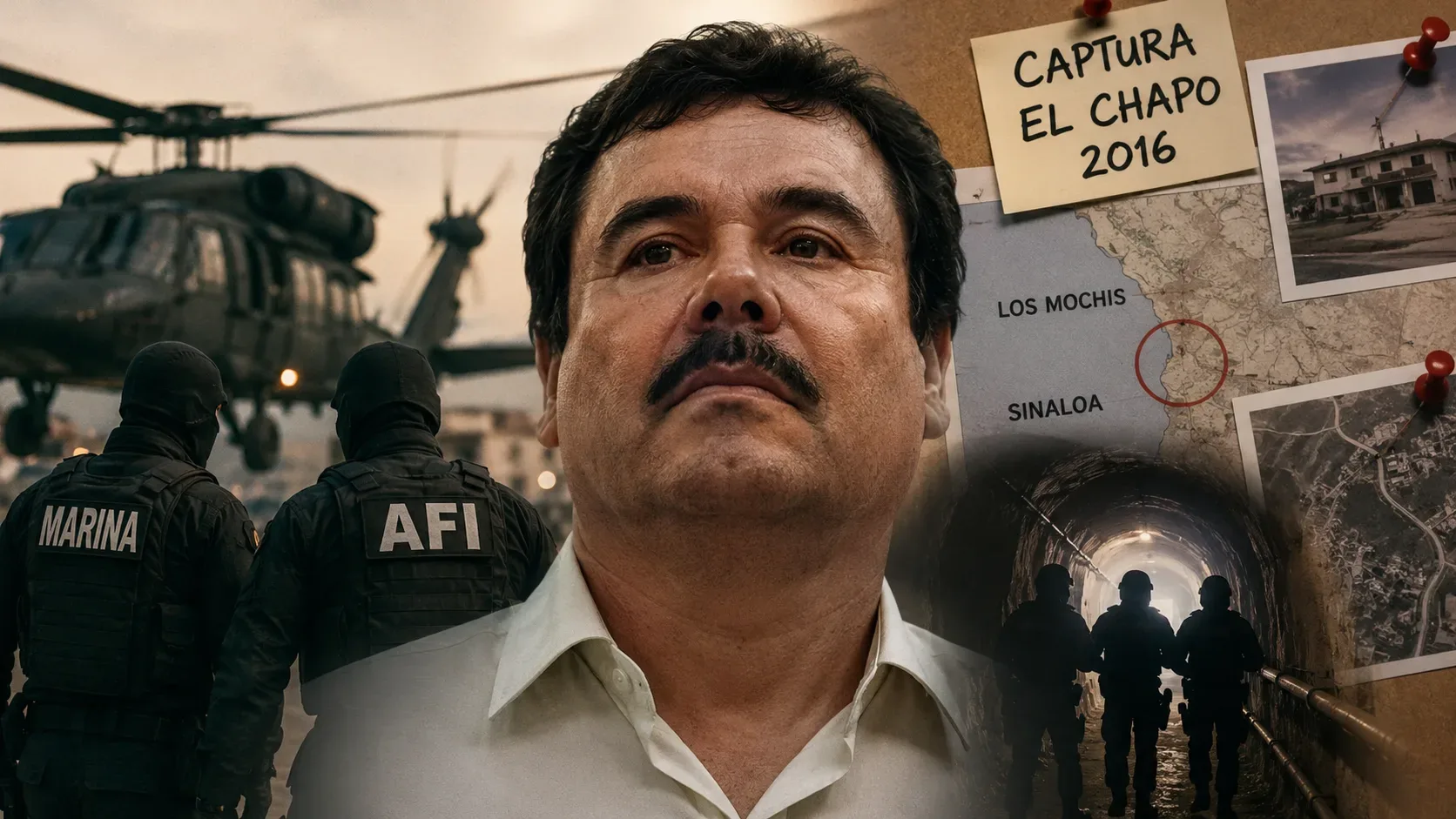
Yes: the core of Facing El Chapo is real. Joaquín “El Chapo” Guzmán was recaptured in Los Mochis, Sinaloa, on January 8, 2016 after escaping from a house surrounded by Mexican forces, moving through the sewer system, taking vehicles, and ultimately being detained by federal police officers. What should not be read as a literal record are the officers’ names, the dialogue, the protagonists’ private lives, the exact size of the bribe, and some simplifications involving timing and the number of officers present.
That distinction became especially relevant after the film debuted at the top of Netflix’s global non-English film list with 18 million views for the week of August 17–23, 2026 and ranked No. 2 among films in Brazil for the same period, according to Netflix’s own rankings. Its popularity revived a simple question: how much of the thriller is history, and how much is dramatic construction?
Short answer: the capture is real; Arturo Carmona and Héctor Rosales are not confirmed identities
Netflix presents Arturo Carmona, played by Alfonso Herrera, and Héctor Rosales, played by Noé Hernández, as the two officers who stop the vehicle and face the movie’s central dilemma. But Netflix’s own Tudum explanation of Facing El Chapo says that the real officers’ names have never been made public and that the film dramatizes the events.
That matches the 2016 record. Days after the capture, then-National Security Commissioner Renato Sales said the officers’ identities would be protected and that they would be safeguarded and decorated. Therefore, Arturo Carmona and Héctor Rosales should be treated as fictionalized screen identities, not as a disclosure of the real officers’ names.
What happened on January 8, 2016: the documented timeline
1. The operation began at a house in Los Mochis
In the early hours of January 8, Mexican Marines went to an address in Los Mochis after receiving a report of armed people there. A Mexican Navy statement said the Marines were fired upon, returned fire, and that the clash left five assailants dead, six people detained, and one Marine wounded but out of danger. The statement also said that “Orso Ivan Gastelum Cruz,” then identified as a criminal leader in the region, had escaped.
Later U.S. documents identify that man as Jorge Iván Gastélum Ávila, known as “Cholo Iván”, a high-ranking Sinaloa Cartel member who worked closely with Guzmán. The U.S. Department of Justice records that the two men were arrested together in Los Mochis while trying to flee.
2. El Chapo escaped the house and entered the sewer system
Guzmán was not simply captured inside the property. A 2017 U.S. Department of Justice detention memorandum summarizes that Mexican forces raided the location, a gun battle occurred with Guzmán’s bodyguards, he used a hidden escape route, and he was pursued through the Los Mochis sewer system until he returned to the surface. At that point, he was detained by Mexican federal police.
This is one of the most solid parts of the story: the house, hidden route, sewer escape, and recapture by federal police are part of the documentary record, not inventions created for the movie.
3. Two stolen cars were involved, but sources differ on why the first was abandoned
Netflix’s reconstruction describes a white Volkswagen Jetta taken during the escape, followed by a red Ford Focus. Journalist Héctor de Mauleón, in a January 2016 reconstruction for El Universal, also mentions both vehicles.
There is, however, a useful difference for separating fact from narrative detail. Tudum says the Jetta developed a mechanical problem; De Mauleón wrote that it was abandoned a few blocks later to mislead police if the theft was reported. Because public accounts diverge on this point, the safest conclusion is: the two vehicles are well documented; the exact reason the first one was abandoned should not be treated as settled fact.
4. Two federal officers intercepted the Focus
De Mauleón reports that two Federal Police officers spotted the Focus on the Los Mochis–Navojoa road after the stolen vehicles had been reported to the emergency system. They managed to stop the car and remove Guzmán and Cholo Iván from it. This core sequence matches Netflix’s version: an escape that began with a military operation ended with a federal police stop on the road.
What is less secure is the idea that the officers were completely “unaware” of the manhunt. Netflix uses that framing to build the characters’ surprise; contemporary accounts show alerts, stolen-car reports, and security forces mobilized in the area. There is not enough public evidence to say that the officers knew exactly whom they were looking for before the stop, but it is also an oversimplification to portray them as entirely outside the operational context.
The motel was real, and the bribery attempt was not invented
After the stop, the officers feared an armed rescue attempt. Renato Sales publicly confirmed that the officers took Guzmán to the Doux motel and requested reinforcements. According to Sales, El Chapo threatened the officers with the possibility of a violent rescue and tried to bribe them, even offering each one a company. The account is preserved in a January 15, 2016 report by Animal Político.
De Mauleón added another reconstruction in which Guzmán offered companies, houses, businesses, and money while waiting. Therefore, the existence of a bribery attempt is supported by a public statement from a security official and by contemporary reporting. What the available material does not establish as a historical transcript are the exact words, the tone of the exchange, or a precise dollar amount.
This matters because Netflix’s presentation refers to a multimillion-dollar offer. The general point — El Chapo tried to buy his freedom — has historical support. But the exact amount and the way the bargaining unfolds on screen belong to dramatization unless specific documentary evidence is produced.
The movie reduces the story to two officers; the 2016 account shows a group that quickly grew
It is accurate to say that two officers were central to the initial interception. But the image of two men completely alone with El Chapo for a long period needs qualification.
In De Mauleón’s reconstruction, two officers initially stopped the Focus. Before they went to the motel, a second patrol car with two more officers had already arrived. At the Doux, two officers covered the roof while two stayed in the room with Guzmán; six more officers then arrived, followed by Mexican Navy and Army personnel. The account says the officers who stayed with Guzmán spent about 20 minutes alone with him.
So if a viewer takes Facing El Chapo to mean that literally only two officers single-handedly held Guzmán at the motel for hours, that goes beyond what this contemporary reconstruction supports. The movie concentrates the point of view around two protagonists to create a clear dramatic line; the real operation quickly involved additional officers.
What is fact, reporting, or dramatization in Facing El Chapo
| Element | Status | Safest reading |
|---|---|---|
| Los Mochis operation on Jan. 8, 2016 | Documented | Confirmed by the Mexican Navy and U.S. court records. |
| Escape through a hidden passage and sewer system | Documented | Recorded in a U.S. Department of Justice filing. |
| White Jetta and red Focus | Widely corroborated reporting | The vehicles appear in contemporary reconstructions and Netflix’s account; sources differ on why the Jetta was abandoned. |
| Two federal officers make the initial stop | Well supported | This is the core of 2016 reporting and Netflix’s version. |
| Doux motel | Well supported | Confirmed in a public statement by the security commissioner and in journalistic reconstructions. |
| Threat of a rescue and bribery attempt | Well supported as an event | Reported by Renato Sales and journalists; exact dialogue and staging are not documentary proof. |
| Arturo Carmona and Héctor Rosales as the real names | No | Netflix says the real officers’ names were not disclosed; their identities were protected. |
| A multimillion-dollar offer with a defined amount | Not established as a figure | There is evidence of bribery, but the consulted sources do not establish a precise historical amount. |
| Only two officers isolated for hours at the motel | Dramatic simplification | A 2016 reconstruction describes additional officers arriving and about 20 minutes alone with Guzmán. |
| Dialogue, personal conflicts, and family life of the protagonists | Dramatization | Without independent documentation, these should be read as character construction, not a historical transcript. |
So does the movie “invent” the story?
Not in the sense of creating the capture from scratch. The better description is that Facing El Chapo uses a true historical backbone and builds a character thriller around it. The Los Mochis operation, the sewer escape, the cars, the stop, the motel, fear of a rescue, and the bribery attempt all have a basis in documents or contemporary reports.
The move into fiction happens when the film must turn anonymous officers into protagonists with names, personalities, private relationships, and dramatic arcs. That does not make the movie “false”; it means that viewers should not use intimate scenes, dialogue, or the identities of Arturo and Héctor as if they were a biographical dossier on the real officers.
Why the officers’ names still matter
The absence of names is not a gap that should be filled by speculation. In 2016, Mexican officials said the officers’ identities would be protected for security reasons. That decision makes sense in the context of a capture in which the officers themselves feared that armed men might try to rescue Guzmán.
For that reason, any page presenting “Arturo Carmona” or “Héctor Rosales” as the officers’ true names goes beyond the available public evidence. The accurate formulation is: they were real federal police officers, but their names were not released; the movie gives them dramatized identities.
What happened to El Chapo after the capture
The 2016 recapture ended the fugitive period that began in July 2015, when Guzmán escaped from a Mexican maximum-security prison through a tunnel. On January 19, 2017, he was extradited to the United States. In February 2019, a federal jury convicted him on all ten counts in his case, and in July that year he was sentenced to life in prison plus 30 years, according to the U.S. Department of Justice.
Verdict: what to take as history and what to take as cinema
Take as history: the date and place of the capture, the military operation, the underground escape, the stolen vehicles, the federal police stop, the use of a motel as a temporary secure location, and the bribery attempt.
Take as cinema: the names Arturo Carmona and Héctor Rosales, dialogue presented as exact wording, the quantified offer, private-life details, and any compression that makes it seem as though only two officers controlled the entire situation alone for hours.
That is the most useful way to watch Facing El Chapo: not as a documentary, but as a drama built on a verifiable real episode whose human details had to be reconstructed because the police protagonists remained anonymous.
Main sources: Netflix Tudum; Netflix Top 10; Netflix Top 10 in Brazil; Mexican Navy; U.S. Department of Justice — detention memorandum; Héctor de Mauleón / El Universal; Animal Político.