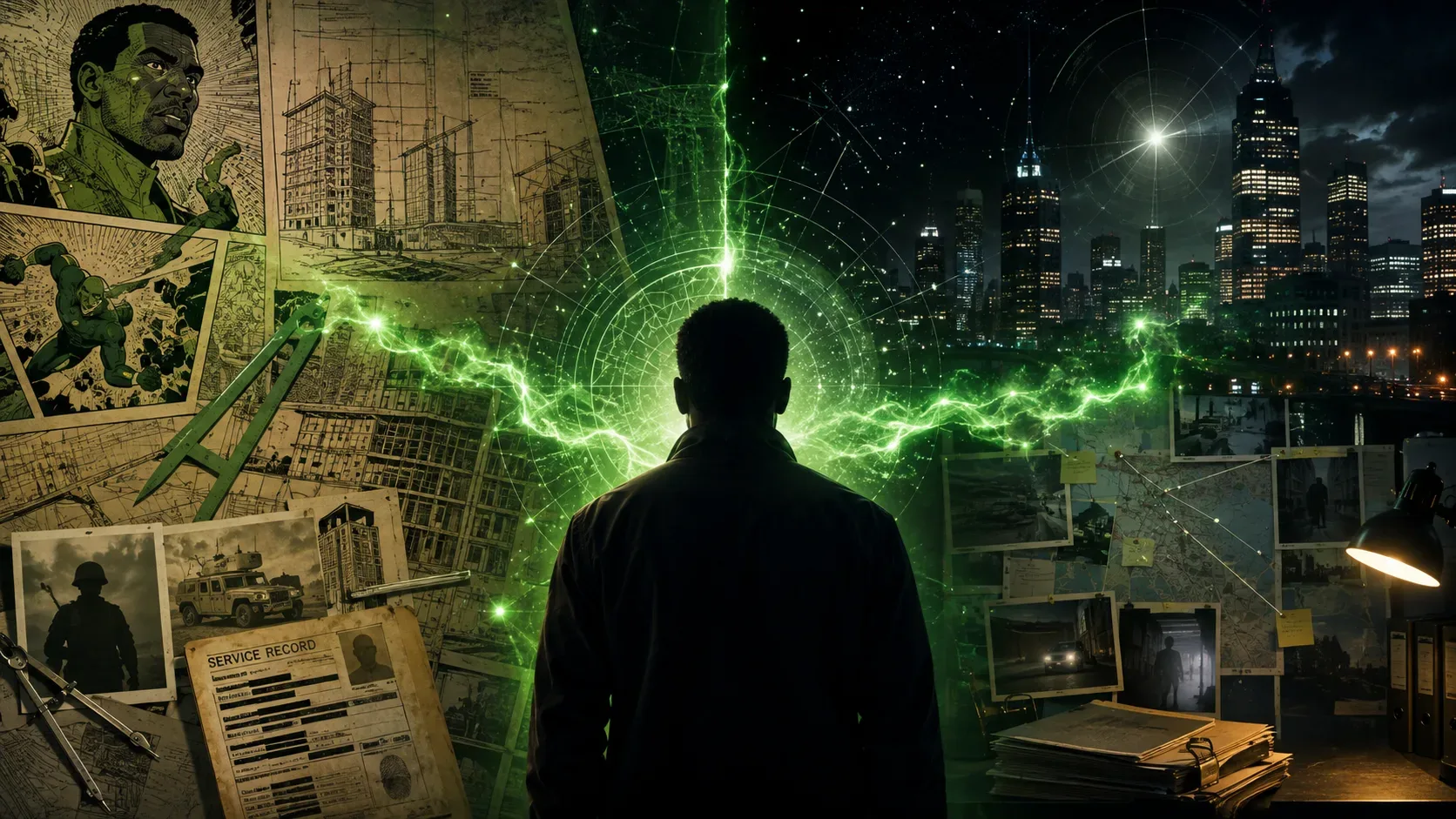
Spoilers for Lanterns Episode 3, “OutKast.” The central change is easy to state: in the comics, John Stewart enters Green Lantern mythology as a Black architect from Detroit chosen by the Guardians to serve as Hal Jordan’s backup; in the series, his path to the ring becomes the result of a family project that began when he was still a baby. The episode preserves major pieces of the character — architecture, military service, precision, tension with Hal and the political dimension of his history — but reorganizes them into a new origin for the DCU.
What changed, in one sentence
Instead of John being discovered as an adult and recruited as a reserve Lantern, Lanterns creates a story in which his father is tested before Hal Jordan, his mother negotiates a second chance with a Guardian and his parents spend years training their son to become “fearless” enough to receive the ring. The difference is not merely chronological: the series turns John’s selection into a story about preparation, family pressure, merit and the need to chase an opportunity that Hal receives almost spontaneously.
| Version | How John enters the path to becoming a Lantern | What defines the origin |
|---|---|---|
| 1971 comics | The Guardians choose him as Hal Jordan’s backup after Guy Gardner is incapacitated. | A Black architect from Detroit, skeptical of authority and placed directly inside the racial and political conflicts of the era. |
| Later revisions | A military past is added to his biography and later reconciled with his career as an architect. | John becomes both a former Marine and an architect, a combination tied to discipline, strategy and the precision of his constructs. |
| Lanterns, Episode 3 | His family knows from childhood that John may become a Lantern and prepares him for it for years. | Conditioned destiny, pressure to excel, and the difference between being chosen and having to earn the choice. |
The 1971 origin: architect, politics and conflict with authority
John Stewart debuted in 1971’s Green Lantern #87, by Denny O’Neil and Neal Adams. DC itself recalls that he appears as a Black architect struggling to find work and catches a Guardian’s attention when he confronts police officers harassing Black men. Hal Jordan distrusts his attitude toward authority, but the Guardians stand by their choice.
John’s initial role is also different from the structure created by the series. He is selected as a substitute Green Lantern after Guy Gardner is incapacitated. His first mission reinforces the character’s political dimension: John and Hal clash, and John ultimately exposes a scheme by a racist politician. The original origin therefore does not depend on a family prophecy, a childhood test or decades of training for the ring. It grows out of who John already is as an adult — a creative professional, a politically aware Black man and someone willing to challenge authority.
The former Marine was not part of his debut: that came later
The John Stewart audiences know today is the result of decades of revision. DC summarizes the evolution by noting that his origin was later changed to make him a Marine and was eventually reconciled in a “best of both worlds” version: he served in the Marines before becoming an architect. The character’s current official profile describes him as a U.S. Marine Corps veteran and former architect.
A major step in that transformation came with the animated Justice League series in the early 2000s, which popularized John as a former Marine. According to Inverse, the comics formally incorporated that military history in 2007’s Green Lantern vol. 4 #26. That matters because Lanterns is not replacing one fixed, immutable origin: it is intervening in a biography that has already been rewritten and recombined before.
Episode 3 invents a new backbone for the biography
“OutKast” takes familiar elements and creates an earlier cause for all of them. In the episode, Abin Sur’s ring seeks out John Stewart Sr. before it reaches Hal Jordan. John’s father admits that he is afraid and is not chosen. Later, Bernadette Stewart confronts a Guardian over the inequality implied by demanding fearlessness from a Black man in America. The Guardian then opens the possibility that the couple’s infant son could become the future candidate.
From there, John grows up under a family program designed to prepare him for “fearlessness.” He joins the Marines, has his military career destroyed after an operation is disrupted by Hal’s intervention and, after returning to civilian life, pursues his interest in art and architecture. When the Guardians finally evaluate him, the series makes those paths converge: military discipline, architectural creativity and an obsession with precision now share the same emotional origin.
The comparison with the comics, then, is not “architect became soldier.” The series keeps both identities and changes the relationship between them. In the modern comic-book canon, Marine and architect are chapters in John’s biography; in Lanterns, they become stages in a project to manufacture the ideal candidate.
Why the writers made the change
The clearest explanation came from episode writer Vanessa Baden Kelly. In an interview with TheWrap, she said the writers’ room saw far more established lore around Hal Jordan than around John and wanted to go “an extra layer deep” to determine who the show’s specific version of John would be. The team also started from the question of what it means for a Black man to receive the ring after other characters have already worn it, and how much more a Black superhero might have to do to be accepted in that world.
That reasoning becomes the theme of the Stewart family. Baden Kelly connected the story to the pressure for exceptionalism placed on Black athletes, artists and professionals: if the system can still remove the opportunity even when someone does everything “right,” the family decides to prepare John to become so exceptional that the choice becomes difficult to deny. The series therefore dramatizes a difference between being chosen and having to become undeniable in order to be chosen.
Series co-creator Tom King offered a complementary explanation to Inverse: the team wanted to give John an origin “hook” with the structural force that characters such as Batman and Spider-Man have. In his reading, the contrast is that Hal receives the opportunity and accepts it, while John’s family understands that he will have to pursue it and prepare for it.
What the series preserves from comic-book John Stewart
Despite the radical change, “OutKast” does not discard the elements that make John recognizable. Four of them remain especially clear:
- Architecture and creativity: his original profession remains part of the story and connects to the meticulous way John imagines constructs.
- Military history: the revision that was already part of modern canon is retained, but given a new dramatic function.
- Conflict with Hal Jordan: friction between the two existed in 1971; the series turns it into a more personal dispute over succession, privilege and deservingness.
- Racial and political dimension: the episode changes the context, but it does not invent John’s willingness to confront power structures from scratch. His 1971 debut already put race, policing, professional opportunity and prejudice at the center of the story.
The precision of John’s constructs also works as a bridge between versions. DC highlights his history as a marksman and strategist, while modern characterization links his architectural training to projections built with attention to every detail. Episode 3 translates that precision into the new origin: John was trained not to miss.
So does the new origin replace the comic-book canon?
No. It is canon for this version of John Stewart within Lanterns and the audiovisual DCU continuity, not a retroactive correction of Green Lantern #87. In the comics, DC’s official biography still presents John as a former architect, Marine veteran and someone originally chosen as Hal Jordan’s alternate Green Lantern.
The best way to understand the adaptation is as a recombination. The series takes the 1971 architect, the Marine added later, the precision of his constructs, the tension with Hal and the character’s racial consciousness, then adds a new cause: a childhood shaped by the expectation that he would one day receive the ring.
The dramatic payoff is the contrast between Hal and John
The rewritten origin gives Episode 3 an idea the 1971 comics did not need: Hal and John do not reach the same symbol by the same route. Hal is presented as someone to whom the opportunity comes; John is someone whose family reshapes its life so that he will be ready when the opportunity finally appears.
That is why the change should not be reduced to abandoning canon. It changes the mechanism of the origin to produce a thematic conflict specific to the series. The John of Lanterns remains recognizable as an architect, Marine, strategist and politically aware character, but he now carries an additional question: how much of his courage is his own choice, and how much was built by a family that decided, before he could decide for himself, that he would have to be extraordinary?