Short answer: Season 3, Episode 8 of Silo finally explains what the silos were designed for: Per Stensen and Rosalind Thurman present the project as a way to preserve people, knowledge, and resources capable of rebuilding humanity after a global catastrophe. The number 50 is revealed as the scale chosen for the project, but the episode does not demonstrate that 50 is a scientifically or demographically “necessary” number. Episode 9, meanwhile, shows a nuclear explosion on the horizon on the complex’s opening day — and builds strong signs that some organizers expected an emergency — but it still does not identify on screen who ordered or detonated the bomb.
That distinction matters because the two revelations answer different questions. Episode 8 clarifies the silos’ stated purpose and how a fifty-silo construction plan would be carried out. Episode 9 changes the question: did the catastrophe that activated the system happen by chance, come from an outside attack, or was it triggered by someone connected to the project? By the end of Episode 9, the last possibility remains a theory, not a confirmed fact.
What Episode 8 reveals about the origin of the silos
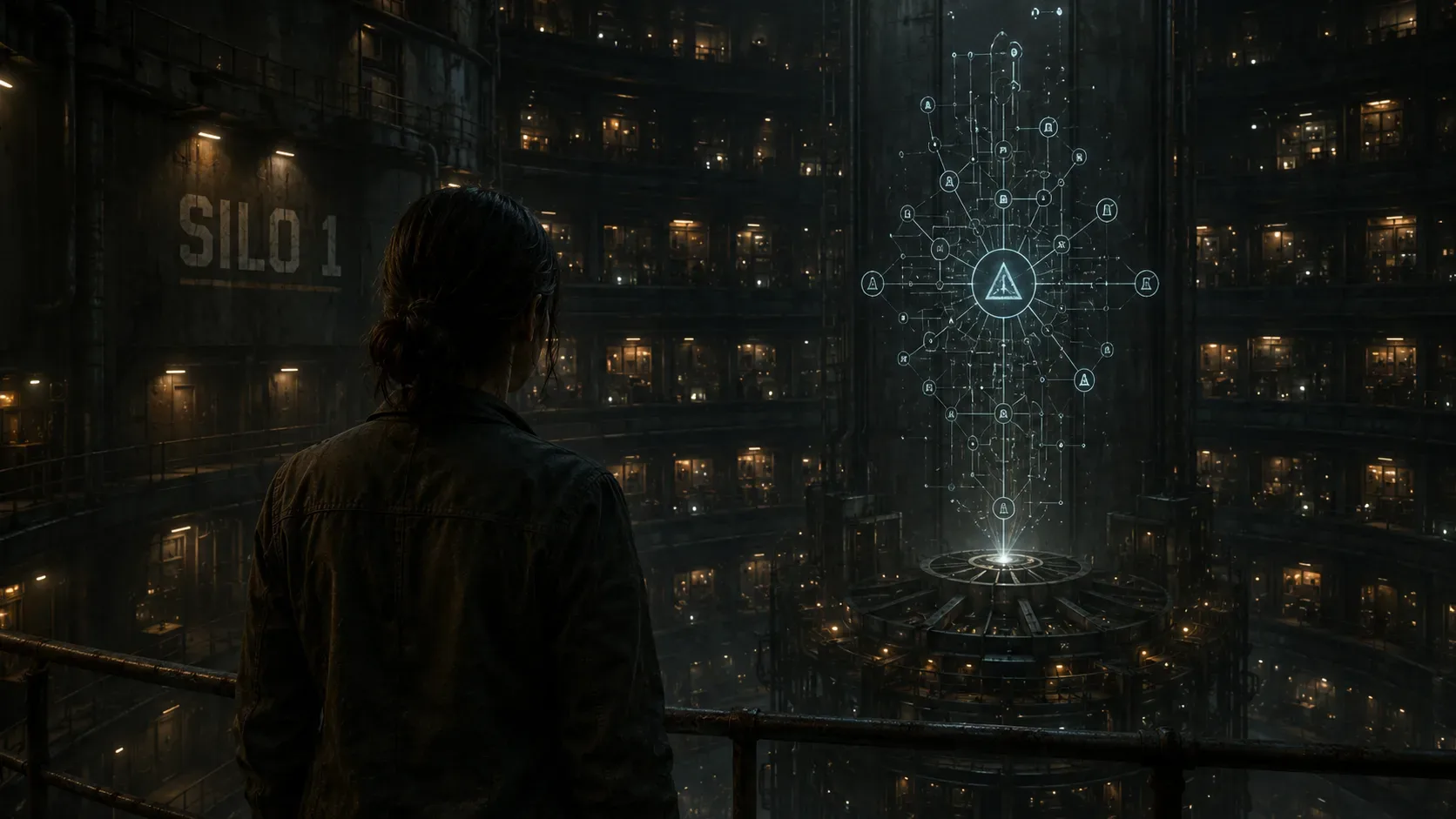
In “Gray Goo,” Daniel Keene and Helen Drew reach the heart of the project that the “Before Times” flashbacks had been revealing piece by piece. Stensen and Thurman explain that the underground structures are not merely storage facilities. The idea is to create survival nuclei: preserve seeds and cultural heritage, but also keep human populations alive so they can eventually return to the surface and repopulate the world after a civilization-ending crisis.
Stensen’s argument is that humanity has entered an era in which destructive technologies can become cheap, discreet, and difficult to stop. Weaponized nanotechnology is the central example. According to the founders’ account, an attack publicly described as a “dirty bomb” was actually a nano-weapon, and the United States’ response was part of the same escalation. The episode therefore places the silo project inside a logic of anticipation: the silos are a continuity plan for a catastrophe Stensen considers inevitable.
Two layers need to be separated. It is a fact that Stensen and Thurman present this justification to the characters. That is not the same as the show independently proving that every part of the founders’ account of the threat is true. Season 3 has repeatedly shown that the project was born amid secrecy, manipulation, and decisions made by a very small group.
Why are there 50 silos?
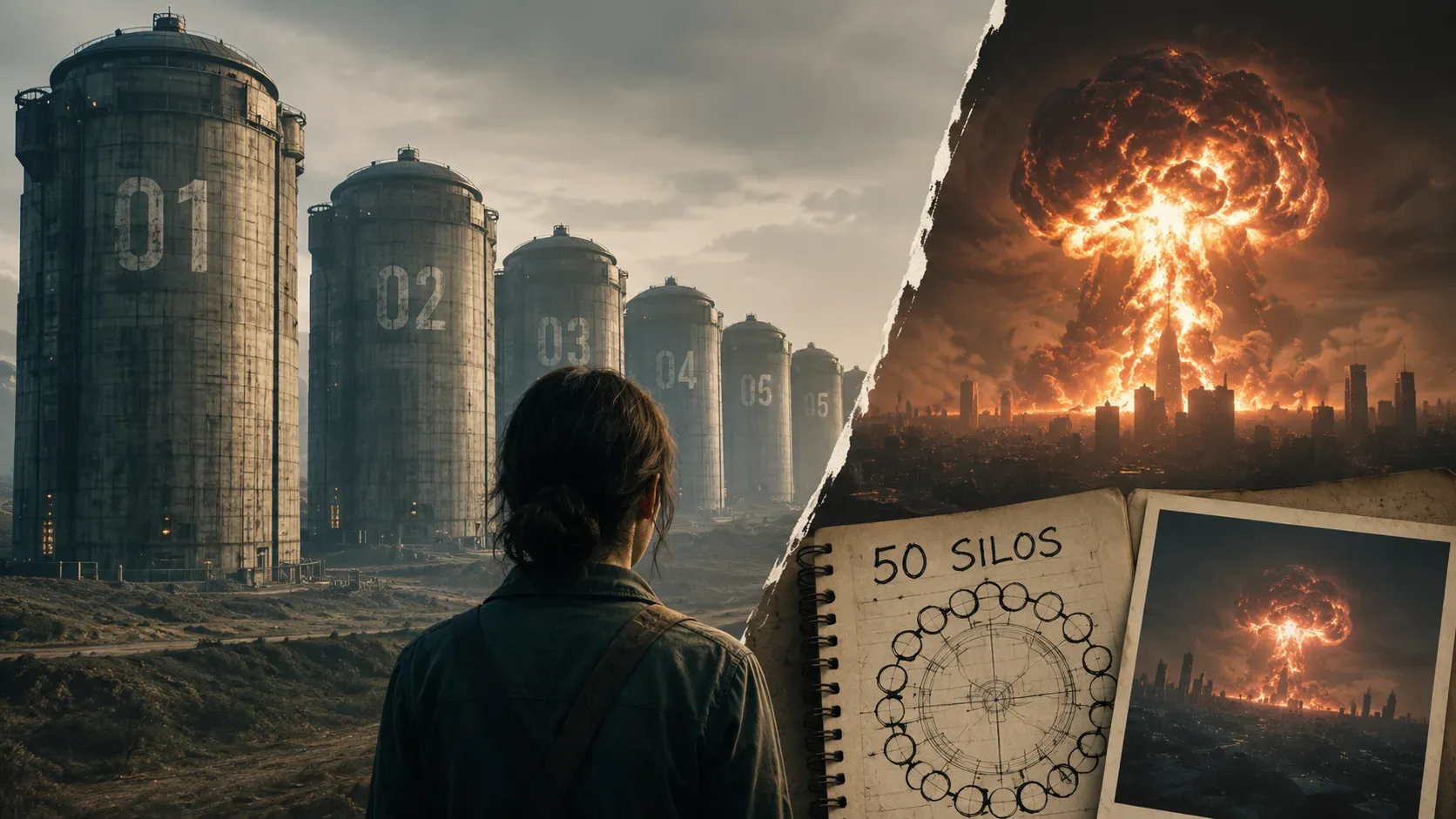
Episode 8 gives an operational answer, but not a complete mathematical justification. The plan is to build 50 silos. The prototype digger Daniel sees is meant to be followed by more machines, allowing the shafts to be excavated in sequence. Daniel then proposes a more efficient solution: build one digger for each silo and leave it at the bottom after excavation instead of hauling and reusing enormous machines.
That conversation explains two things at once: how the project reaches a scale of fifty structures and why a massive machine can remain buried beneath a silo. But it does not answer a narrower question: why exactly 50 rather than 40, 60, or 100? Through Episode 9, the series has not presented a minimum-population calculation, a genetic-diversity threshold, a resource-capacity formula, or a geographic model that makes fifty inevitable.
The safest formulation is therefore: 50 is the number chosen by the founders’ project and revealed by the series; it has not yet been shown to be a scientifically necessary limit. Episode 9 reinforces that people were being selected and assigned across the complex, but that does not provide an equation explaining the number 50.
What changes in Episode 9
“Farewell” jumps three years forward in the past timeline. The complex is complete and receives visitors for an opening event. Daniel and Helen arrive together but are routed to different areas: he is taken to Silo 1, while she joins a tour of Silo 18. The separation initially looks procedural until small warning signs suggest that something is wrong.
Daniel becomes suspicious of messages sent from Charlotte’s phone, Henry tries to steer him back, and other behavior from people tied to the project takes on a more ominous tone. Then, as Daniel and Helen try to reunite outside, a nuclear explosion appears on the horizon and the system orders everyone to seek shelter in the nearest silo. In an instant, the experimental project becomes a sealed survival system.
The timing is extremely suspicious: the explosion happens just as the complex is ready, guests have been distributed, and the founders are on site. But “suspicious” is not the same as “proven.” Coverage after the episode still treats responsibility for the attack as an open question, and showrunner Graham Yost declined to confirm whether the explosion was part of Stensen’s plan when asked after the episode aired.
Fact, inference, or theory: what can be said after Episodes 8 and 9
| Point | Status | What the show supports so far |
|---|---|---|
| The project calls for 50 silos | Shown fact | Stensen and Thurman present fifty structures as the scale of the plan. |
| The silos were designed to preserve and repopulate humanity | Fact about the stated purpose | This is the founders’ explicit justification in Episode 8. |
| 50 is the scientifically minimum or ideal number | Not proven | Through Episode 9, no formula or technical criterion demonstrates that. |
| A nuclear explosion occurs as the complex opens | Shown fact | Episode 9 depicts the detonation and the immediate rush into the silos. |
| Part of the organization seemed to expect an emergency | Strong inference | The separation of guests, the behavior of several insiders, and the strange messages support that reading. |
| Per Stensen ordered the explosion | Still an unconfirmed theory | The timing and his role in the project fuel suspicion, but the episode does not show the order or identify the perpetrator. |
| The nuclear blast alone explains the toxic world 500 years later | Not proven | The season has also introduced the nanotechnology threat; the relationship between the events is not fully resolved. |
Episode 9’s bomb does not erase Episode 8’s explanation
There is a deliberate-looking tension: Stensen spends Episode 8 emphasizing a nanoweapon threat, while Episode 9 ends with a nuclear explosion. That does not automatically mean the earlier explanation was false. The blast could be the immediate trigger that forces people underground, part of a wider chain of attacks, or even an event planned by someone who wanted the silo system activated. Episode 9 does not establish which option is correct.
Nor has the show demonstrated that the detonation on the horizon is, by itself, the cause of all the environmental devastation seen centuries later. The story has already established internal control mechanisms, the Safeguard, and a broader technological threat. Saying that “one bomb created the entire world of Silo” would go beyond what Episodes 8 and 9 actually show.
So what is the safest reading?
After Episode 8, the answer to “why do the silos exist?” is much more concrete: they were built as species-continuity units, planned by Stensen, Thurman, and their circle to survive an extinction-level scenario and eventually rebuild the human population. The show also confirms a fifty-unit project and reveals the construction logic associated with that scale.
What remains open is the second “why”: why did the founders need the world to enter the silos at that specific moment? Episode 9 provides enough clues to suspect an anticipated — or even engineered — catastrophe, but it does not identify the person responsible for the explosion. Calling Stensen guilty at this stage turns a very plausible theory into a certainty the series has not yet delivered.
As of August 31, 2026, Episode 9 is the latest episode available. Apple lists Episode 10, “Troy,” as the season finale premiering September 4, 2026. Any claim about who caused the bomb before that chapter should therefore remain labeled as interpretation or theory.