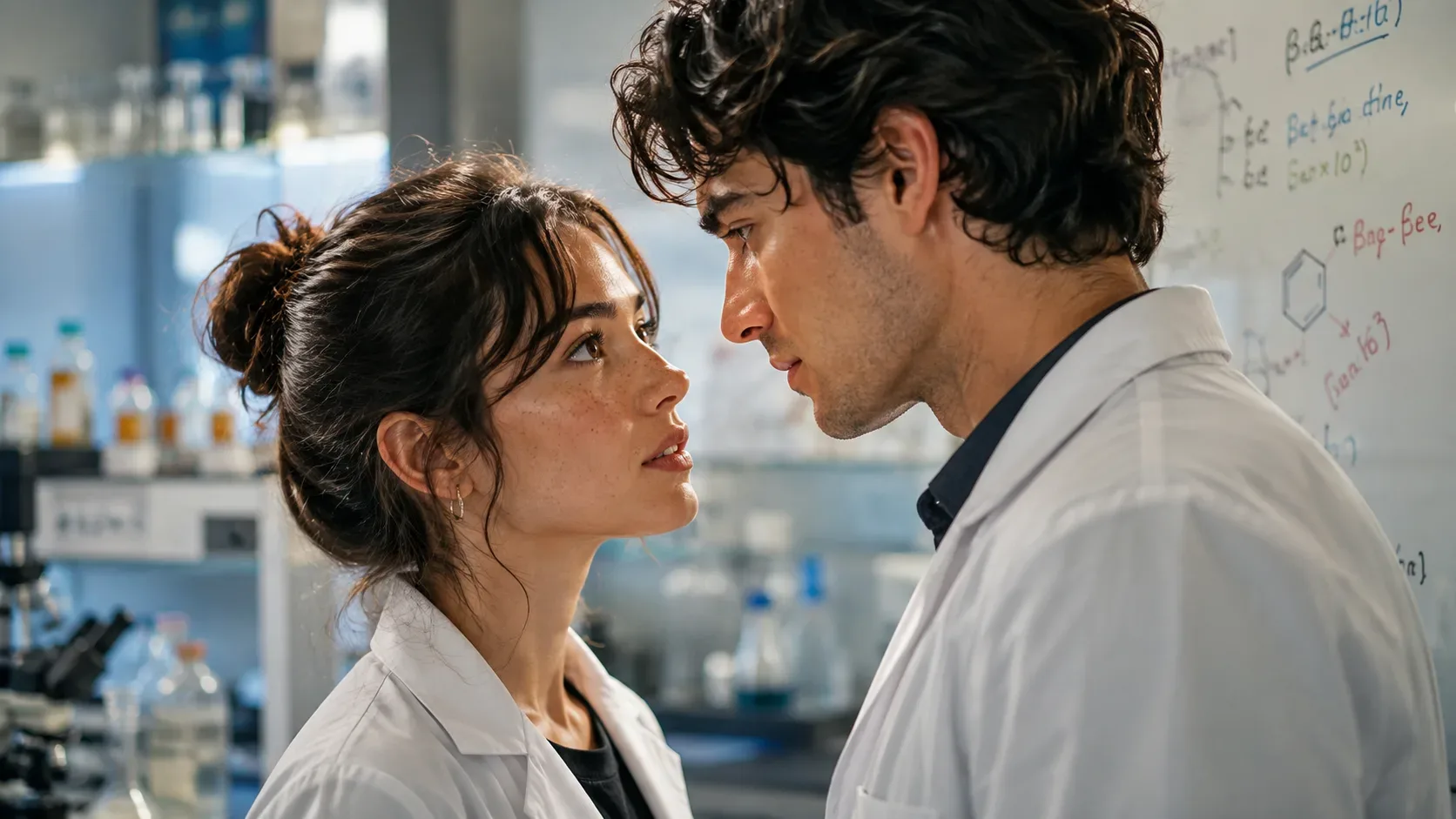
Short answer: The Love Hypothesis directly adapts Ali Hazelwood's novel of the same name, published by Berkley on September 14, 2021 and released in Brazil by Editora Arqueiro as A hipótese do amor. The film premieres globally on Prime Video on September 23, 2026, with Lili Reinhart as Olive and Tom Bateman as Adam Carlsen. These details are confirmed by Amazon's official page, the U.S. publisher, and the Brazilian edition.
Which book does the film adapt?
It is Ali Hazelwood's first published novel, The Love Hypothesis, not a combined adaptation of several of her books. The Brazilian edition is titled A hipótese do amor. The setup is an academic romantic comedy: Olive Smith is a biology Ph.D. candidate who, trying to convince her best friend that she has moved on from a romantic interest, impulsively kisses the first man she sees. He is Adam Carlsen, a professor known for his intimidating demeanor. From there, the two enter a fake relationship that has to look convincing to other people.
The film's official materials retain that core. Amazon describes Olive as a Ph.D. candidate focused on her academic future and Adam as the professor who joins the fake-relationship arrangement. Claire Scanlon directs, and Sarah Rothschild wrote the screenplay based on Hazelwood's novel.
Book → film map: what already matches
| Point | In the book | Already confirmed in the film |
|---|---|---|
| Source | The Love Hypothesis by Ali Hazelwood | A direct adaptation of the novel, not a story merely “inspired” by it |
| Olive | A biology Ph.D. candidate at Stanford, focused on an academic career | Lili Reinhart plays a Ph.D. candidate whose priority is her future in academia |
| Adam | A young, prestigious professor feared for his demanding manner | Tom Bateman plays Professor Adam Carlsen, presented as intimidating |
| Inciting event | Olive kisses Adam to prove to her best friend that she has moved on | The impulsive kiss and the explanation involving her friend appear in the synopsis and trailer |
| Central trope | Fake dating with rules and practical interests | The film also establishes a mutually beneficial arrangement with rules and boundaries |
Readers comparing materials may notice a small spelling detail: the publisher uses Anh for Olive's best friend, while Amazon's official film page lists the character as Ahn. Without an official explanation, that spelling difference alone is not evidence of a different character or narrative function.
What to know about Olive before the premiere
Olive does not enter the story looking for romance. The initial engine is friendship and her attempt to convince someone else that she has already moved on from a previous interest. That matters because the fake relationship does not begin with a declaration of love: it starts as an improvised solution to a social problem and then acquires rules.
It also matters that Olive is building a scientific career. The novel presents her as a biology Ph.D. candidate, and the adaptation keeps academia as an essential part of the conflict. The story is therefore more than “two people pretend to date”: personal choices coexist with reputation, research, colleagues, and professional expectations.
What to know about Adam without turning the premise into a spoiler
Adam is Olive's immediate contrast: a professor with a difficult reputation, direct and not especially approachable. The trailer adds a practical reason for him to accept the arrangement: his professional situation may benefit from the appearance of stability that a serious relationship could create. That gives both characters something to gain from the deal instead of making it only a favor Adam does for Olive.
The useful question to carry into the film is not to predict in advance “whether they fall in love” — the campaign itself sells a romantic comedy — but to see how the adaptation builds the shift from public performance to genuine intimacy.
What the trailer already confirms from the book
The official Prime Video trailer, released in August, visually confirms elements already present in the written premise: the kiss that starts the ruse, the negotiation of the fake relationship, and the academic setting. Entertainment coverage also noted recognizable reader-favorite material, including the sunscreen moment, without needing to explain its context to understand the campaign. See the trailer report from Entertainment Weekly.
- The first kiss is in the adaptation: it remains the incident that puts Olive and Adam into the same “experiment.”
- The arrangement has rules: the trailer treats the relationship as a deal that must look convincing to other people.
- Adam benefits from the ruse too: promotional material connects his participation to professional stability and research funding.
- Recognizable book scenes are present: the campaign uses familiar moments as signals of continuity, but that does not reveal how much of the complete plot has been retained.
What only the film can answer on September 23
A trailer can confirm scenes, cast, and premise; it cannot measure chapter-by-chapter fidelity. Before release, there is not enough evidence to state with confidence:
- which subplots and supporting characters were condensed, moved, or removed to fit a feature-film runtime;
- how Olive's internal perspective, important to the novel's humor and interpretation of situations, will be translated into dialogue, performance, and editing;
- how the film will frame the academic-position difference between a Ph.D. candidate and a professor across the relationship;
- whether recognizable scenes shown in the trailer will serve the same function and appear in the same context as in the book;
- what the final balance will be among comedy, romance, the scientific setting, and career conflicts.
Those are adaptation questions, not gaps that marketing has to answer. Seeing a familiar scene in the trailer is evidence that the scene exists in the film, not that everything surrounding it was preserved.
Do you need to read The Love Hypothesis first?
No. The official synopsis presents the central conflict as a self-contained setup, so the film has been announced in a way that can be followed by viewers who have never read Hazelwood. Reading first is most useful for people who want to compare adaptation choices: the novel has more room for Olive's inner voice, academic day-to-day life, and the progression of the relationship. Viewers who would rather avoid knowing which book scenes may appear can simply start with the premise and trailer.
For confirmed information leading up to release, prioritize Amazon's official film page; for the literary source, check Editora Arqueiro and Penguin Random House.