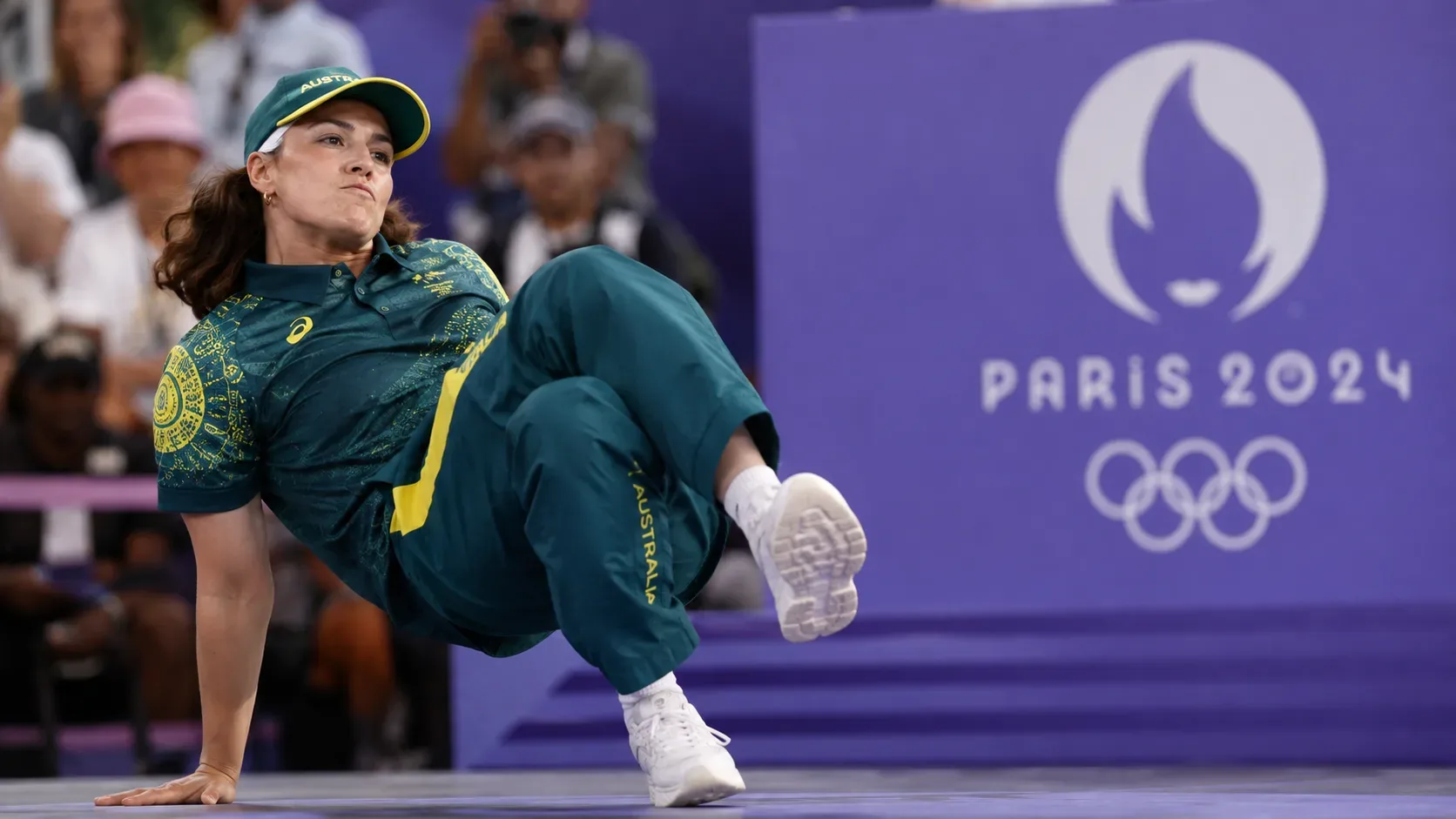
Rachael “Raygun” Gunn was not picked by a secret committee and did not receive an invitation spot. The official World DanceSport Federation (WDSF) record shows that she qualified for Paris 2024 by winning the Oceania Breaking Championship in Sydney on October 27–28, 2023. Under the Olympic qualification system for that cycle, the highest-placed athlete at each continental qualifier earned a direct quota place, provided the eligibility requirements were met.
How Raygun earned the Olympic spot
The road to Paris had more than one entry route. WDSF published a qualification system with a place through the World Championship, places through continental qualifiers, and places through the Olympic Qualifier Series. In the Paris-cycle document, the rule for continental events was straightforward: the highest-placed athlete at each continental qualifier would receive an Olympic quota place. The rule is available in the official WDSF qualification system for Paris 2024.
Raygun first tried the 2023 World Championship in Leuven and finished 64th in the women's category, according to the official WDSF ranking. That result did not give her a direct Olympic place.
A month later, she entered the WDSF Oceania Breaking Championship in Sydney. WDSF recorded 15 B-Girls in the tournament and confirmed that the women's gold medal carried direct entry to the Games. In the official result, Raygun is listed first, ahead of Holy Molly and Hannah. The final-stage page also records the title battle between Holy Molly and Raygun and places Raygun at the top of the stage ranking.
Did Raygun's husband judge the qualifier?
No. That was one of the claims that spread after Paris, but it conflicts with the official officials list. WDSF identifies the nine judges at the event: Dong (TPE), Kim (CHN), JustRoc (HKG), Rush (NZL), Chao (JPN), Skim (KOR), Frost (GER), Kid Glyde (PUR), and Moy (USA). Samuel Free, Gunn's husband and coach, is not on the panel.
The Australian Olympic Committee (AOC) issued a specific statement on the Oceania qualification process in August 2024. It said the panel was selected by WDSF and made up of nine independent international judges; it also said Rachael Gunn held no position with AUSBreaking or DanceSport Australia, Samuel Free was not a judge at the event, and no other athlete appealed the result.
So was the qualification “legitimate”?
The available records support a more precise conclusion: there is official documentation for the qualification route, the result that awarded the spot, and the composition of the judging panel, and those documents do not support the claim that Gunn or her husband manipulated the selection. That is not the same as saying every debate about the qualification model is invalid.
There is a criticism that can be made without relying on conspiracy theory: the Oceania women's field was small and concentrated. WDSF recorded 15 B-Girls, and the final ranking lists competitors from Australia and New Zealand. That can support a discussion about competitive depth, access to the circuit, and regional representation. But a smaller field, or a field with a different level from other regions, is not evidence of fraud; under the rules, that continental tournament was the event that distributed Oceania's quota place.
Why does the Paris performance seem to contradict the qualification?
Because they are facts from different moments. Winning a qualifier does not guarantee the same result months later against the world elite. In the official ranking of the women's Olympic event, Raygun finished 16th. The poor result in Paris explains the public surprise, but it does not erase the qualifying result that had awarded her quota under the rules then in force.
It is also important to separate “being the best in the world” from “being ranked No. 1 by WDSF at a specific moment.” In September 2024, the federation itself published an explanation of the B-Girl world ranking after Raygun appeared at the top. WDSF said the 1,000 points from her continental title took precedence, in a tie, over 1,000 points from a Breaking for Gold World Series event because of the competition hierarchy. The ranking therefore reflected points and result-validity rules, not a new vote on her Olympic performance.
What “Untold Raygun: Breaking Badly” adds in 2026
The documentary premiered on Netflix on September 1, 2026; in Brazil it is listed as “Untold - Raygun: A Polêmica do Breaking”. Netflix's official introduction says the film revisits Gunn's rise, fall, and reinvention and, in particular, the avalanche of memes, misinformation, and conspiracy theories about how she reached the Games.
That description helps explain the film's narrative focus, but it should not be treated as independent proof that the process was proper. To verify the central question — “how did she get the spot?” — the strongest records remain the qualification system, WDSF results and officials list, and the AOC statement.
Timeline of the qualification and controversy
- April 2022: WDSF announces the qualification routes for breaking at Paris 2024, including continental events.
- September 23–24, 2023: Raygun finishes 64th at the WDSF World Championship in Leuven and does not qualify through that route.
- October 27–28, 2023: she wins the Oceania Championship in Sydney and secures the direct Olympic quota place.
- August 9, 2024: she competes in Paris; the official WDSF ranking places her 16th.
- August 15, 2024: the AOC publishes a statement rejecting allegations of manipulation and conflict of interest.
- September 10, 2024: WDSF explains why Raygun appeared at the top of the world ranking at that moment.
- September 1, 2026: “Untold Raygun: Breaking Badly” premieres, revisiting the story and the misinformation surrounding her Olympic place.
What the official records do — and do not — establish
The records establish that Raygun won a WDSF-recognized continental qualifier, with a direct Olympic place written into the rules, in front of an internationally identified judging panel. They also establish that her husband is not listed as a judge and that the AOC rejected claims that the couple controlled the organizations responsible for the selection.
The same records do not prove that the qualification format was perfect, that the Oceania tournament had the same competitive depth as other regions, or that Raygun was, in an absolute sense, the best possible Australian B-Girl to face the Paris field. Those are different questions. What the documentation undermines is the strongest version of the allegation: that she improperly “rigged” her way into the Olympics through her own influence or her husband's.