
Yes. There is evidence that interval walking with 3 minutes at a fast pace alternating with 3 minutes at an easy pace can improve aerobic fitness and strength in middle-aged and older adults. But the viral version called "Japanese walking" often leaves out exactly the parts that make that conclusion accurate: the fast pace was individualized, the program lasted for months, and the original study did not compare the method with 10,000 steps per day.
The protocol studied is known as Interval Walking Training, or IWT. In the 2007 trial led by Ken-ichi Nemoto of Shinshu University, the main comparison was with a continuous walking program targeting at least 8,000 steps per day at moderate intensity. So saying that the method "beat 10,000 steps" does not describe the experiment that produced the evidence.
What the original study actually compared
The study published in 2007 in Mayo Clinic Proceedings recruited 246 healthy, nonsmoking adults aged 44 to 78, with an average age of 63. Participants were assigned to three groups: no walking training, continuous moderate-intensity walking, and high-intensity interval walking.
In the continuous walking group, participants were instructed to walk at around 50% of peak aerobic capacity for walking and reach at least 8,000 steps per day on four or more days per week. The group used a pedometer to check daily volume.
In the interval group, the prescription was to repeat five or more cycles per day. Each cycle had 3 minutes of easy walking, at around 40% of peak aerobic capacity for walking, followed by 3 minutes of fast walking, above 70% of that capacity. The frequency was also four or more days per week, for five months.
Five complete cycles add up to a 30-minute session, with 15 minutes in the fast segment and 15 in the easy segment. The most important detail is that "fast" and "easy" were not fixed speeds in kilometers per hour. They were intensities relative to each participant's capacity, estimated and monitored with measurement instruments.
And what improved with 3-3
Among participants who met the targets defined for each group, the interval group showed 13% increases in isometric knee-extension strength and 17% in flexion strength. Peak aerobic capacity increased 8% in the bicycle test and 9% in the walking test. These gains were greater than those observed in the continuous walking group following the 8,000-step target.
Resting systolic blood pressure also fell more in the interval group in that study. That result, however, should not be turned into a promise of lower blood pressure for everyone. A later study in older adults, published in 2022, found no significant difference between IWT and the control group in blood-pressure changes over five months. The evidence is more consistent for improving physical fitness than for guaranteeing a specific effect on blood pressure.
A larger analysis published in 2019, involving 679 people who completed five months of IWT, found an average 14% increase in estimated aerobic capacity and an improvement in a score of factors related to lifestyle-associated diseases. In that analysis, accumulated fast-walking time appeared as an important determinant of fitness gains. Because it was not the same randomized comparison as the 2007 study, it helps explain the dose-response relationship but does not replace a controlled trial.
A 2024 review of the method concluded that IWT is effective for improving physical fitness and muscle strength and may reduce some factors associated with chronic diseases. The authors themselves, however, noted that longer-term studies in real-world conditions are still needed to determine how well the benefits persist and whether they translate into harder clinical outcomes.
The study did not compare 3-3 with 10,000 steps
This is the point most often lost when the method circulates on social media. The 2007 comparator was continuous moderate-intensity walking with a target of at least 8,000 steps per day, four or more days per week. It was not a "10,000 steps" strategy, nor a contest between a 30-minute timer and a universal step target.
Volume and intensity are different questions. A step goal tries to organize how much movement fits into the day. IWT organizes how part of the walking is distributed between easy segments and more demanding segments. A person can, in fact, accumulate steps throughout the day and use intervals for part of them.
The study also does not prove that exactly 3 minutes is the only or ideal duration for everyone. It shows that this protocol, applied with individualized intensity and repeated over five months, produced certain results in the population studied.
How to interpret the fast pace without a laboratory
In the study, the fast segment was above 70% of peak aerobic capacity for walking. That cannot be converted precisely into one speed for everyone. A pace of 6 km/h may be comfortable for one person and very demanding for another.
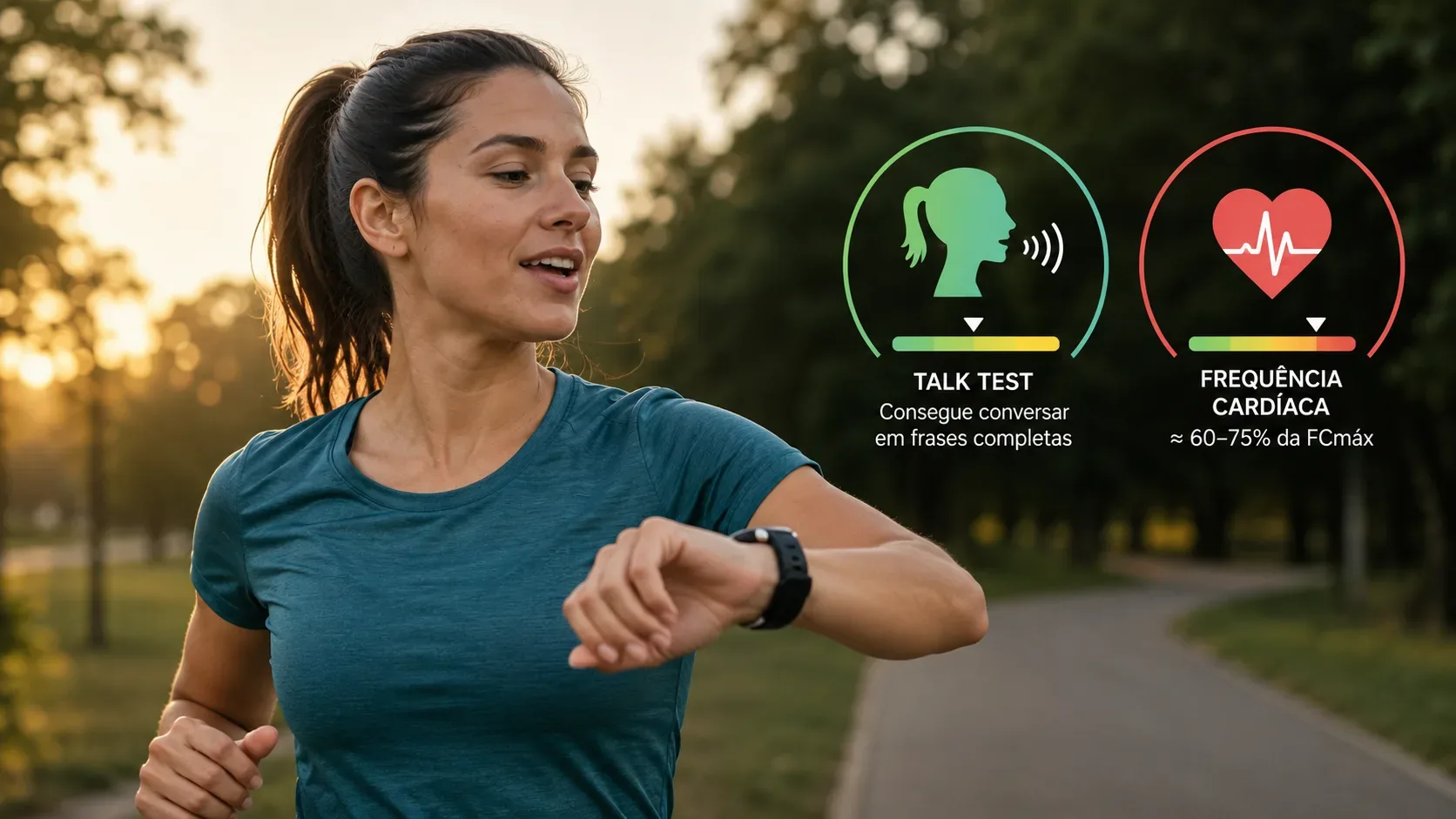
At home, the adaptation needs to be understood as an approximation, not a perfect reproduction of the laboratory. The CDC uses a perceived-exertion scale from 0 to 10 and considers relative vigorous intensity to begin around 7 or 8. It also uses the "talk test": at moderate effort, a person can talk but not sing; at vigorous effort, a person tends to be able to say only a few words before needing to breathe.
Those cues are not mathematical equivalents of the 70% used in the study, but they help avoid a common mistake: calling a pace "fast" when it remains completely comfortable. The hard segment should clearly increase breathing and perceived effort without requiring running. The 3 easy minutes should allow noticeable recovery before the next block.
If 3 fast minutes are too much, adapt without pretending it is the same protocol
Shinshu University itself states that people with lower physical capacity can reduce the fast segment to 2 minutes or even 1 minute. That can be useful for starting, but it changes the dose compared with the classic 3-plus-3 trial.
In practice, the best interpretation is to use the structure as a progression. If three minutes at high effort causes technique to deteriorate, prevents recovery, or makes it impossible to repeat the cycles, shortening the fast block may make more sense than turning the walk into improvised running. As tolerance improves, the fast segment can move closer to the 3 minutes that were studied.
The same applies to the number of cycles. The most-cited evidence comes from a prescription of five or more cycles per day on four or more days per week. Doing two cycles occasionally is still movement, but it should not be presented as though it has the same evidence base as the full protocol.
What "works" means in this case
The method works in the sense that structured interval walking has studies showing gains in aerobic capacity and strength, and those results do not depend only on a recent social-media trend. The effect appears to be linked mainly to accumulating enough time in the more intense segment, not to the "Japanese" label itself.
At the same time, the research does not support several popular conclusions. It does not show that 3-3 replaces every daily activity goal, that it is superior to every other form of walking, that 3 minutes is a universal formula, or that the protocol guarantees weight loss, longevity, or lower blood pressure for everyone.
It is also important to remember who took part in the original trial: healthy adults with no history of cardiovascular or pulmonary disease. People with a clinical condition, symptoms during exertion, mobility limitations, or a need for individualized exercise prescription are not automatically represented by that group and may need professional guidance before adopting more intense segments.
3-3 walking and Namba Aruki are not the same thing
"Japanese walking" has become too broad a label. The 3 minutes fast and 3 minutes easy protocol studied by Shinshu University is interval walking training, defined by alternating intensity.
Namba Aruki, on the other hand, is a term associated with traditional patterns of movement and walking mechanics, with historical and martial descriptions involving coordination of the arms, legs, and torso. A page about Namba Aruki may be discussing posture and gait pattern, not IWT. Mixing the two leads to attributing explanations and benefits to 3-3 that were not the subjects of the 2007 trial.
How to use the evidence without turning the method into a magic recipe
The most faithful reading is simple: the original study tested intensity, not just a timer. The fast block needs to be genuinely more demanding for that person; the easy block exists for recovery; and repetition over weeks and months is part of the protocol.
If you want to try the format, think of the timer as the structure and relative effort as the content. Three fast minutes plus three easy minutes can be a practical way to make a walk more challenging, but the benefit does not come from a secret count of minutes. It comes from alternating intensities sustainably and accumulating enough training for the body to adapt.
So the short answer is: yes, the Japanese 3-3 walking method has a real scientific basis when we are talking about Interval Walking Training. What is not supported by the original study is saying
that it was tested against 10,000 steps or treating any walk done in 3-minute alternations, at any pace, as equivalent to the studied protocol.