
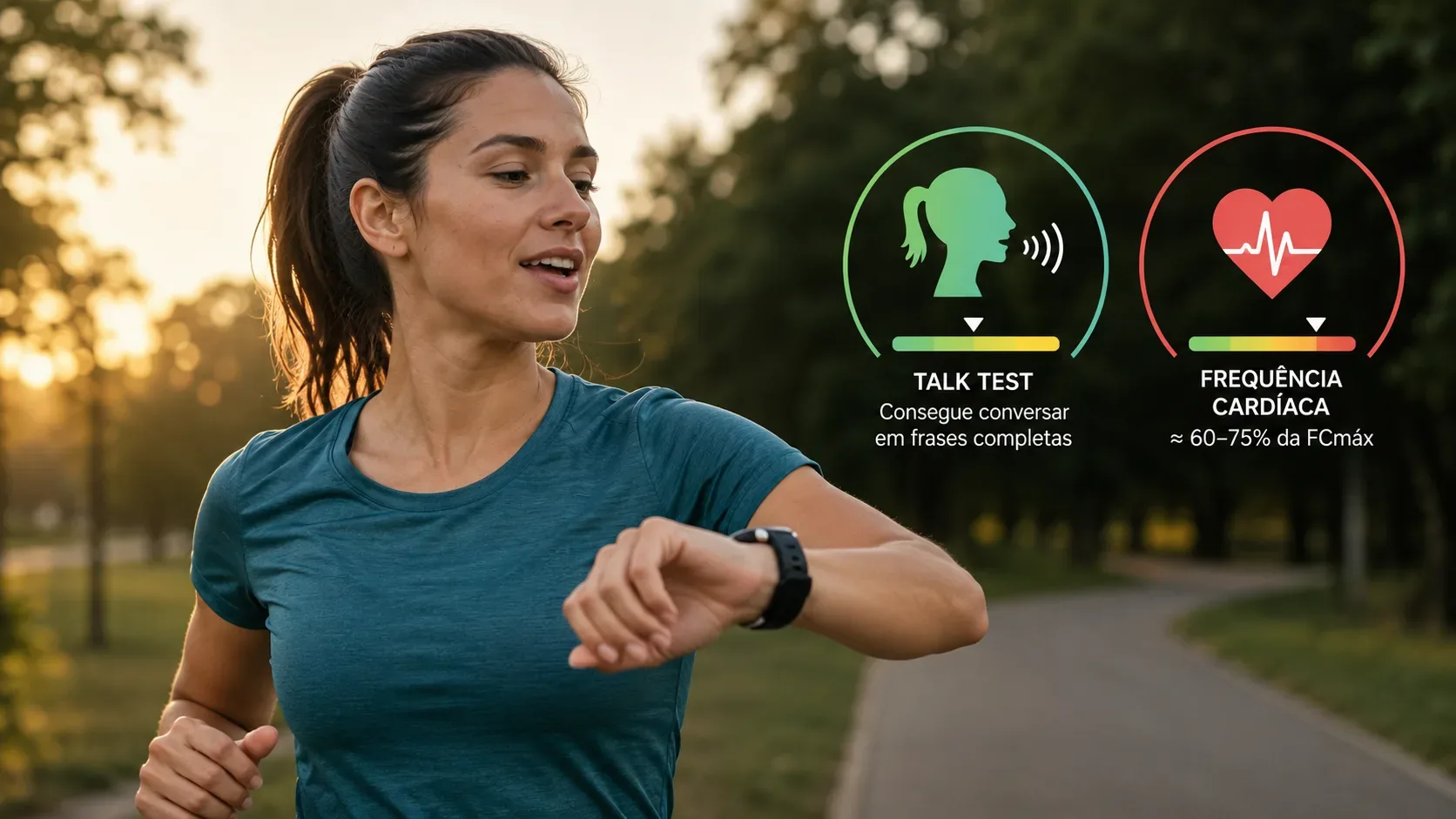
For a healthy adult who wants to do light-to-moderate aerobic training, the best way to use the idea of “Zone 2” is to move away from the belief that there is one correct heart-rate number. In practice, it is more useful to combine two signals: how breathing affects speech and how heart rate behaves at that effort. The first helps you judge intensity in real time; the second helps you log and compare sessions.
This matters because “Zone 2” has no universal definition. Different training systems can use the same label for different intensity ranges. An expert panel published in 2025 proposed that, in the current endurance-training use of the term, Zone 2 should preferably be understood as work performed immediately below the first lactate or ventilatory threshold. Public-health guidance, meanwhile, often uses broader categories such as moderate and vigorous intensity. A fixed percentage of maximum heart rate can therefore be a starting reference, but not an individual truth.
First: understand what “Zone 2” means in your context
There are at least three common languages for describing intensity. One uses numbered zones on watches and apps. A second uses physiological domains separated by lactate or ventilatory thresholds. A third, common in public health, uses light, moderate and vigorous effort. They overlap, but they are not equivalent.
In exercise physiology, the first ventilatory threshold (VT1) marks a detectable change in ventilation as workload rises. An expert consensus on “zone 2 training” linked the preferred practice to intensities just below this first threshold. Reviews of exercise-intensity domains also show that threshold names, testing protocols and determination methods vary between laboratories and training models. That variation is one reason to avoid saying “my Zone 2 is exactly X bpm” unless you know how X was established.
Sources: expert commentary on the definition of Zone 2 and review of thresholds and exercise-intensity zones.
Use the talk test as a practical breathing signal
The talk test is simple: notice whether you can speak while maintaining the pace. The CDC uses speech as a practical rule for relative intensity: during moderate-intensity activity, a person can usually talk but not sing; during vigorous-intensity activity, they generally cannot say more than a few words without pausing for breath.
For someone trying to stay in a controlled aerobic effort close to the popular idea of Zone 2, the useful signal is not passing or failing one specific sentence. It is whether speech remains comfortable and sustainable. You should be able to say complete sentences without gasping, without interrupting the sentence to breathe and without feeling that conversation is competing with the exercise.
This method has a reasonable physiological basis: a systematic review of the talk test found a relationship between the last stage at which speech remained comfortable and the first ventilatory threshold in clinical studies. That does not make the talk test a perfect substitute for cardiopulmonary exercise testing, but it helps explain why speech is useful for regulating intensity outside the laboratory.
| Signal during exercise | Practical interpretation | What to do |
|---|---|---|
| Conversation is very easy; singing is comfortable too | Effort is probably low relative to the CDC's moderate-intensity reference | If you want a somewhat more demanding aerobic session, increase the pace gradually |
| Complete sentences are comfortable, but sustained singing would be difficult | Range compatible with moderate effort in practical terms | Hold the pace and use heart rate as a secondary data point |
| You can say only a few words before breathing | The effort has moved into a more vigorous range | Reduce intensity if the goal is to keep the session light to moderate |
Then add heart rate — without turning it into an oracle
Heart rate is useful because it lets you compare sessions and spot trends. The problem starts when a population formula is treated as an individual measurement. The American Heart Association (AHA) uses “220 minus age” as an estimate of maximum heart rate and generally places moderate-intensity activity at about 50% to 70% of HRmax and vigorous activity at 70% to 85%. The AHA itself notes that these numbers are averages and should be used as a general guide.
For that reason, 50% to 70% of HRmax should not be read as a universal definition of Zone 2. The range can be useful for starting observation, especially without laboratory testing, but an individual's first ventilatory threshold may not line up exactly with a standardized percentage.
Medications can also change the heart-rate response to exercise. The AHA advises people with a heart condition or who take medication that affects heart rate to ask a health professional what target range is appropriate.
A simple triangulation protocol for healthy adults
- Warm up for 8 to 10 minutes. Start easy and increase gradually. Do not use the first few minutes of heart-rate data as your main reference because your response is still settling.
- Find a comfortably conversational pace. Brisk walking, cycling, elliptical work or easy running can all work. The rule is that you can speak in full sentences without breaking them to breathe.
- Observe heart rate after the pace stabilizes. Record the value or range that appears while speech is comfortable. Compare it with the general moderate-intensity reference, but do not force the workout to fit a percentage if your breathing and effort tell a different story.
- Repeat across three to five similar sessions. Look for a heart-rate range that appears relatively consistently when the talk test also indicates controlled effort.
- Use that personal range as an operational reference, not a medical limit. On another day, heat, stress, poor sleep, caffeine, dehydration or a change in equipment may alter the relationship between pace and heart rate.
The goal of this triangulation is simple: instead of asking “what is the magic number for my Zone 2?”, ask “at what effort can I maintain comfortable speech and a stable, repeatable heart-rate response?”.
When your watch, formula and perceived effort disagree
If your watch says you left the zone but conversation remains comfortable and the effort feels steady, you do not need to correct the pace for every heartbeat. Watches use different algorithms and zone settings, and heart rate does not respond instantly to every change in pace.
The reverse also matters. If heart rate looks “low” but talking becomes difficult and breathing is heavy, the talk test suggests the session is more intense than the isolated number indicates. Slowing down is more consistent with the goal of controlled aerobic work.
If you train for performance and need more precision, a cardiopulmonary exercise test with gas analysis, or an appropriate threshold protocol performed under qualified supervision, can individualize zones more accurately. Laboratory measures remain more appropriate when a difference of a few beats per minute or watts changes training decisions.
What Zone 2 does not promise
The recent popularity of Zone 2 has also created the impression that it is the “optimal” intensity for every goal. A 2025 narrative review challenges that generalization for the general population: cardiovascular and metabolic benefits can be achieved at different intensities, and adaptations attributed to Zone 2 are not necessarily unique to that range.
That does not make light-to-moderate training less useful. It can be comfortable, sustainable and easy to accumulate in volume. The point is different: Zone 2 is a way to organize training, not a magic formula or a guarantee of superior results.
When to seek professional guidance
This guide is intended for healthy adults who already tolerate light-to-moderate aerobic activity. Seek individual guidance before using heart-rate targets if you have cardiovascular disease, take medication that alters heart rate, are returning after a cardiac event or have been given specific medical exercise instructions.
During activity, warning signs such as chest pain or pressure, dizziness or confusion, unusual or extreme shortness of breath, and a very fast or irregular heartbeat are reasons to stop exercising and seek assessment. The AHA lists these symptoms as warning signs in physical-activity planning. If symptoms are severe, persistent or suggest an emergency, seek urgent care.
Practical summary
- Do not treat “Zone 2” as one universal heart-rate percentage.
- Use the talk test to confirm that speech remains comfortable and sustainable.
- Use heart rate to log and compare effort, not to override all other signals.
- Treat 50% to 70% of HRmax only as a general moderate-intensity reference, not an automatic Zone 2 definition.
- If sports precision matters, individualized threshold testing is more informative than age-based formulas.
- Stop exercising if warning symptoms occur and seek guidance when a relevant medical condition or medication is present.