
If your phone shows 3,200 steps on an average day, looking at 10,000 can turn a useful tool into a distant goal. The most recent evidence does not require that leap. The best use of the counter is to understand how much you already move, increase it sustainably and remember that steps are just one part of physical activity.
The short answer: 7 thousand is a good benchmark, not a magic number
A systematic review with meta-analysis published in 2025 in The Lancet Public Health brought together 57 studies from 35 cohorts and examined the relationship between device-measured steps and various health outcomes. For all-cause mortality, incidence of cardiovascular disease, dementia and falls, the curves showed an inverse non-linear association, with inflection points around 5,000 to 7,000 steps per day.
This helps explain why 7,000 has come to feature so much in discussions about walking. The number summarizes a range in which several observed benefits were already significant. It does not mean that the body "turns on" a protective mechanism upon completing step 7,000, nor that 6,999 is insufficient.
The review itself treated 7,000 as a potentially more realistic benchmark for some people, while stating that 10,000 steps remains an achievable goal for those who are already more active. This distinction is important: a population reference is not an individual prescription.
What the 2025 review actually found
In meta-analyses, comparing 7,000 with 2,000 steps per day was associated with relevant differences in several outcomes. For all-cause mortality, the association corresponded to a 47% lower risk; for incidence of cardiovascular disease, 25% lower; and for dementia, 38% lower. Favorable associations were also observed for cardiovascular mortality, cancer mortality, type 2 diabetes, depressive symptoms and falls.
These percentages should not be read as an individual promise. The studies included were prospective and observational. Even with statistical adjustments, factors such as health status, income, diet, smoking, functional capacity and other habits can influence both the number of steps and the outcomes. The authors also highlighted limitations such as few studies for several outcomes, lack of age-specific analysis and risk of residual confounding.
The certainty of the evidence was considered moderate for several outcomes, but lower in some, such as cardiovascular mortality, cancer incidence, physical function and falls. In other words, the most solid message is the shape of the relationship: moving out of very low levels of movement is often associated with important gains, and the curve does not offer a single binding point for everyone.
Why 10 thousand steps didn't become "wrong"
The popularity of 10,000 steps often leads to a false choice: either this is the correct goal, or science has "replaced" 10,000 with 7,000. The 2025 revision does not say this.
For some outcomes, risk continued to decline above 7,000 steps, although additional gains tend to be smaller in curves that begin to flatten. Who already walks
9,000, 10,000 or 12,000 steps comfortably without needing to reduce activity to fit into a new numerical fashion.
The useful point is another. Ten thousand does not appear as a universal biological threshold. Neither does seven thousand. The two figures can act as practical references, but the value of the goal depends on the starting point, the ability to maintain the routine and the rest of the weekly physical activity.
Start with your starting point, not your internet number
The U.S. Department of Health and Human Services' physical activity guidelines reinforce that inactive people can start with small amounts and progress over time. This logic matches well with what the step curve shows: the biggest practical difference for those who move little may be in leaving their current level, not in immediately chasing a five-digit number.
If you are well below 7 thousand
First find out what an average day is. Look at several days, including workdays and weekends, and look for an average that represents your real life. From there, choose a raise that fits into your week without requiring a sudden change in schedule.
If your average is around 3,000 or 4,000 steps, for example, the most useful question is not "how do I get to 10,000 tomorrow?", but "what's the next level I can repeat?" Walking part of a route, taking a short walk after lunch, or adding walking trips can increase your daily volume without relying on a long session.
The objective is to transform progression into routine. A goal that you consistently achieve is more useful than a high number that only appears on exceptional days.
If you are already close to 7 thousand
Seven thousand can serve as a reference to consolidate regularity. If this range already happens most days and you feel fine, there is no need to treat 7,000 as a ceiling. You can maintain this base and direct some of the effort to walking faster, doing structured aerobic activity, or including strengthening.
You can also increase the number of steps if that makes sense for your routine. The review found favorable associations beyond 7,000 for some outcomes. The point is not to interpret the brand as an obligatory finish line.
If 10 thousand already fits into your routine
There is no evidence in the 2025 review that already active people should drop 10,000 steps. For those who enjoy walking, have the time, tolerate this volume well, and are not replacing other important forms of exercise, the goal can continue to work.
The care is to avoid the logic of "the more, always the better" without context. Very high volume may be unnecessary for some people's goals, and any progression needs to respect capacity, recovery, pain and health conditions.
Steps count movement, but they don't tell everything
The counter is excellent for showing displacement volume. He is less able to respond on his own if his week includes sufficient aerobic effort, strength stimulation, balance, or
mobility.
Intensity still matters
World Health Organization guidelines recommend that adults do 150 to 300 minutes of moderate-intensity aerobic activity per week, or 75 to 150 minutes of vigorous-intensity aerobic activity, or an equivalent combination. A brisk walk can contribute to this goal, but a daily step total does not automatically tell you how much time was spent at moderate or vigorous intensity.
Two people can end the day with 7,000 steps and have different physiological experiences. One may have accumulated the total in slow movements; another may have included continuous walking at a fast pace. The number of steps is similar, but the intensity is not.
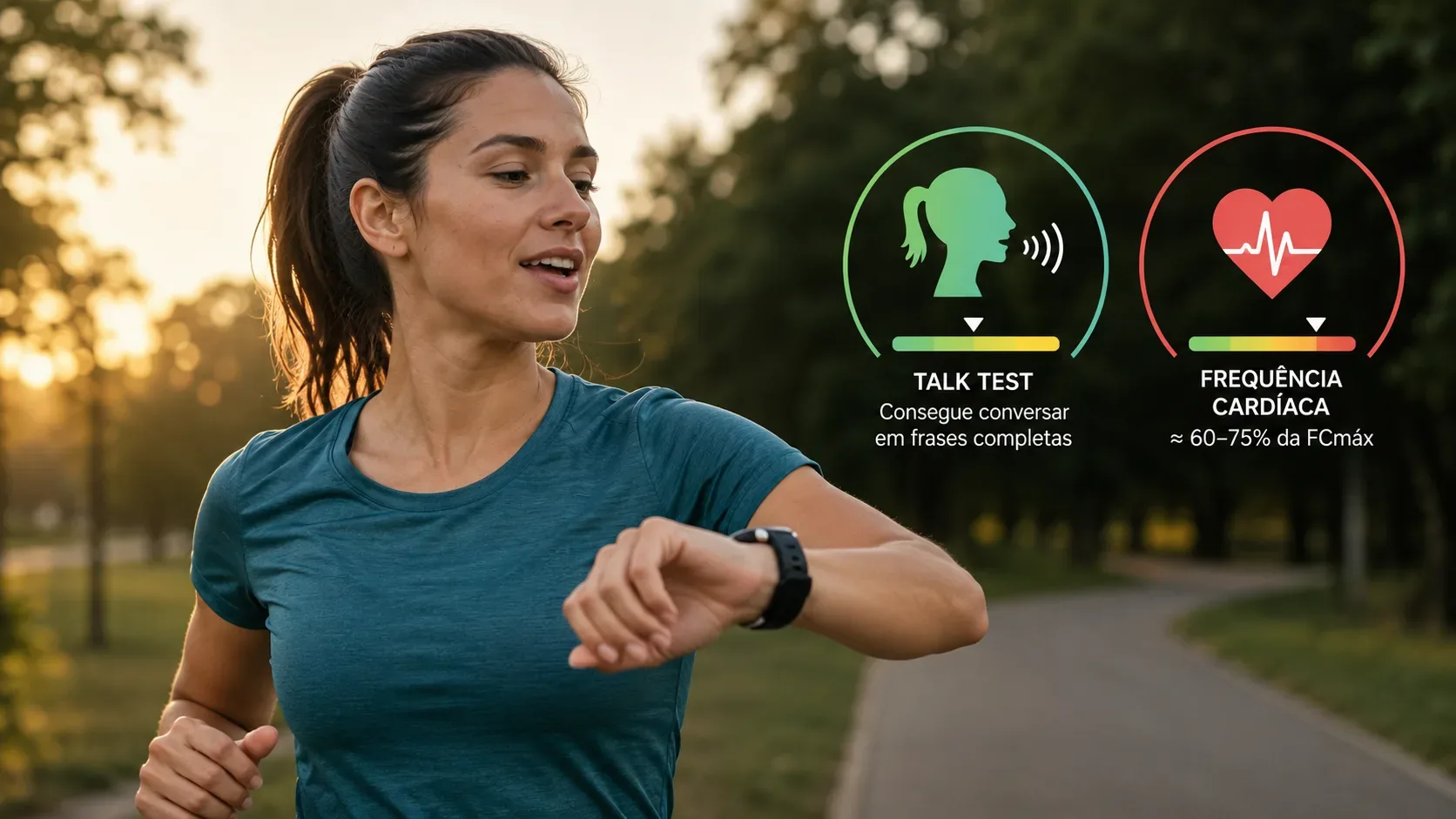
Therefore, using steps as the only measurement can leave out an important part of the picture. For cardiorespiratory conditioning, it is also worth observing whether there is activity at a pace that elevates your breathing and heart rate appropriately for you.
Strengthening is also off the counter
The WHO recommends strengthening activities for the main muscle groups on at least two days a week. Squats, weight exercises, machines, elastic bands and other forms of strength training can generate few steps and still fulfill a function that walking cannot completely replace.
This corrects a common error: reaching 10,000 steps does not, in itself, mean that all physical activity recommendations have been met. Likewise, a day with fewer steps can still include a relevant strength session or an activity without a high step count, such as cycling or swimming.
How to turn the counter into a useful goal
Use the number as a trend instrument. A typical week provides a better reference than a single day. Then, choose a progression that is small enough to fit into the routine and large enough to represent more movement.
Check whether the new level is sustainable for a few weeks. If it's easy and you want to increase, go ahead. If the goal is producing poor compensations, such as reducing sleep, ignoring pain, or abandoning other forms of exercise, the number is no longer doing its job.
It is also worth separating a minimum goal from an aspirational goal. On busy days, you can have a level that avoids returning to inactivity. On days with more time, you can walk beyond that without turning every daily variation into failure.
When is it worth individualizing with a professional
A step target for the population does not replace clinical guidance when there is known cardiovascular disease, significant mobility limitation, recovery from surgery, restricted pregnancy, persistent pain or symptoms triggered by exercise. In these cases, the best starting point and speed of progression may need individual adjustment.
Even without a specific condition, professional support can be useful when the step goal is part of a plan to improve fitness, control risk factors or return to activity after a long period of inactivity.
The most useful goal is the one that improves your routine without becoming a daily test
If 10,000 seems unattainable, current evidence offers a more practical message than simply swapping one number for another. Benefits appear before 10,000 steps, and the range around 7,000 has emerged as a relevant benchmark in a large synthesis of observational studies. That doesn't make 7,000 a universal prescription.
The best way is to use your starting point to decide the next step, literally. Increase movement sustainably, preserve space for intensity and strengthening, and treat the counter as a tracking tool, not a verdict on your day.
This content is informative and does not replace individual assessment by a healthcare professional.