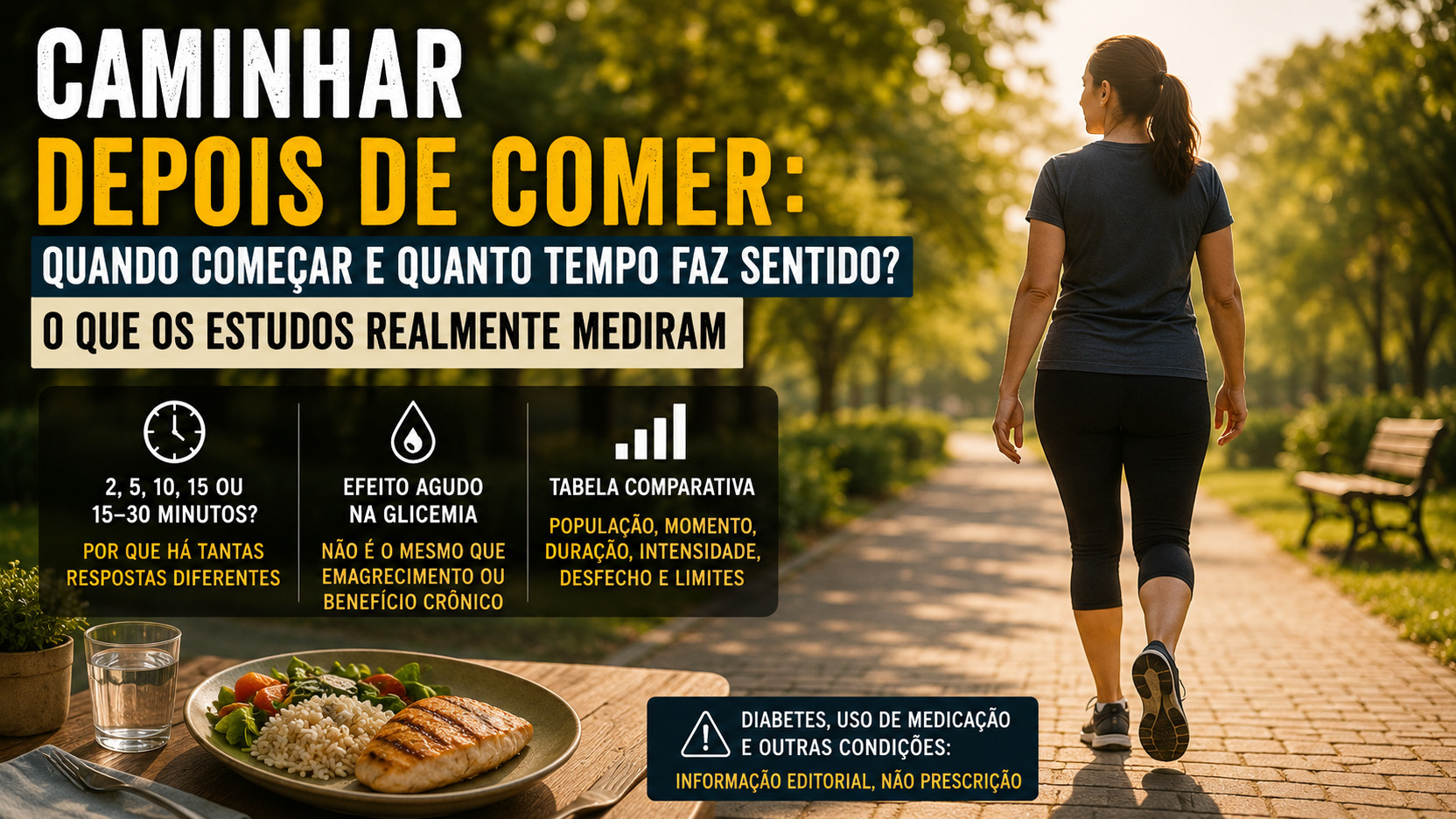
If the question is “do I need to wait half an hour to walk after eating?” or “is ten minutes enough?”, the literature does not provide a single number. What it shows most consistently is that walking close to a meal can reduce acute glucose elevation in different populations and protocols. The problem begins when durations tested in different studies become a universal rule.
The most repeated numbers - 2, 5, 10, 15, 20 or 30 minutes - answer different questions. Some experiments interrupted hours of sitting time with very short walks. Others prescribed a walk after each meal. Others have compared starting right away to waiting 30 minutes. And the outcomes varied between glucose peak, area under the curve, 24-hour average and glycemic variability.
The short answer: the objective changes the answer
For the most studied outcome, acute postprandial blood glucose, there is good reason not to treat “waiting 30 or 60 minutes” as a requirement. A meta-analysis published in Sports Medicine in 2023 found greater acute benefit when post-meal exercise started earlier, compared with starting later or exercising before eating. But the authors themselves worked with only eight crossover trials, 116 participants in total and a high risk of bias in the studies included.
This does not mean that walking immediately is always superior to any person, meal or goal. It means that, when the outcome is the glucose curve in the hours immediately after eating, the temporal proximity between meal and movement seems to matter.
Why 2 to 5 minutes is not a one-time walk
The most important source of this number is a 2022 review and meta-analysis on sitting time disruptions. The seven studies included were acute, one-day experiments in which participants spent long periods of time sitting and took frequent breaks from light activity. Many protocols used two minutes of walking every 20 minutes or five minutes every 30 minutes.
The meta-analysis found a better glucose and insulin response when sitting was interrupted by light walking, compared to remaining seated; walking was also superior to simply standing. However, this did not test the “finish lunch and walk for two minutes once” rule. The stimulus was repeated over several hours, and the total daily accumulated movement was well over two minutes.
For this reason, the headline “two minutes after eating is enough” compresses the protocol too much. The study supports that very short walking breaks can have an acute metabolic effect when repeated during sedentary periods. It does not establish two minutes as a universal minimum dose of post-meal walking.
What the 10-Minute Studies Really Tested
One of the most cited trials was published in Diabetologia in 2016. Forty-one adults with type 2 diabetes underwent two periods of intervention. In one, they were instructed to walk 30 minutes a day. In the other, they were instructed to walk ten minutes after each of the three main meals. The incremental area under the glucose curve in the three hours after eating was smaller with walking distributed after meals, with a particularly marked effect after dinner.
This drawing shows two things at the same time: the timing of the activity and the distribution of the same daily volume can change the postprandial response. It doesn't prove that ten minutes is a magic threshold, because the comparison was between three ten-minute meal-related blocks and one daily 30-minute block with no specific time.
In 2025, a study by Scientific Reports added another piece. Twelve young, healthy adults ingested 75 grams of glucose and, on different days, either rested, walked for ten minutes immediately, or waited 30 minutes and then walked for 30 minutes. Both walking conditions reduced the area under the curve and two-hour average glucose relative to rest. The glucose peak, however, was significantly lower compared to the control only in the immediate ten minute condition.
This result draws attention because it suggests that starting early can compensate for a shorter duration for some outcomes. But the study was small, used a glucose load instead of a regular meal, and included only young, healthy adults. It does not authorize the conclusion that ten minutes are always better than 30.
What does the 15-minute recommendation mean?
In 2013, a trial in Diabetes Care studied ten people aged 60 and over at risk of glucose intolerance. Participants took three 15-minute walks, starting 30 minutes after each meal, or one continuous 45-minute walk in the morning or afternoon. The sessions were done on a treadmill, at a standardized intensity of 3 METs.
Post-meal walks improved 24-hour blood glucose and were especially effective in reducing post-dinner blood glucose levels compared to continuous walks. The protocol helps explain why “15 minutes after eating” appears frequently in popular recommendations.
But the study did not directly compare five, ten, 15 and 20 minutes. It also involved a very small sample and a specific population. Fifteen minutes, therefore, is a duration that worked in that design, not a cutoff point demonstrated for the entire population.
Where do the 20 minutes come from
Another example is a 2018 study of 29 people with type 2 diabetes. On one of the days, participants walked for 20 minutes on a treadmill, at a moderate intensity, starting half an hour after the first bite of dinner. In another, they maintained their usual activities without extra exercise. Diet and medication were standardized.
Walking reduced the peak, mean and elevation of glucose in the two hours after dinner. Again, number 20 describes the protocol that was tested. The study did not demonstrate that 20 minutes is necessary, nor that it is greater than ten or 15 minutes under equivalent conditions.
Thirty minutes does not automatically mean “more benefit”
30-minute durations appear frequently because they are common in exercise protocols and because they allow you to accumulate a relevant volume of activity. But for the glycemic response immediately after a meal, duration and timing interact.
The 2025 study illustrates this well: walking for 30 minutes, but only after waiting half an hour, did not produce a glucose spike significantly lower than the control, while ten minutes started immediately did. This is not general proof that walking less is better. It is a demonstration that a comparison of duration without looking at the start time can be misleading.
So when to start: immediately, 15 minutes later or later?
The 2023 meta-analysis was designed precisely to compare exercise before and after a meal and evaluate the influence of the interval. In the pooled studies, post-meal exercise reduced glucose excursion relative to pre-meal exercise and the no-exercise control. The interval between meal and activity appeared as a moderator: the longer the delay, the lower the acute benefit on postprandial glucose, within the protocols analyzed.
On July 20, 2026, however, a new systematic review and meta-analysis brought a result that seems to point in another direction. She brought together 17 crossover studies in adults with type 2 diabetes and evaluated outcomes obtained by continuous glucose monitoring. Postprandial exercise produced modest improvements in mean 24-hour glucose, time above range, and measures of glycemic variability.
In subgroup analyses, sessions starting more than 60 minutes after the meal showed the greatest reductions in average 24-hour glucose and time above range. The decisive detail is that the differences between the time groups were not statistically significant. Exploratory analysis also did not find session duration or intensity as significant moderators after statistical correction.
Therefore, the 2026 review does not demonstrate that it is best to wait more than an hour. It shows that when the outcome changes from “peak or excursion shortly after a meal” to glucose metrics throughout the day in people with type 2 diabetes, the signals may change and the moderators remain unclear.
Why two studies can seem contradictory without actually canceling each other out
Population is a central difference. Healthy young adults, older people at risk for glucose intolerance, and people with type 2 diabetes do not have the same metabolic response or use the same medications.
The type of meal also changes the context. There are studies with a common meal, a standardized meal, a mixed drink and a load of 75 grams of glucose. Fat, protein, fiber and carbohydrates alter the speed at which glucose appears in the blood.
The outcome is another divider. Reducing the peak in the two hours after breakfast is not the same thing as reducing the 24-hour average glucose. The 2026 review, for example, found the strongest meal-specific effect at breakfast, while the 2016 trial noted a particularly important effect after dinner. These results came from different designs and comparisons.
There are also differences in intensity, environment and experimental control. Walking on a treadmill at 3 METs, walking at a comfortable pace and doing standardized moderate activity are not identical interventions. Turning them all into “a walk after eating” erases part of what the study actually tested.
Acute glycemia is not synonymous with weight loss, digestion or prevention
Most of the evidence discussed here measures glucose over a few hours or, at most, over the course of a day. Even the 2016 trial, which repeated the guidance for two weeks, had postprandial blood glucose as its primary outcome, not weight loss.
It is also necessary to separate gastrointestinal tolerance from “improving digestion”. In the 2025 study, participants reported little gastrointestinal discomfort from both the immediate ten-minute walk and the 30-minute walk started later. This informs tolerability in that small group; does not measure speed of digestion, reflux, gastric emptying or treatment of bloating.
The same care applies to preventing diabetes, cardiovascular disease or chronic benefits. Reducing a glycemic excursion in the laboratory is an acute physiological effect. It is not, in itself, proof that a certain duration of walking prevents a disease. The 2023 meta-analysis itself highlights that extrapolating its acute findings to long-term effects is speculative.
How to interpret 2, 10, 15 and 20 minutes without turning study into revenue
Two to five minutes mainly represents the literature of frequent breaks to break up long periods of sitting. Ten minutes is supported both in a trial of people with type 2 diabetes, when repeated after main meals, and in a small study of healthy adults when started immediately after a glucose load. Fifteen minutes appear in a small experiment with older people and risk of glucose intolerance. Twenty minutes was tested on people with type 2 diabetes after dinner.
These numbers are not interchangeable answers because the experimental question was not the same. If the editorial objective is to translate the evidence without exaggeration, the most defensible conclusion is that light or moderate walking undertaken close to a meal may improve the acute glycemic response, but there is still no basis for declaring a single duration nor an exact minute start as a rule for everyone.
For those who just want to incorporate movement into their daily lives and feel comfortable walking after eating, starting early is consistent with much of the evidence on acute blood glucose. If there are only a few minutes available, this may serve to break a sedentary lifestyle, but should not be presented as equivalent to the ten, 15 or 20 minute protocols.
Diabetes, insulin and medications require a different reading
In people with diabetes, especially when using insulin or medications that can cause hypoglycemia, the timing of activity is not just a question of metabolic efficiency. The 2026 Standards of Care in Diabetes warn that physical activity can precipitate hypoglycemia in those using insulin or insulin secretagogues if medication dose and carbohydrate intake are not appropriately adjusted.
Therefore, study results serve to explain trends, not to replace individual guidance. A meta-analysis may show an average reduction in glucose and still not predict the response of a person who uses insulin, has recurrent hypoglycemia, neuropathy, cardiovascular disease, or another condition that modifies the safety of exercise.
What is most useful
When one source says “two minutes,” another says “ten,” and a third says “15 to 30,” the correct question is not just which one is right. It is necessary to ask who was studied, how long after the meal the activity began, how long it lasted, at what intensity and what outcome was measured.
For acute postprandial glycemia, walking close to a meal is consistently supported. The most important point, however, is precisely what the headlines tend to miss: there is no single protocol capable of transforming all these studies into a universal rule of time and duration.