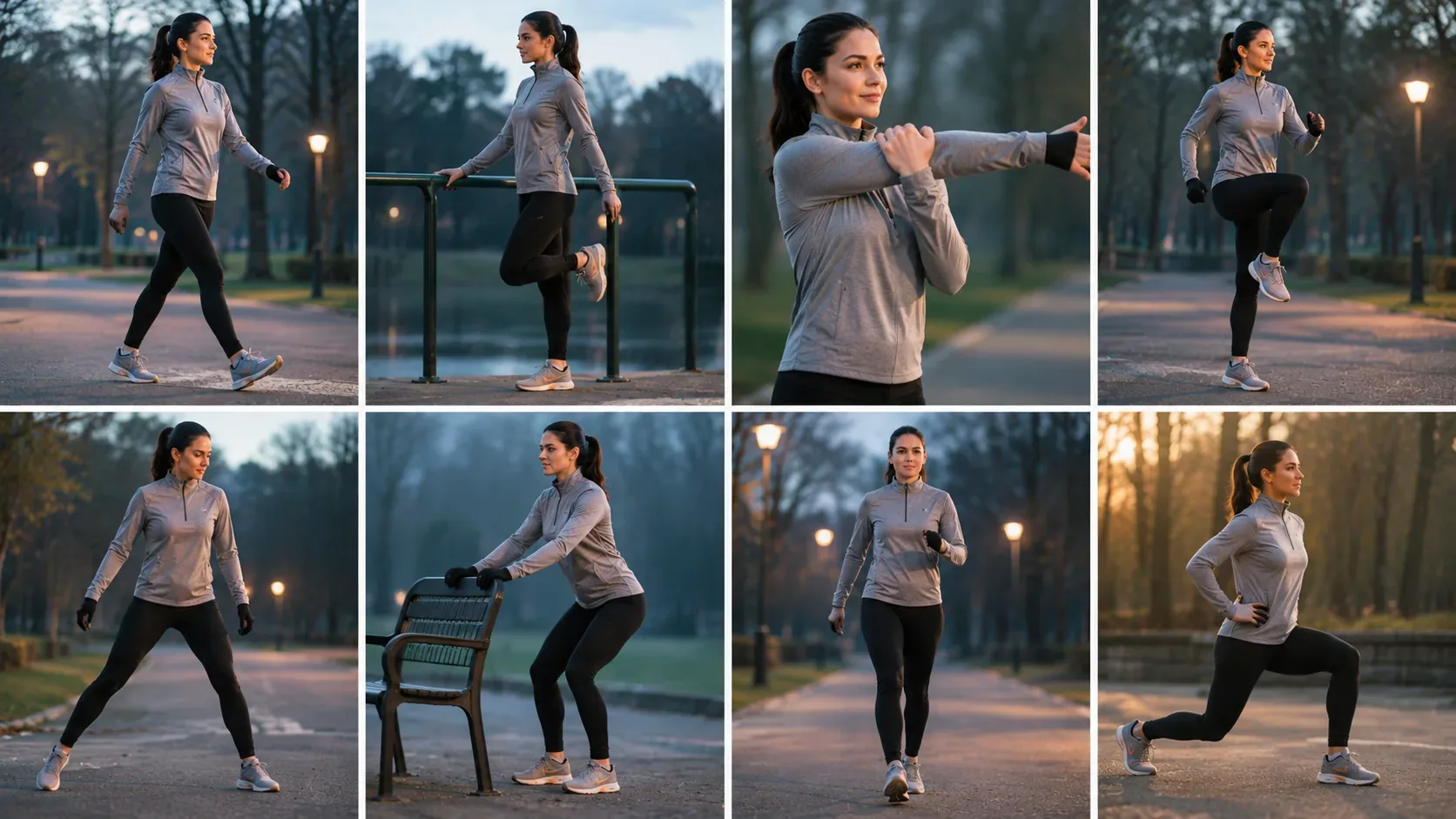
On a cold morning or evening, starting your workout in a hurry can make the first few moves feel stiff and uncomfortable. The solution is not to turn the warm-up into another workout: it is to increase the pace little by little until the body is ready to start the main activity.
The sequence below lasts eight minutes, requires little space, and can be used before a walk or strength training. The goal is to finish warmer and more coordinated, but still rested.
Eight minutes falls within the 5 to 10 minute range suggested by the American Heart Association for a gradual warm-up. In low temperatures, guidance published by the Ministry of Health recommends starting at a less intense pace and, when necessary, prolonging the preparation.
This is an educational guide, not an individual prescription or a promise to prevent injuries. People with symptoms during exertion, recent injury, medical condition, difficulty with balance or long period of inactivity may need professional evaluation and adaptation.
Before starting: the warm-up should remain light
Use a personal effort scale of zero to ten, where zero represents rest and ten represents the greatest effort possible. For most of this sequence, try to stay roughly between two and four: your breathing may get a little deeper, but you should still be able to speak in full sentences without difficulty.
This range is a practical reference for this guide, not a clinical classification. As a comparison, the CDC characterizes moderate intensity as five or six out of ten, typically allowing for talking but not singing. The proposed warming should be below this for most people.
Before you begin:
- choose a dry, stable and well-lit floor;
- use a wall, handrail or fixed bench for support, if necessary;
- Wear layers that can be removed if you start to sweat;
- avoid starting outdoors in wet clothing or in cold, windy or rainy conditions that you cannot comfortably tolerate.
Stretching does not replace warming up. In this sequence, the movements are continuous, small and controlled. Longer stretches, when they are part of the routine, can be performed after the muscles have already warmed up.
Eight-minute warm-up sequence
The proposal is an editorial synthesis based on the principle of starting with light movements, gradually increasing breathing and rehearsing the activity that will be performed next. It is not necessary to reach a specific amplitude or follow someone else at the same pace.
-
Minute 1 — Slow walk or march in place
Walk in a safe space or march without raising your knees too high. Let your arms hang loose and find a comfortable rhythm.
Expected sensation: easy movement, practically normal breathing and no rush to increase speed.
-
Minute 2 — Ankles and heel raises
Alternately, lift your heels and return to resting your feet. Then, gently transfer your weight between one foot and the other. Use fixed support if insecure.
Expected sensation: ankles and calves starting to work, without pain, tremors or loss of balance.
-
Minute 3 — Moving shoulders and arms
Make small circles with your shoulders. Then swing your arms back and forth without excessive momentum and without straining the joint.
Expected sensation: less still upper body, relaxed neck and free breathing.
-
Minute 4 — Low Knee Walk
Continue marching and raise each knee a little higher, just to a comfortable height. Keep your torso stable and slow down if you need to lean over or lose your rhythm.
Expected sensation: slight increase in body temperature and heart rate, still easy to talk to.
-
Minute 5 — Short Side Steps
Take a short step to one side, bring the other foot closer and repeat in the opposite direction. Keep your feet pointed forward and avoid crossing your legs.
Expected sensation: hips and legs participating in the movement, without rush and without impact.
-
Minute 6 — Sit and lift or slightly bend your knees
With a firm chair against the wall, sit down and slowly stand up a few times. Without a chair, do a small bend in your knees while holding a stable surface. Use short amplitude.
Expected sensation: light leg work, with control to go up and down without momentum.
-
Minute 7 — Resume walking and increase the pace a little
Walk or march a little faster than in the first minute. Don't try to reach the main training rhythm yet.
Expected sensation: warmer body, slightly faster breathing and still less than moderate effort.
-
Minute 8 — Rehearse the beginning of the main activity
To walk, gradually approach the pace you want to maintain for the first few minutes. To train strength, reproduce the first planned movement without load or with minimal resistance, in a few slow and controlled repetitions.
Expected feeling: preserved coordination, absence of abnormal symptoms and impression that you are ready to start — not that you have already trained.
How to know if the eight minutes were enough
When finished, note four points:
- you feel less cold or less rigid;
- breathing has increased slightly and remains comfortable;
- can speak a complete sentence;
- movements seem more coordinated than in the first minute.
If it's still too cold or stuck, don't compensate by accelerating suddenly. Repeat a minute or two of light walking, prepare indoors, or reduce your planned activity. At lower temperatures, heating may need to be longer, but should remain progressive.
If your warm-up is already at a five or six on your effort scale, you probably picked up the pace too soon. Slow down, reduce the amplitude and check if your breathing becomes comfortable again.
Signs to stop heating
A gentle warm-up should not produce intense symptoms. Stop the activity before:
- pain, pressure, heaviness, tightness or burning in the chest;
- intense, uncomfortable or very different from usual shortness of breath;
- dizziness, feeling faint, fainting or confused;
- very fast or irregular heartbeat accompanied by malaise;
- sharp or increasing pain that changes the way you walk or perform movements;
- loss of coordination, altered speech or sudden difficulty controlling arms and legs;
- persistent tremors, drowsiness, confusion, or clumsy hands after exposure to cold.
Persistent tremors, confusion, slurred speech, extreme tiredness and loss of coordination are among the signs associated with hypothermia. They require getting out of the cold, seeking shelter and seeking immediate medical attention, especially when there has been prolonged exposure, rain, sweat or wet clothing.
Chest pain or pressure accompanied by shortness of breath, heavy sweating, nausea, vomiting, or fainting may represent an emergency. In this situation, do not resume the exercise and call SAMU via number 192.
Even when symptoms improve with rest, new or recurring episodes of chest pain, unusual shortness of breath, dizziness, or palpitations need to be evaluated before attempting a new workout.
When to adapt the sequence with a professional
Seek individual guidance before using or progressing this sequence when:
- recent injury, surgery or pain crisis;
- recurrent falls or significant insecurity when standing;
- heart, respiratory, metabolic or kidney disease;
- shortness of breath, chest pain, palpitations or dizziness during daily efforts;
- pregnancy, postpartum, disability or functional limitation;
- medical guidance to control intensity, heart rate, blood glucose or blood pressure;
- return after a prolonged period of inactivity accompanied by symptoms or functional reduction.
Adaptation may involve sitting movements, additional support, more time at an easy pace or specific preparation for the chosen activity. It is not necessary to copy all eight movements when any of them do not suit your condition.
Heating prepares; he doesn't need to get tired
Regular physical activity is associated with physical and mental benefits, and the World Health Organization reinforces that any amount of movement is better than none. This doesn't mean that every session needs to start off intense or that the eight minutes should turn into a conditioning test.
In the cold, the best sign of a good warm-up is simple: you end up ready to go, with more natural movements and effort under control.
Save the sequence for the next cold mornings and nights. To also organize your weekly frequency, consult the guide How to maintain an active routine on cold days without trying to make up for everything on the weekend. When necessary, adapt the movements with a qualified health or physical education professional.