
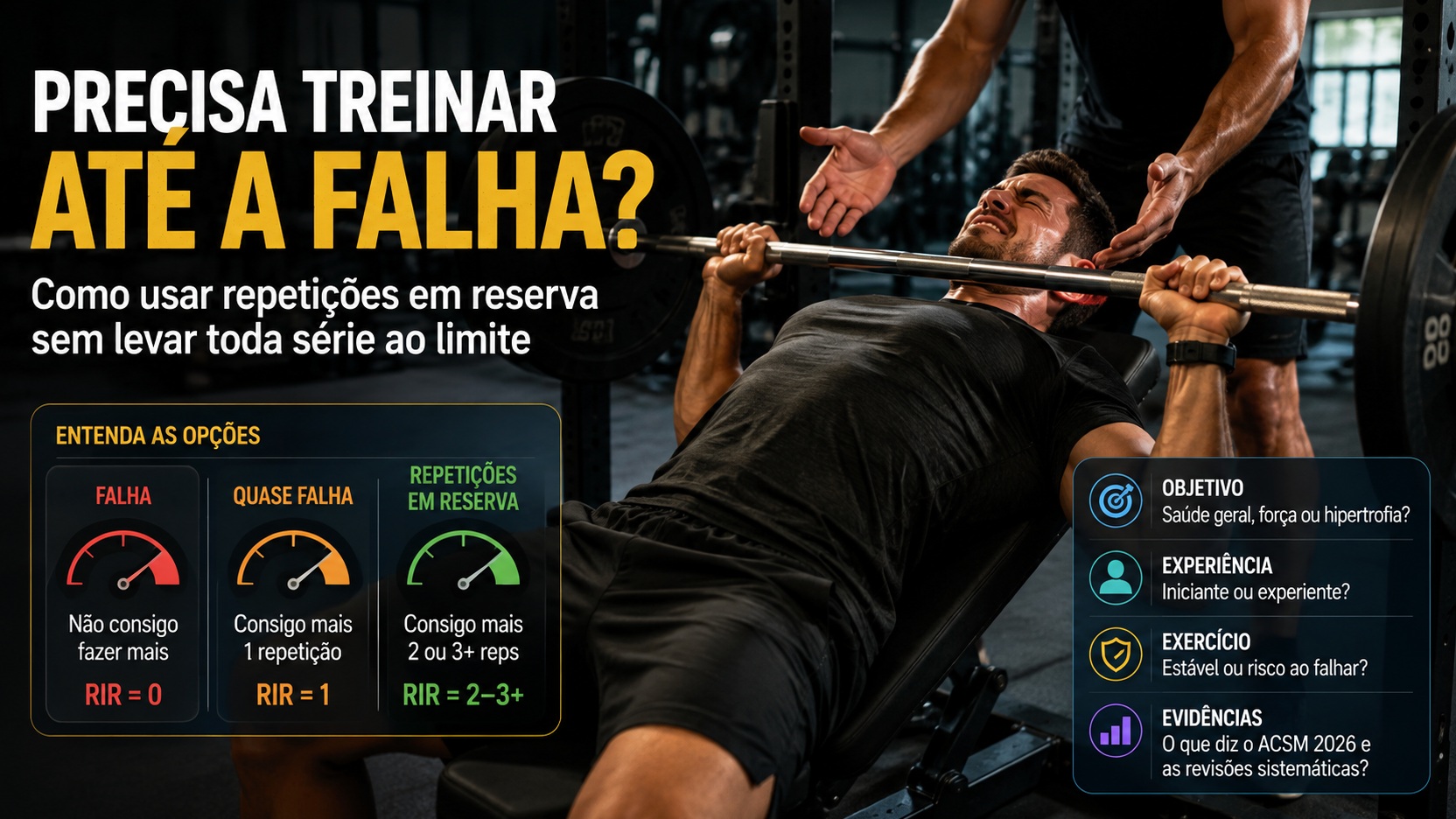
Failing every set is not a mandatory condition for gaining strength or muscle mass. The 2026 update from the American College of Sports Medicine (ACSM) reinforces a simpler message: For healthy adults, consistency, progression, and a goal-oriented program matter more than making muscle failure the norm. Failure can be a tool, but its cost in fatigue and its usefulness change depending on the exercise, experience and what you intend to develop.
In practice, the most useful question is no longer "to fail or not to fail?" and becomes "how close to failure does it make sense to get in this series?". That's where reserve repetitions, or RIR, come in. The method estimates how many complete repetitions would still be possible before momentary failure. RIR 3 means stopping when approximately three repetitions would still fit; RIR 1, when there would be one left; RIR 0, when no further complete repetition would be possible with the intended execution.
Momentary failure, technical failure and RIR are not the same thing
Momentary failure is the point at which the person can no longer complete the effort phase of another repetition, with the expected amplitude and without changing the way they perform the exercise. This definition is important because studies on "training to failure" have not always used the same criteria, one of the reasons why comparisons between studies require caution.
Technical failure is a different practical reference. It happens when the next repetition would require a relevant change in technique, range or body position to continue. In an exercise where losing position increases risk, the series should end before turning effort into improvisation. Thus, someone can end a series by technical limit even if, in a strict sense, they still had the strength to produce some movement in another way.
RIR is a pre-failure estimate. If you end a set at RIR 2, you are saying that you believe you could get two more full reps before momentary failure. This does not mean the estimate will be perfect. The value is used to regulate effort, not to measure capacity with laboratory precision.
What the 2026 ACSM update changes to the conversation
On March 17, 2026, the ACSM released its first major update on resistance training prescription since 2009. The document synthesized 137 systematic reviews, involving more than 30 thousand participants. For the average healthy adult, the ACSM concluded that advanced techniques, including bringing sets to fatigue or momentary muscle failure, did not consistently alter results to the point that they should be treated as a requirement.
This is not the same as saying that effort matters little. The synthesis itself highlights that programs must be individualized and that variables such as load and volume can be adjusted according to the objective. For strength, higher loads gain importance. For hypertrophy, weekly volume plays a relevant role. The message is that there is no need to add failure to every series to make a program effective.
The literature published before and after this update points in the same general direction, but with nuances. A meta-analysis published in July 2026 brought together 20 randomized studies, with 556 participants, and found a small advantage of failure-free training for dynamic strength, with no significant difference for hypertrophy, isometric strength, muscular endurance or power. The authors themselves classified the evidence on the outcomes as moderate and highlighted small samples and very different protocols.
For hypertrophy, getting close may matter more than getting exactly to failure
A 2024 meta-regression treated fault proximity as a continuous variable in RIR. For strength, gains were similar across a wide range of bench reps. For hypertrophy, the models indicated a tendency for greater growth as the sets ended closer to failure. At the same time, the authors warned that the RIR needed to be estimated from the description of the studies and that the exact relationship between the number of repetitions in reserve and the result has not yet been established.
This point helps to avoid two extremes. The first is to think that RIR 4 or 5 produces the same stimulus as any more difficult series in any context. The second is to conclude that RIR 0 will always be superior to RIR 1 or 2. The current best reading is that, for hypertrophy, sufficiently challenging sets seem important, but the evidence does not support the need to exhaust them all.
A systematic review with meta-analysis published in 2022 and printed in 2023 also found no advantage of momentary muscle failure over non-failure training for hypertrophy. The authors drew attention to the lack of a single definition of failure and the difficulty of knowing how close to failure the "no-failure" groups actually came.
Another meta-analysis, published in 2022 in the Journal of Sport and Health Science, included 15 studies, all with young adults. In the overall result, there was no significant difference between failing and not failing for strength or hypertrophy. There were signs in subgroups: when volume was not equalized, training without failure favored strength; Among trained practitioners, the analysis found a small advantage from failure for hypertrophy. These subgroup findings do not negate the overall result and have limited generalizability, particularly because the baseline was young adults and there was little data on older people and high-level athletes.
How to interpret RIR 3, RIR 2, RIR 1 and RIR 0 in practice
RIR 3 is a demanding series, but with a clear edge. When finished, you estimate that you would still be able to do approximately three full repetitions. For many specific warm-up sets, learning phases, heavy exercises that require a lot of technique or weeks in which recovery is worse, this margin may be enough to maintain quality without turning each set into a maximum test.
RIR 2 often represents a useful balance point. The series is clearly laborious, but there is still some reserve. In many strength and hypertrophy programs, working most of the time at around two reps in reserve allows you to accumulate quality work without the cost of trying to fail.
repeatedly.
LAUGH 1 is almost a failure. You believe you could only do one more full rep. This level of effort can be useful in selected hypertrophy sets or at specific moments in training, as long as the technique is stable and fatigue does not impair the rest of the session.
RIR 0 corresponds to momentary failure: no further complete repetition would be possible under the predicted conditions. It can be used strategically, especially in exercises where ending the series is simple and safe. It doesn't need to appear in every series or every exercise.
The decision changes depending on the objective
General health and strength maintenance
For those who train mainly for health, autonomy and maintenance of physical capacity, reaching failure in every series adds a requirement that current evidence does not show is necessary. The focus should be on training the main muscle groups regularly, progressing gradually and using an effort that is challenging without compromising execution. In the 2026 update, the ACSM reinforces that moving from no training to regular resistance training produces the biggest jump in benefit for most adults.
In this scenario, working frequently with some repetitions in reserve is a coherent choice. RIR 2 to 4 may be sufficient for most of the workout, especially for beginners or people still building exertion tolerance.
Maximum strength
For strength, the absolute proximity to failure appears to be less determining than other variables, such as the load used and the quality of repetitions. The ACSM synthesis favors higher loads, close to or above 80% of a maximum repetition, when the specific objective is to increase strength. The 2024 meta-regression also found similar strength gains across a broad range of RIR.
This makes failure unattractive as a pattern in heavy lifting. Stopping with one or more repetitions in reserve can preserve speed, technique and ability to perform the following sets. A really heavy set can be very stimulating without having to figure out, with each attempt, which repetition is going to get stuck.
Hypertrophy
To increase muscle mass, it is worth getting relatively close to failure in a relevant part of the sets, but this does not require that they all end at RIR 0. More recent literature suggests that proximity can influence hypertrophy, while direct reviews do not demonstrate consistent superiority to momentary failure.
In practice, RIR 1 to 3 provides a useful range for many series. Failure can occur in specific series, especially at the end of a stable exercise or in isolation movements in which the interruption is simple. If failing early greatly reduces the repetitions or load of the following sets, the effort gain in that set can cost volume and quality in the rest of the training.
Beginners and experts do not need to use the same margin
For beginners, the first challenge is learning to recognize effort and maintain technique. A person may think they are one repetition away from failure and, in fact, have several repetitions left; or it may persist beyond the point at which the execution began to fall apart. Studies on RIR-based scaling show that the method is usable, but its accuracy depends on familiarity with high effort, exercise, load, and proximity to failure.
Therefore, a beginner does not need to transform RIR into an exact account. Starting with a larger margin, like RIR 3 or 4 on many sets, and learning to recognize increasing slowdown and difficulty is a simpler strategy. Progression may bring some sets closer to the limit as technique and awareness improve.
Those who have been training for longer tend to have more references to compare today's series with previous series. Still, experience does not make the estimate infallible. A 2025 study found similar accuracy between novice and experienced Smith machine squatters, suggesting that familiarity with high efforts may be more important than just counting years of training.
The type of exercise changes the cost of making mistakes
Coming too close to failure on a knee extension, machine curl, or other exercise with a stable trajectory is often operationally different from failing an unlocked barbell bench press, a heavy free squat, or a movement in which losing position can leave a person trapped under the load.
This does not mean that free exercise is inappropriate. It just means that the margin of safety must enter into the decision. The greater the consequence of a failed repetition, the less sense it makes to use failure as a routine way to measure effort. Supports, safety stops, a competent partner and consistent technique reduce risks, but do not turn an uncontrolled repetition into a training objective.
In any exercise, sharp pain, dizziness, sudden loss of control or a major change in technique are reasons to end the series. LAUGHING should not be used to justify continuing when the problem is no longer just muscular fatigue.
Fatigue is part of the bill, not a trophy
A 2023 study of trained men and women compared sets to failure, 1 RIR, and 3 RIR. Acute neuromuscular fatigue increased as sets approached failure: failure produced more fatigue than 1 RIR, which produced more than 3 RIR. This relationship helps explain why two routines capable of generating similar adaptation can produce very different training experiences.
If the session has many exercises, if the practitioner trains the same muscle group again in a short time or if he also needs to perform in another sport, the cost of repeating RIR 0 may be more important. In contrast, in a short routine with few exercises and good recovery, a set to failure on a safe movement can be perfectly tolerable.
A decision matrix without turning RIR into dogma
If your main goal is general health and you are a beginner, keep a larger margin on most sets. Think of RIR 3 or 4 as a starting point and approach the limit only when the technique is stable and you better understand your response to exertion.
If the main objective is strength, prioritize quality repetitions and loads compatible with strength. Failure doesn't have to be the goal. In heavy, technically demanding lifts, leaving one to three reps in reserve tends to be more useful than proving that the next one wouldn't come.
If the main goal is hypertrophy, make the work sets difficult enough. RIR 1 to 3 is a practical range for much of the training. RIR 0 may be reserved for selected sets, especially in stable exercises, when additional fatigue will not impair the remainder of the session.
If the exercise becomes dangerous when the repetition fails, safety outweighs the search for RIR 0. In this case, treat the loss of technique or position as an operational limit and maintain enough reserve to finish the series under control.
If you can't estimate RIR, use performance over the weeks as feedback. Load, repetitions, amplitude, technique and perception of effort form a set. As you gain reference, the estimate improves. It is not necessary to test failure in high-risk exercises to "calibrate" the scale.
So, you need to train until failure?
Not as a rule. The best synthesis of evidence available in 2026 is that failing every set is not a requirement for strength, hypertrophy, or general health. For hypertrophy, getting relatively close to failure seems to matter more than for strength, but the exact point that maximizes results is not yet defined and varies with load, exercise, volume and individual.
RIR works better as a regulator of effort than as a command. Use higher margin when technique, security and recovery require it. Get closer to failure when the objective justifies it, the exercise allows it and the quality of the following series does not collapse. The right question is not whether the failure is good or bad, but whether the cost of that series to the cap buys something the rest of the program really needs.
The evidence cited here applies mainly to healthy adults undergoing resistance training. People with an injury, persistent pain, cardiovascular disease, relevant clinical condition or undergoing rehabilitation need individualized prescription by a qualified professional.