
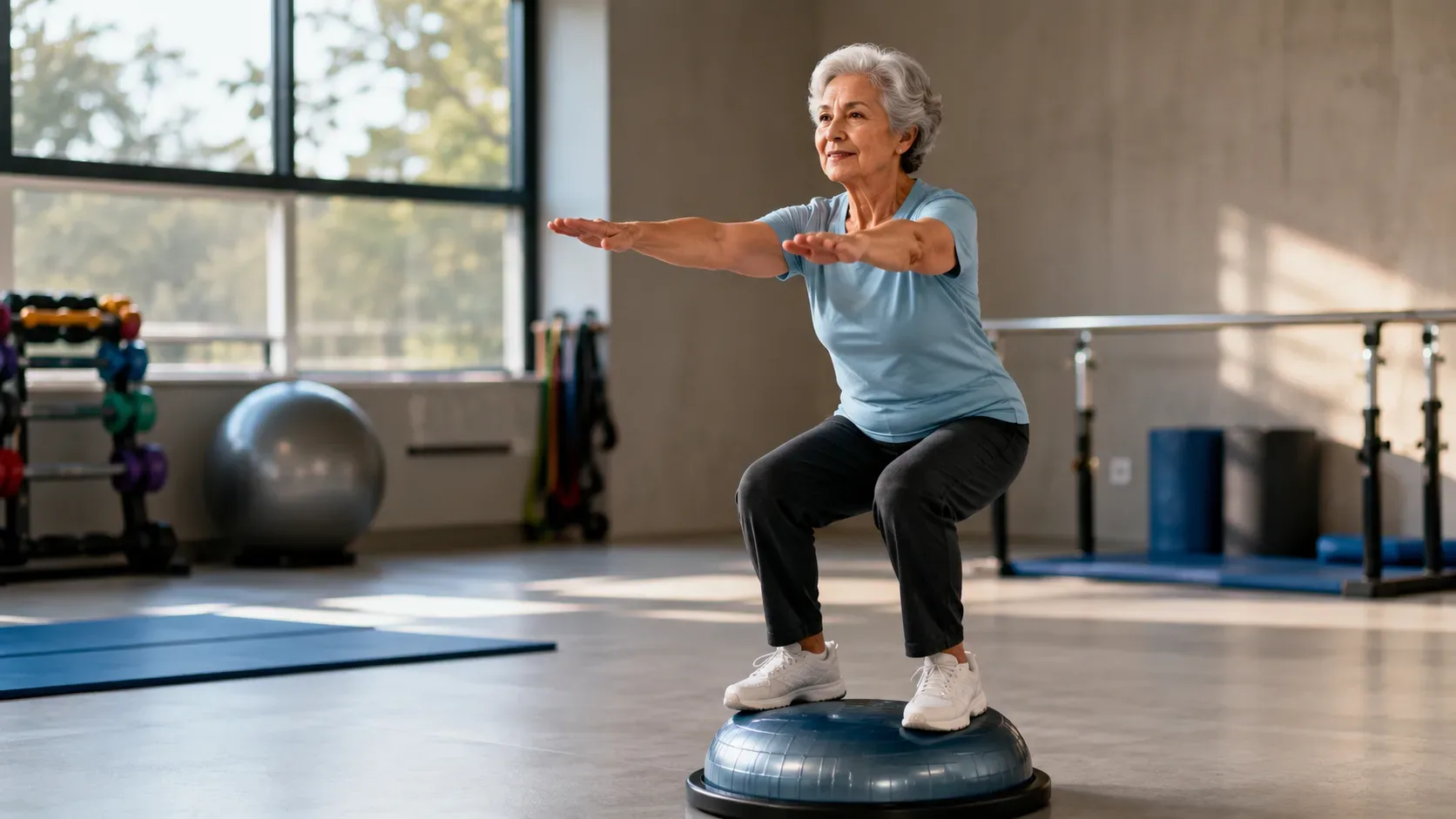
More unstable does not automatically mean more effective and it also does not mean useless. This is the most accurate reading of a new systematic review that compared resistance training performed on unstable surfaces with equivalent exercises on stable bases among older people.
The study was published in advance online on July 17, 2026 and is part of the August 1, 2026 issue of the American Journal of Physical Medicine & Rehabilitation. Therefore, August 1st is the date of the printed or formal edition of the journal, and not exactly the first publication of the research.
The review brought together seven randomized clinical trials described in eight articles. Six trials provided data for at least one meta-analysis, while one was analyzed descriptively. The bibliographic search included studies available up to July 9, 2025.
The conclusion is not that unstable training is always better nor that it should replace conventional training. Over 10- to 12-week periods, he did not demonstrate consistent superiority for leg strength, gait speed, or functional mobility. The advantages appeared in two specific points: less concern about falls in the short term and better results in the Timed Up and Go test after 24 weeks.
Myth: the more unstable, the better the training
Balls, inflatable discs, foam bases and balance platforms increase the need for postural adjustments during movement. This may give the impression that an exercise that is more difficult to stabilize will necessarily be more effective for strength, balance and fall prevention.
The evidence does not support this automatic equivalence.
Instability modifies the stimulus. It can increase the demand for postural control, but it can also reduce the external load, change the execution of the movement and shift part of the effort towards stabilization. The result depends on the objective analyzed: maximum strength, ability to stand up, speed when walking, response to disturbances or confidence to carry out activities.
In a trial with adults aged 65 to 80, for example, training with free weights on unstable bases was carried out with lower loads than those used in other modalities. Even so, the stable and unstable groups showed improvements, without a consistent overall advantage of one strategy over the others.
What the review actually compared
The question investigated was not “is training better than not training?”. The researchers compared two active interventions:
- resistance training on unstable surface;
- resistance training on a stable surface.
The outcomes were grouped into:
- lower limb strength:maximum isometric leg extension and sit-to-stand test five times;
- mobility: Timed Up and Go and gait speed;
- worry or fear of falling: Falls Efficacy Scale–International, the FES-I.
The authors separated short-term interventions, lasting 10 to 12 weeks, from those long-term interventions lasting 24 weeks.
This distinction is essential. A missing difference between two active programs does not demonstrate that either worked. It simply indicates that the inclusion of instability did not produce a sufficiently clear additional gain in that outcome and in that period.
Results by outcome and duration
The values below are standardized mean differences, or SMD. This measure makes it possible to combine studies that evaluated the same concept using different scales. The closer to zero, the smaller the difference observed between the groups.
| Outcome | Duration | Comparison result | Estimate presented | Practical reading | Editorial trust |
|---|---|---|---|---|---|
| Isometric leg extension strength | 10 to 12 weeks | No superiority of unstable training | SMD 0.16; 95% CI from −0.19 to 0.51; p=0.37 | Data is compatible with little or no difference between strategies | Low, due to the small set of studies and the range that includes no effect |
| Sit down and stand up five times | 10 to 12 weeks | No confirmed superiority; trend in favor of stable training | SMD 0.30; 95% CI of approximately 0 to 0.60; p=0.05 | Instability did not improve this test and the borderline result does not confirm a statistical advantage | Low, due to imprecision and result very close to the statistical limit |
| Timed Up and Go | 10 to 12 weeks | No significant difference | SMD 0.28; 95% CI from −0.23 to 0.80; p=0.28 | In the short term, there was no clear additional gain from instability | Low, with a wide range and compatible with different effects |
| Gait speed | 10 to 12 weeks | Practically no difference | SMD −0.03; 95% CI from −0.42 to 0.35; p=0.87 | The type of surface did not significantly change this result | Low, due to limited number of tests and imprecision |
| Concern about falls by FES-I | 10 to 12 weeks | Statistical advantage of unstable training | SMD −0.30; 95% CI from −0.56 to −0.03; p=0.03 | Small effect, favorable to reducing concerns about falls | Low, because the effect is small, the interval is close to zero and the outcome is self-reported |
| Timed Up and Go | 24 weeks | Advantage of unstable training | SMD −0.95; 95% CI from −1.38 to −0.52; pYou may also likeKeep reading the latest articles from the blog.  Need to train until failure? How to use reserve reps without pushing every set to the limitFailing every set is not a requirement for gaining strength or muscle. Understand RIR 0, 1, 2 and 3 and adjust effort to the goal, experience and exercise. Read article Walking is great — how to add strength twice a week without putting together an impossible workoutA guide to transforming strength recommendations into two simple sessions, with equipment-free movements, seated versions, and stop signals. Read article Incline walking or light jogging: how to compare intensity beyond speedSpeed alone cannot compare incline walking with light jogging. Learn how incline, perceived exertion, and the talk test help interpret relative intensity without turning the compar... Read article Delayed-onset muscle soreness: can you train the same sore muscle? Adjust by functionDOMS does not always rule out training. Use warm-up response, range, strength, and warning signs instead of treating soreness as proof of a good workout. Read article |