Many people record their walks and conclude that their physical activity routine is complete. Walking is an affordable and valuable choice, but the guidelines treat aerobic activities and muscle strengthening as different components.
The official calendar of the Ministry of Health marks August 5th as National Health Day. The date of 2026 can serve as a reminder to add what is still missing to the routine — not to start a program that is impossible to sustain.
For adults, the Physical Activity Guide for the Brazilian Population advises including muscle and bone strengthening activities on at least two days of the week. The World Health Organization also recommends strengthening activities of moderate or greater intensity, involving the main muscle groups, on two or more days per week. This is a population recommendation, not an individual prescription of exercises, loads or repetitions.
The purpose of this guide is to transform this guidance into a realistic starting point: two short sessions, organized by movement patterns, with equipment-free options and seated or supported adaptations.
Walking counts — but strength is another component
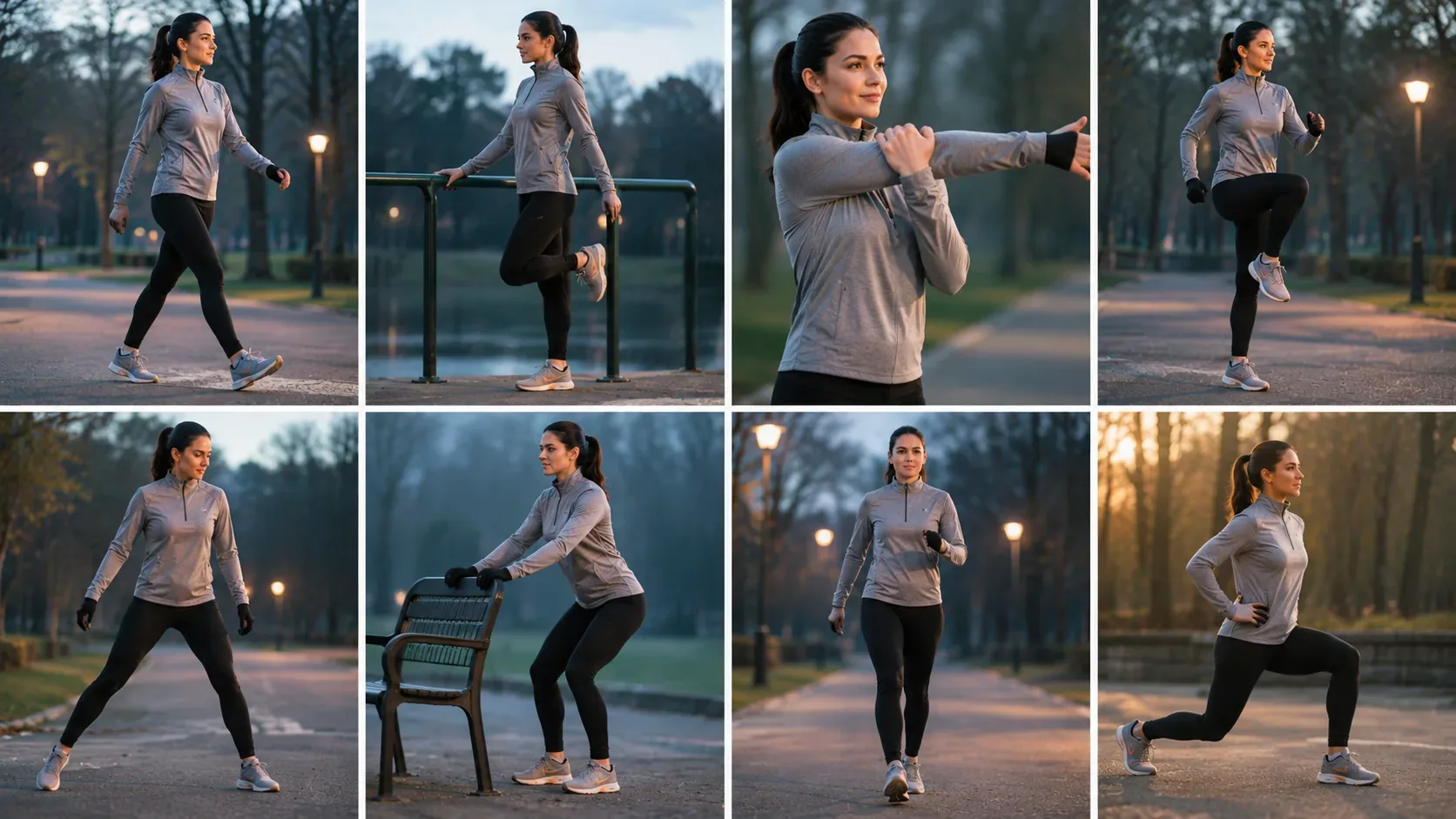
Walking can contribute to the aerobic portion of the routine, especially when the pace moderately increases breathing and heart rate. It can also make it easier to travel, socialize and maintain an active life.
A strengthening activity requires the muscles to produce force against some resistance. This resistance may come:
- own body weight;
- of a wall or stable surface;
- of an elastic band;
- of devices or weights;
- the opposition created by the body itself, in some isometric movements.
Therefore, walking on level ground should not automatically be counted as a full strength session. Climbs, stairs and more demanding walks can increase muscular work, but do not, in themselves, guarantee balanced stimulation for the upper body, trunk and all the main muscle groups.
The goal is not to choose between walking and strength. It is keep walking and reserve two small spaces to strengthen movements that help with daily tasks, such as getting up, pushing, pulling, supporting the torso and controlling the hips.
What “twice a week” doesn’t mean
The recommendation does not oblige a person to join a gym, train for an hour or follow a spreadsheet divided by muscles.
An update published by the American College of Sports Medicine in March 2026 concluded that, for healthy adults, moving from no resistance training to some regular practice produces a significant portion of the benefits. The document highlights consistency, individualization and the possibility of using body weight, elastic bands or home routines. Advanced techniques and training to muscle failure are not requirements for most people.
For starters, “twice” can mean:
- two full-length sessions;
- about 12 to 20 minutes per session, as an initial example;
- a single round of few moves;
- intervals as long as necessary;
- Easy enough versions to preserve control and security.
Separating the sessions by at least one day usually makes recovery easier for those just starting out. This is a practical organizing strategy, not a universal rule.
Assemble session by movement patterns
Thinking in patterns avoids the feeling that you need to memorize a long list of exercises. The idea is to choose an option from each group that is compatible with the person's space, mobility and experience.
The adaptations below are general examples. They do not replace a professional's assessment, especially when there is pain, injury, chronic condition, difficulty with balance or functional limitation.
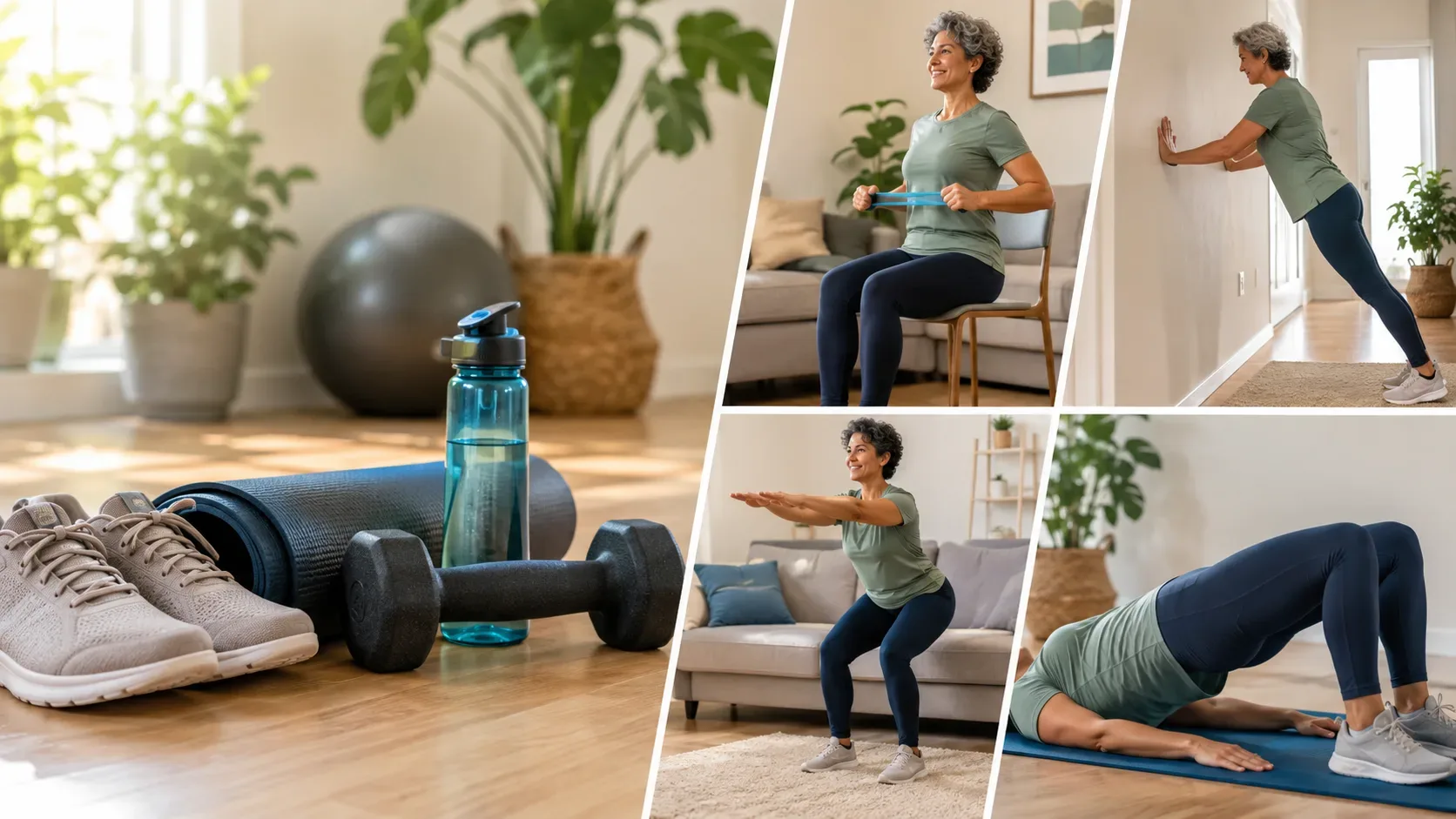
| Default | Unequipped option | Supported version | Seated or lower barrier version |
|---|---|---|---|
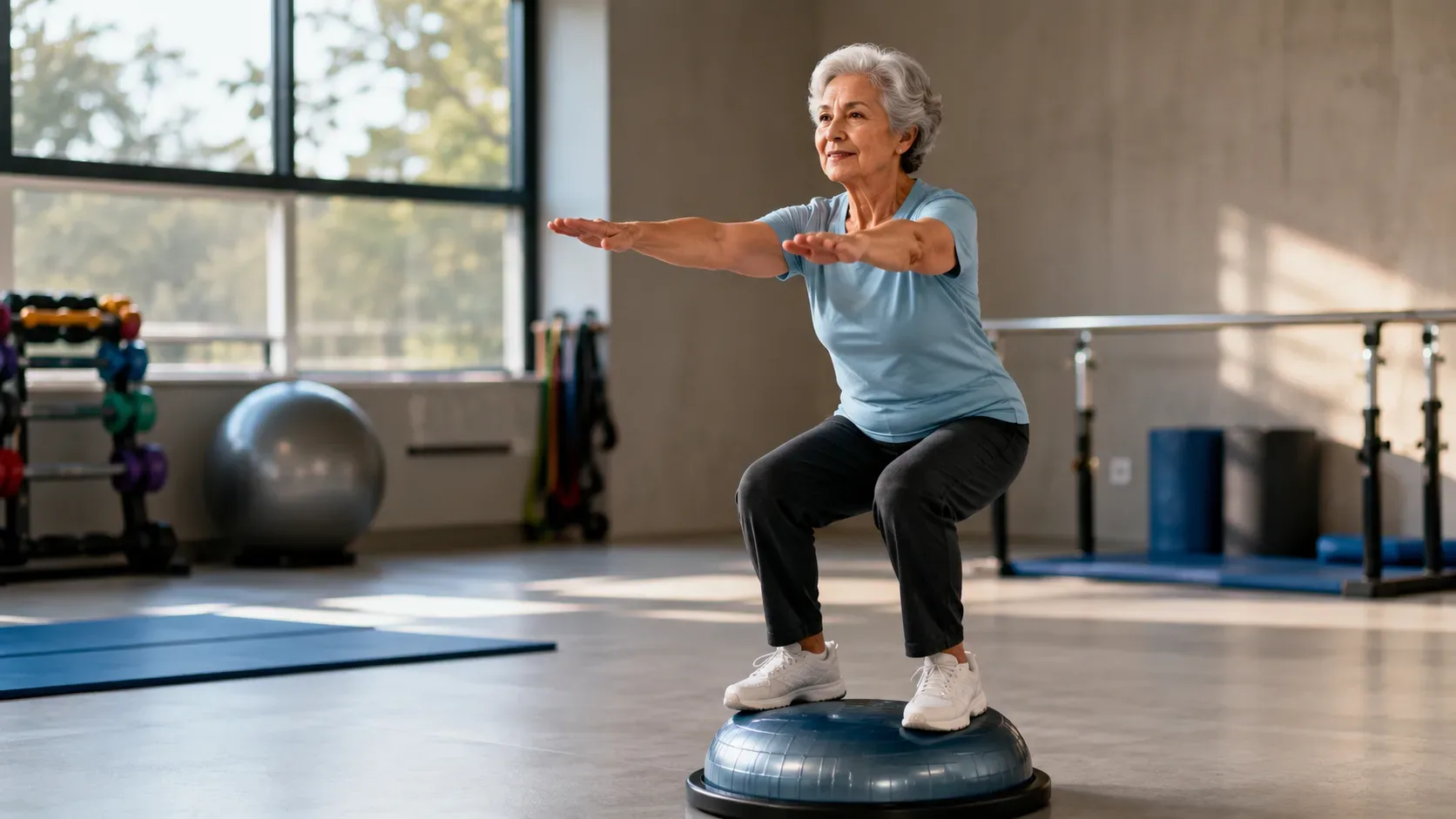
| Sitting and standing | Getting up from a chair and sitting down slowly | Short squats holding a fixed bench | Extend one knee at a time, keeping your torso supported |
| Push | Wall push-up | Push-up on a firm bench, higher than the floor | Press one palm against the other for a few seconds |
| Pull | Tension a towel between your hands, without catching it in doors | Rowing with elastic band securely attached | Gently retract your shoulder blades or use a seated elastic band |
| Hip bend | Raise your hips back until they lightly touch a wall | Lean torso with hands on a stable bench | Contract your glutes and alternate raising your feet |
| Ankles and calves | Raise and lower your heels | Heel raises holding a fixed surface | Raise your heels with your feet flat on the floor |
| Trunk and stability | Inclined wall support | Hand support on a bench | Seated gait, keeping the torso high and stable |
The pulling movement is the most difficult to reproduce without any equipment. Tensioning a towel or bringing your shoulder blades together can be an introduction, but offers limited resistance. When possible and safe, an elastic band expands options without requiring braces.
When using support, choose a really stable wall, handrail, or bench. Do not lean on a light chair, table with wheels or object that can slide. Clinical fall prevention resources reinforce the importance of using fixed supports and adjusting the level of support to the person's confidence and balance.
A simple scale to avoid turning everything into an endurance test
The scale below is a practical tool in this guide, not a clinical classification. When you finish a set, ask: “How much effort did that take, from zero to ten?”
| Perception | How it might look |
|---|---|
| 0 to 3 | Very easy; it would be possible to continue for a long time |
| 4 to 6 | Moderate; there is muscular work, but the movement remains controlled |
| 7 to 8 | Hard; requires attention, although it is still possible to preserve the technique |
| 9 to 10 | Near maximum or maximum; control and rhythm can start to get lost |
For an initial general health routine, a possible benchmark is to stay at around 5 to 7, without seeking failure. The last few repetitions may require effort, but should not cause contortions, loss of balance or the need to hold your breath.
During movements:
- breathe continuously;
- reduce amplitude when you lose control;
- stop the series before the posture becomes disorganized;
- rest until you feel you can safely repeat the movement.
Adequate effort varies between people and also from one day to another. Sleep, heat, food, medications, stress and recent illnesses can alter the response.
Weekly grid example
It is not necessary to abandon walking days. The force can be slotted between them.
| Day | Possible activity |
|---|---|
| Monday | Usual walk |
| Tuesday | Strength Session A |
| Wednesday | Light or usual walk |
| Thursday | Walking, mobility or rest |
| Friday | Strength Session B |
| Saturday | Walking or other enjoyable activity |
| Sunday | Rest or light movement |
Walking can be done on the same day as strength training when it fits better into your routine. In this case, a person can walk and then perform a few strengthening movements — or separate activities between morning and afternoon. The best arrangement is one that does not generate abnormal symptoms and can be repeated.
Session A: initial release
Choose a comfortable variation of each pattern:
- Sitting and standing up.
- Push the wall.
- Tension a towel or do rows with a band.
- Raise your hips back toward the wall.
- Raise your heels.
- Support the torso leaning against the wall.
Initially do one round. In repeated movements, use only the amount that allows you to maintain control — for example, between five and ten repetitions. For holds, a few seconds may be enough. Rest when necessary.
Session B: same structure, small variations
- Short supported squat or sit-stand.
- Wall push-up with slightly different hand position.
- Scapular retraction or rowing with a band.
- Standing hip extension, with support.
- Alternate knee extension in a seated position.
- Seated gait or bench support.
It is not necessary to change all the exercises. Repeating the same movements for a few weeks can make execution more predictable and make it easier to see progress.
How to progress without rebuilding the entire routine
Progression must be gradual. The Physical Activity Guide for the Brazilian Population advises starting according to possibilities and gradually increasing quantity and intensity.
When a session starts to feel easy, change just one variable:
- add one or two repetitions;
- include a second round;
- slightly increase the sustain time;
- use a variation with less support;
- choose an elastic band that is a little more resistant;
- perform the movement more slowly, without holding your breath.
Do not increase reps, resistance, range and number of rounds at the same time. A small change is easier to evaluate and undo if it causes discomfort.
The 2026 ACSM update also reinforces that programs need to be adapted to objectives, safety and adherence. An overly demanding plan loses value when it cannot be maintained.
When to start with professional assessment
It is not necessary to turn any slight movement into a medical procedure. The Brazilian guide himself states that a physically active daily life is safe for most people and that the fear of injuries should not prevent the practice.
Still, it is worth seeking individual guidance before setting up or progressing the routine when available:
- recent injury or surgery;
- pain that limits daily tasks;
- recurrent falls or significant insecurity in standing;
- shortness of breath, dizziness or chest discomfort during exertion;
- cardiac, respiratory, metabolic or renal condition that is not controlled;
- need to adjust medications, diet or insulin depending on exercise;
- pregnancy, postpartum or condition that requires specific adaptations;
- functional disability or limitation for which the general options are not suitable.
The Basic Health Unit can be a starting point to clarify symptoms and locate programs or professionals available in the territory.
Signals to stop activity
Stop exercise when an abnormal symptom occurs. The Ministry of Health cites chest pain, dizziness, nausea, pain and other discomforts as reasons to stop activity and seek evaluation.
Seek urgent care for signs such as:
- pressure, tightness or pain in the chest;
- severe shortness of breath or very different from usual;
- fainting or feeling faint;
- cold sweat, nausea, or dizziness associated with chest discomfort;
- sudden weakness or numbness, change in speech, sudden loss of balance or visual change.
The American Heart Association lists chest discomfort, shortness of breath, cold sweat, nausea and dizziness as warning signs for cardiac events. Sudden changes in balance, vision, strength and speech also require immediate response.
Stop the session and seek evaluation before resuming when there is acute or increasing pain, swelling, injury, loss of function, or discomfort that does not improve after rest.
A little muscle sensitivity after the first sessions may occur when the body performs movements that it is not used to. This should not be confused with sharp pain, increasing joint pain, or a symptom that changes the way you walk and perform tasks.
The minimum routine that fits into the week
To begin with, the goal can be deliberately simple:
- choose five or six patterns;
- do a controlled round;
- repeat the session on another day;
- keep the walks that already work;
- record the effort and any symptoms;
- progress only one variable at a time.
The two-day recommendation doesn't have to produce anxiety or a perfect spreadsheet. She can start with a firm chair, a wall, few movements and enough space to repeat the following week.
Save the weekly grid and mark the two completed sessions.
Read also: Do five minutes count? How to add physical activity throughout the day.