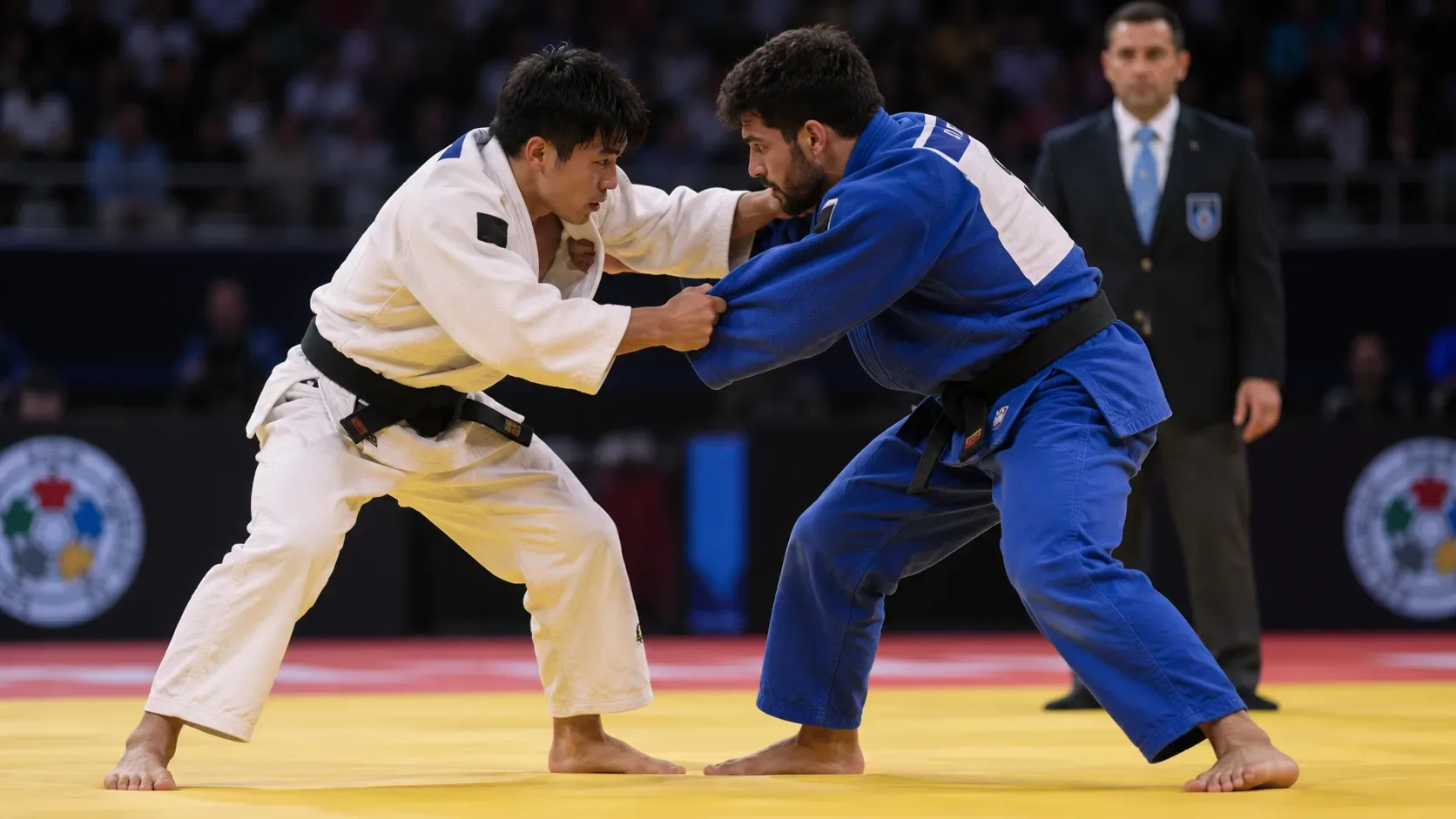
If the four minutes of a contest end with neither judoka holding a technical advantage, or with equal technical scores, the decision is not made simply by counting shidos. Under the current International Judo Federation (IJF) rules, the contest continues into golden score, with no time limit. Scores and penalties from regular time stay on the scoreboard, and the contest ends when there is a valid technical score, hansoku-make, or another rule-defined form of victory.
What happens when regular time ends
In IJF senior, junior and cadet competitions, regular contest time is four minutes of real contest time. At the end of that period, there are two main situations:
- if one judoka is ahead on technical scoring, that athlete wins;
- if there is no technical score or the technical scores are equal, the contest goes to golden score, regardless of how many shidos each athlete has.
This detail is essential: a shido is a penalty, not a score. The IJF rules explicitly state that a penalty does not correspond to a score for the opponent. Therefore, finishing the four minutes with two shidos against zero does not mean an automatic loss if the technical score is tied.
Golden score: a technical tie with no time limit
Golden score begins immediately after regular time is temporarily ended. There is no rest period. The referee restarts the contest once the scoreboard is ready, and there is no time limit for the extra period.
Everything already recorded remains in force: yuko, waza-ari and the number of shidos carry into golden score. From that point, the contest can end by:
- a yuko, waza-ari or ippon scored in golden score;
- hansoku-make, including indirect hansoku-make caused by accumulating three shidos;
- kiken-gachi, when withdrawal or inability to continue applies under the rules.
Because any valid technical score ends golden score, even a yuko is enough to decide the contest immediately. This matters because older explanations of international judo may not reflect the return of yuko in the current system.
Shido: a warning, not a point
The IJF treats shido as the penalty for minor infringements. The first two shidos are warnings. The third becomes indirect hansoku-make: the athlete is disqualified from that contest and the opponent wins by ippon.
That is why the shido count matters greatly even though it does not change the technical score. A judoka entering golden score with two shidos is one more penalty away from defeat. An athlete with zero or one shido has more room before reaching hansoku-make through accumulation.
The easiest point to misunderstand is this: the difference in shidos alone does not decide the contest when regular time expires. What ends the contest through penalties is reaching the third shido, or receiving direct hansoku-make for a grave infringement.
Practical scenarios that show how the decision works
| Situation after 4 minutes | What happens | Why |
|---|---|---|
| 0-0 in technical scores; white has 0 shido, blue has 2 | Golden score | Two shidos do not equal defeat. With the technical score tied, the contest continues. |
| White has 1 yuko and 2 shidos; blue has no score and no shido | White wins in regular time | The yuko is a technical advantage. The two shidos do not give points to blue. |
| 1 yuko each; white has 2 shidos, blue has 1 | Golden score | The technical scores are equal. The shidos carry into the extra period. |
| In golden score, an athlete who already had 2 shidos receives another | Loses by indirect hansoku-make | The third shido ends the contest. |
| In golden score, the score remains tied and one athlete scores yuko | Wins immediately | Any valid technical score ends golden score. |
Which actions can lead to shido under the current rules
The official list is extensive and the context of the action matters. Relevant situations under the current rules include:
- adopting an excessively defensive or negative posture without looking to attack;
- making a false attack, an action that looks like an attack but clearly shows no real intention to throw the opponent;
- showing non-combativity;
- intentionally leaving the contest area;
- using certain grips in a negative, blocking way or without offensive progression;
- grabbing the leg, gripping the trousers, or touching the leg from the top of the inner thigh downward in a prohibited tachi-waza situation;
- committing infringements related to wasting time or improper adjustment of the judogi or hair when covered by the rules.
This is a guide for reading a contest, not a substitute for the full official list. The assessment of an action depends on timing, athlete position and offensive continuity, and the IJF publishes technical examples to standardise refereeing.
Three shidos and direct hansoku-make are not the same thing
When the third shido causes disqualification, the rules call the result indirect hansoku-make. In general, the athlete loses that contest but may continue in the competition if another applicable stage remains.
Direct hansoku-make is different: it can be imposed immediately for a grave infringement without three previous shidos. Depending on the nature of the infringement, the athlete may or may not be allowed to continue in the event. The IJF distinguishes, for example, dangerous techniques from acts against the spirit of judo.
There is also a rare situation: if both athletes receive their third shido simultaneously in regular time or golden score, both receive indirect hansoku-make and are considered losers of that contest, with placement consequences depending on the stage of the competition.
How to read the scoreboard during golden score
- Look at the technical scores first. Yuko, waza-ari and ippon define the sporting advantage; two waza-ari become waza-ari-awasete-ippon.
- Then check the shidos. They do not become points, but they show who is closer to a third shido and hansoku-make.
- At the end of four minutes, compare the technical score. If it is equal, there will be golden score even if the shido counts are different.
- In golden score, the first valid technical score ends the contest. A new shido ends the contest only if it produces hansoku-make, as with a third shido.
Current yuko scoring also has its own rule: yukos can accumulate as yukos, but they do not add up to waza-ari. Two waza-ari, by contrast, result in ippon.
What changed compared with older explanations
Anyone who learned golden score from material produced in previous rules cycles may find differences. The current system again uses yuko, and the IJF explicitly states that yuko, waza-ari or ippon can end golden score. An older guide saying that only waza-ari, ippon or a decisive penalty can end the extra period is therefore outdated for the rules in force in 2026.
It is also important not to reuse explanations from cycles in which the relationship between shidos and tiebreaking worked differently. The current rule is straightforward: if the technical scores are equal at the end of regular time, the contest continues, regardless of the number of shidos already recorded.
Which version of the rules this guide uses
This article uses the IJF Sport and Organisation Rules, version dated 24 July 2026 as its main reference, especially the articles on ending a contest, golden score, scoring and penalties. When confirming the rules for the 2026 season, the IJF also said the refereeing framework would be stabilised for the Olympic qualification period through Los Angeles 2028. The federation can still publish explanatory documents and clarifications, so for future events it is worth checking the IJF's official 2026 rules communication and the latest version of the regulations.