The libero is a defensive specialist who plays as a back-row player. The key rule for understanding entries and exits is that a libero replacement is not a regular substitution. Under the FIVB Official Volleyball Rules 2025-2028, libero replacements do not count as substitutions, are unlimited, and follow their own procedure.
What the libero can do
The libero may replace any player in a back-row position. This lets a reception and defense specialist take the backcourt when, for example, a middle blocker reaches the back row in the rotation.
- Allowed: receive serves, defend attacks, set the ball, and replace players in back-row positions.
- Not allowed: serve, block, or attempt to block under the official 2025-2028 rules.
- May not complete an attack hit: if the ball is entirely above the top of the net at contact, regardless of court location.
There is also a setting restriction. If the libero makes an overhand finger pass from the front zone, a teammate may not complete an attack hit while the ball is entirely above the top of the net. If the same action is made from outside the front zone, the ball may be attacked freely. The FIVB basic-rules explanation also emphasizes serve reception and backcourt defense.
How the replacement works during rotation
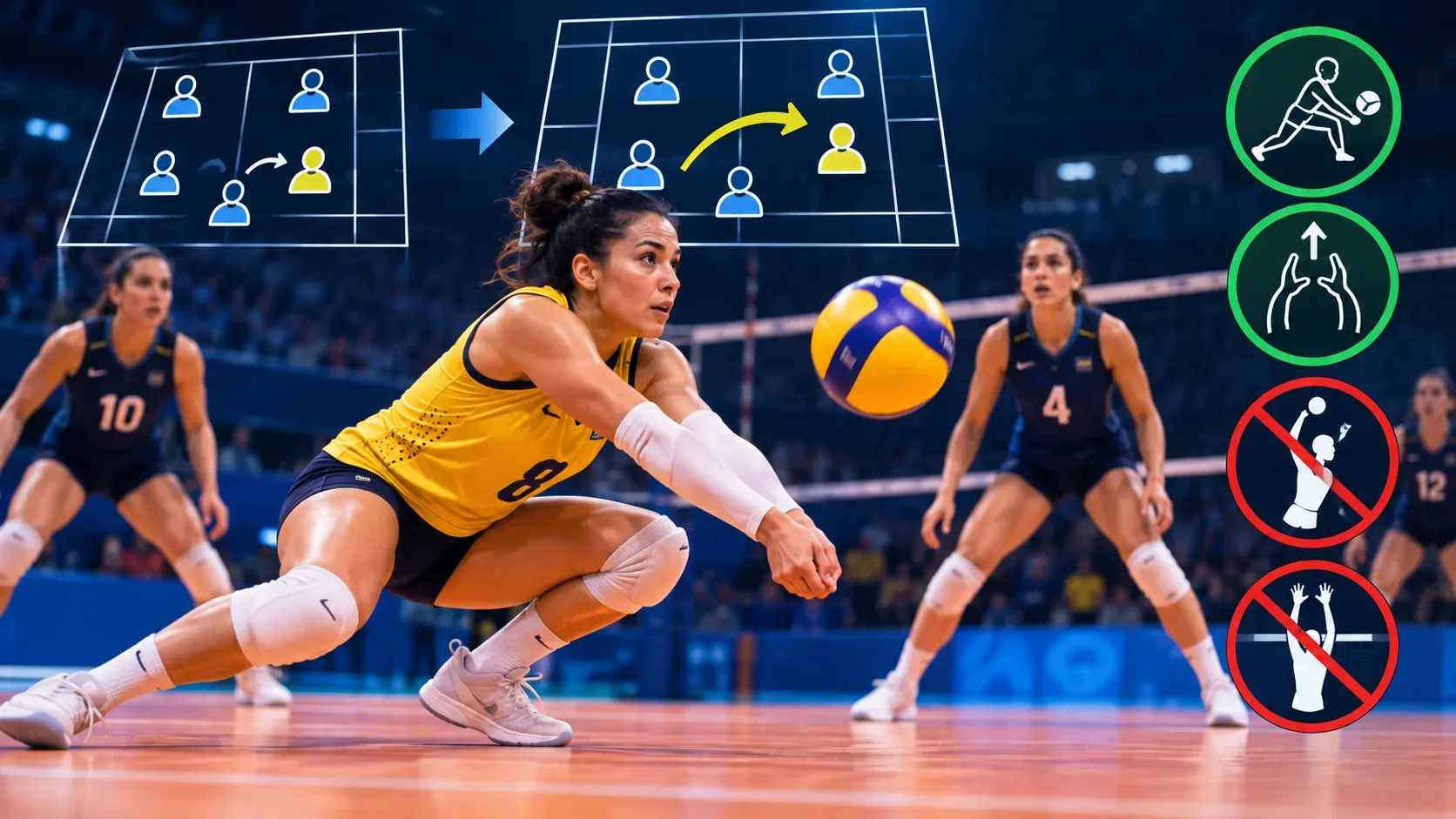
The six players in the lineup keep their rotational order. When the team wins the right to serve, they rotate one position clockwise. The libero does not create a seventh rotational position. The libero enters for a player when that slot is in the back row and must leave when rotation would move the slot to the front row.
Practical example
- A middle blocker in the regular lineup reaches a back-row position.
- While the ball is out of play and before the whistle for service, the libero may enter through the libero replacement zone.
- The libero plays in the backcourt while that rotational slot remains in the back row.
- When rotation moves that slot to position 4 in the front row, the libero must leave. The corresponding regular player returns, or the second libero may take over when the rules allow it.
This is why saying that “the libero rotates” can be misleading. The team rotates normally, but the libero may occupy only back-row positions. Entry and exit track the position of the player being replaced.
A libero replacement is not a regular substitution
| Situation | Libero replacement | Regular substitution |
|---|---|---|
| Counts toward the limit? | No | Yes, under the applicable regulations |
| Number | Unlimited, subject to procedure | Limited by the regulations |
| Who may enter? | The regular replacement player for that position or, when applicable, the second libero | An eligible player under substitution rules |
| Area | Libero replacement zone on the bench side | Substitution zone |
As a rule, there must be a completed rally between two libero replacements. A replacement takes place while the ball is out of play and before the whistle for service. The libero and replacing player enter and leave through the specific zone in the free zone on the bench side, between the extension of the attack line and the end line.
Who can replace the libero when the libero leaves
The regular player replaced by the libero may return to that position. If the team has two registered liberos, the second libero may also replace the acting libero under the conditions in the rules. This prevents libero replacements from becoming unrestricted substitutions between arbitrary players.
What to watch in 2026
The Official Volleyball Rules 2025-2028 remain the general reference. In February 2026, the FIVB announced rule and procedure tests for selected 2026 competitions, including more regular substitutions per set and adjustments to receiving-team positioning. The FIVB stated that any update to the Official Rules would depend on review of the testing phase. These tests do not turn libero replacements into regular substitutions.
How to track it during a match
Follow the regular player whom the libero replaced. If that player was in the back row, the libero may occupy the slot. When the slot advances to the front row, look for the libero to leave and the corresponding player to return. This separates three concepts: the six-player rotational order, the special libero replacement, and a regular substitution.