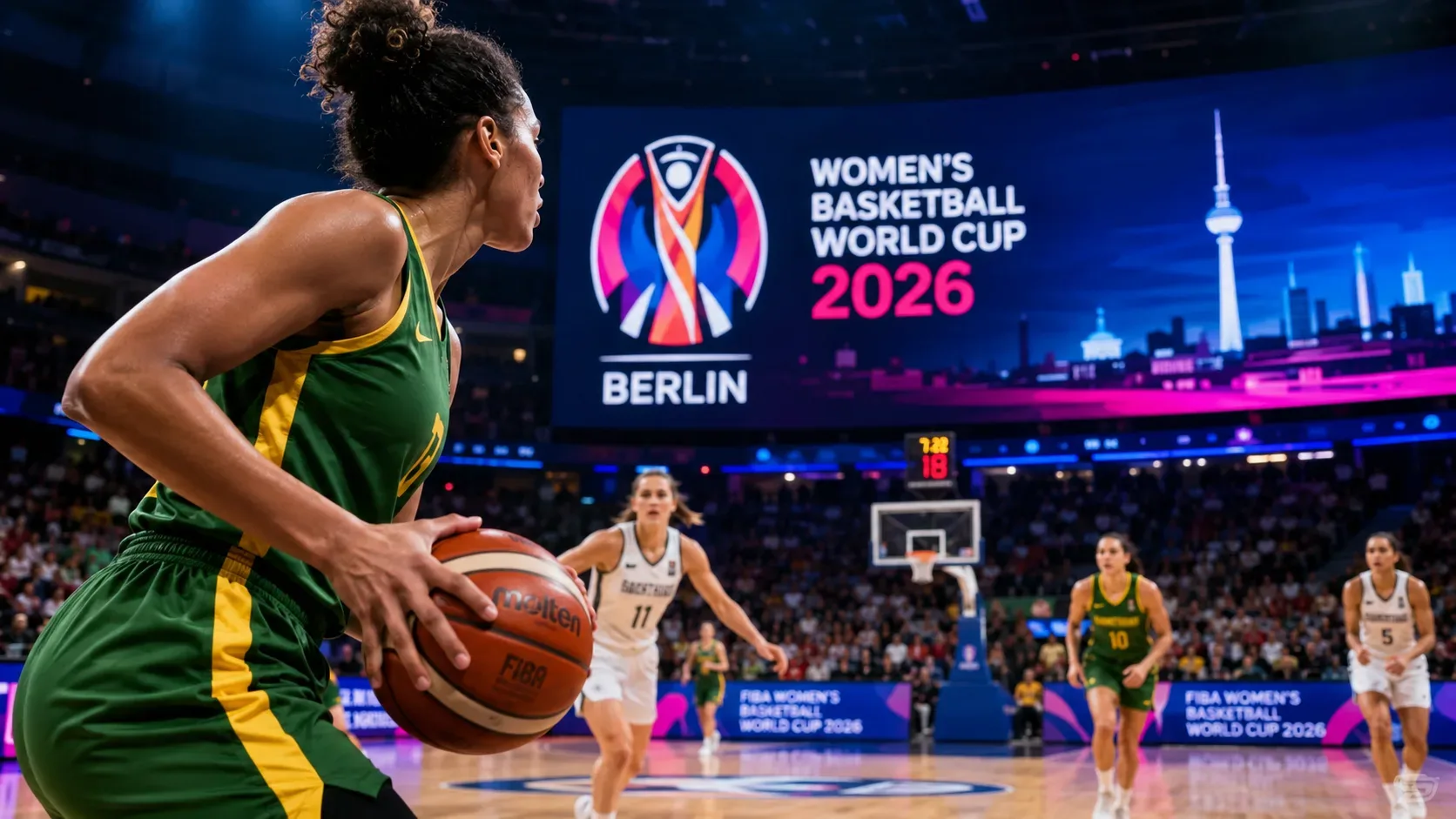
The 2026 FIBA Women's Basketball World Cup in Berlin will feature 16 national teams and a format in which group position directly changes the route through the knockout stage. The biggest advantage is finishing first: the four group winners advance straight to the Quarter-Finals. Teams that finish second or third must play an extra single-elimination game, officially called the Qualification to Quarter-Finals. The fourth-placed team is eliminated.
How the format works at a glance
The competition will run from September 4 to 13, 2026, with 36 games over ten days. The 16 teams are divided into four groups of four, and each team plays the other three teams in its group. After that, the tournament becomes entirely single elimination.
| Group position | What happens | Next step |
|---|---|---|
| 1st place | Direct qualification | Quarter-Finals |
| 2nd place | Plays a single qualification game | Must win to reach the Quarter-Finals |
| 3rd place | Plays a single qualification game | Must win to reach the Quarter-Finals |
| 4th place | Eliminated | End of tournament |
This setup makes winning the group especially valuable: besides avoiding an immediate elimination game, it gives the team an extra day to prepare for the Quarter-Finals.
What are the groups at the 2026 Women's Basketball World Cup?
| Group | Teams |
|---|---|
| A | Japan, Spain, Germany and Mali |
| B | Hungary, Korea, Nigeria and France |
| C | Belgium, Australia, Puerto Rico and Türkiye |
| D | USA, Czechia, Italy and China |
The Group Phase runs from Friday, September 4, through Monday, September 7. With four teams in each group playing a single round robin, there are six games per group and 24 in this stage overall.
What is the “play-in” round for the Quarter-Finals?
“Play-in” is a useful shorthand for readers, but it is not the official name. FIBA calls the stage the Qualification to Quarter-Finals. There is no best-of-three series, home-and-away tie or second chance: it is one single-elimination game.
The matchups are determined by final group position and pair Groups A with B, and Groups C with D:
- Game 25: 2nd in Group A vs 3rd in Group B;
- Game 26: 2nd in Group B vs 3rd in Group A;
- Game 27: 3rd in Group D vs 2nd in Group C;
- Game 28: 3rd in Group C vs 2nd in Group D.
Games 25 and 26 are scheduled for Tuesday, September 8, while Games 27 and 28 are scheduled for Wednesday, September 9. The official schedule reserves 17:45 or 20:45 local Berlin time (GMT+2) for these games; the specific order is set after the previous round.
How the qualification winners enter the Quarter-Finals
The Quarter-Final bracket does not simply keep the A-B and C-D pairings together. After the qualification round, the winners cross over to face group winners from the other half. FIBA has set the path as follows:
- Game 29: winner of Game 27 vs 1st in Group A;
- Game 30: winner of Game 28 vs 1st in Group B;
- Game 31: 1st in Group C vs winner of Game 25;
- Game 32: 1st in Group D vs winner of Game 26.
In practice, a team that finishes second or third in Group A or B, for example, can reach a Quarter-Final against the winner of Group C or D. This avoids the common misconception that a team surviving the play-in must necessarily meet another team from the same paired groups.
Knockout schedule: September 8 to 13
| Date | Stage | Times listed by FIBA |
|---|---|---|
| September 8 | Qualification to Quarter-Finals: Games 25 and 26 | 17:45 or 20:45 |
| September 9 | Qualification to Quarter-Finals: Games 27 and 28 | 17:45 or 20:45 |
| September 10 | Quarter-Finals | 11:30, 14:30, 17:45 and 20:45 |
| September 11 | No knockout games | — |
| September 12 | Semi-Finals | 16:30 or 20:00 |
| September 13 | Third Place Game and Final | 16:30 and 20:00 |
The times above are local Berlin times, shown in the official schedule as GMT+2. FIBA also states that the order of games from September 8 through 12 will be announced after the preceding round, so each team's exact tip-off time depends on who advances.
How the Semi-Finals and medal games are connected
The Quarter-Finals feed two Semi-Finals: the winner of Game 29 faces the winner of Game 32, while the winner of Game 30 plays the winner of Game 31. Both Semi-Finals take place on September 12. The winners play for the title on September 13; the losing teams meet in the Third Place Game on the same day.
The format remains single elimination through the end. FIBA's published system lists the Quarter-Finals, Semi-Finals, Final and Third Place Game, with no separate classification bracket for fifth through eighth place.
How group position changes the number of games
The difference between finishing first and placing second or third is not only the opponent. A group winner that reaches a medal game will play six games in the tournament: three in the Group Phase, then a Quarter-Final, Semi-Final and either the Final or Third Place Game. A second- or third-placed team that follows the same route will play seven because it must add the Qualification to Quarter-Finals game.
A fourth-placed team, by contrast, ends its tournament after three games. The Group Phase therefore determines survival, rest and the maximum number of games required to reach the title game.
Why winning the group matters so much
The advantage combines three factors. First, it removes the risk of elimination in an extra game on September 8 or 9. Second, it reduces accumulated physical load. Third, it allows direct preparation for the Quarter-Finals on September 10 without having to survive the intermediate round. It does not guarantee an easy opponent, because the Quarter-Final opponent will come from a matchup between second- and third-placed teams, but it objectively improves the path into the decisive phase.
Where to check time changes and the updated bracket
For changes and the assignment of exact tip-off times as teams advance, the primary reference should be FIBA's official pages. The competition system explains the qualification logic; the 2026 World Cup guide brings together the groups and stage dates; and the official schedule PDF shows the matchups, game numbers and knockout time windows.
In short: first place goes directly to the Quarter-Finals; second and third play a single qualification game; fourth is eliminated. From there, every game is single elimination, with the Quarter-Finals on September 10, the Semi-Finals on September 12 and the medals decided on September 13.