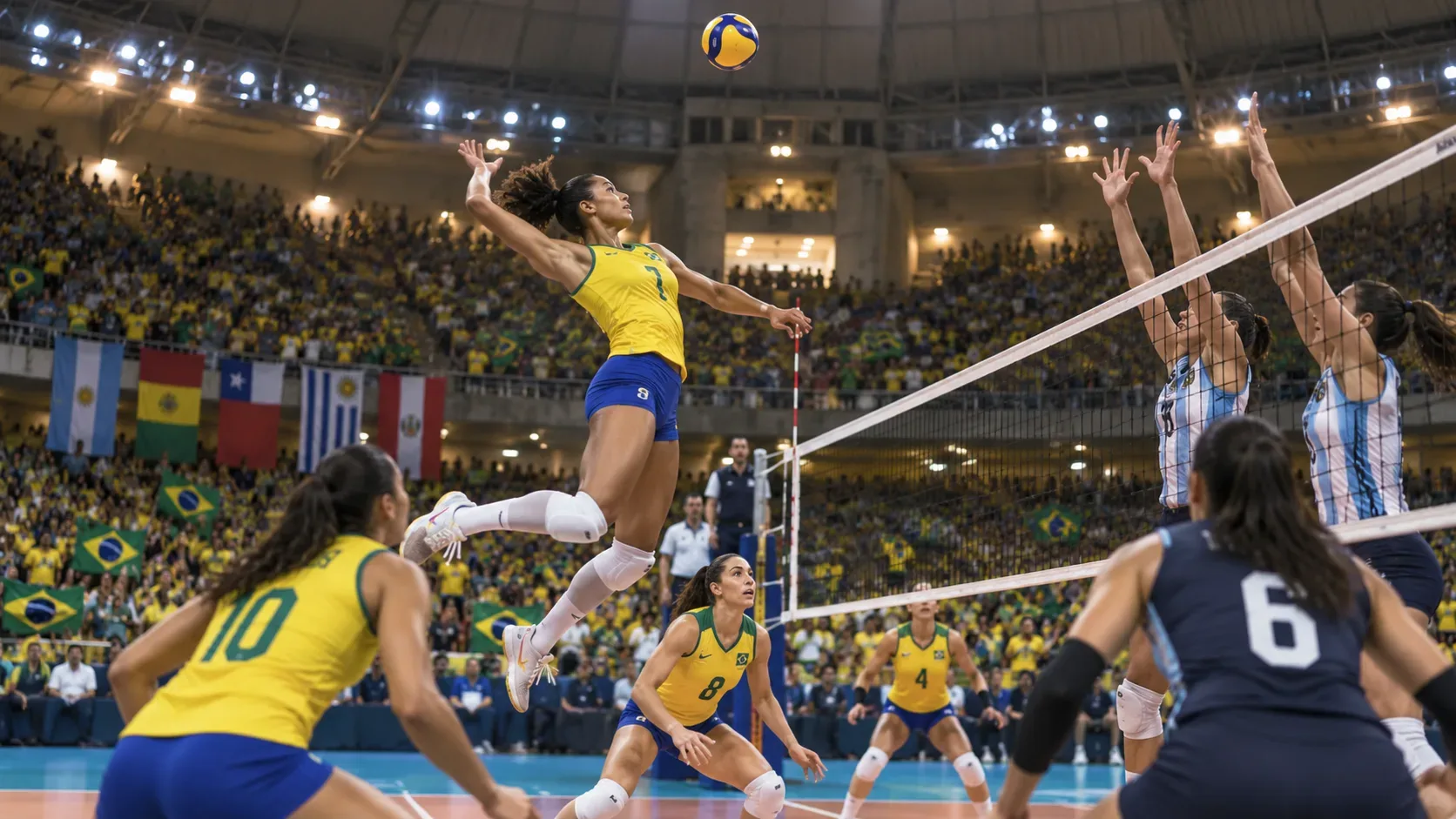
The 2026 South American Women’s Volleyball Championship will be played at Maracanãzinho in Rio de Janeiro from September 8 to 13. Six national teams compete in a single round robin: Brazil, Argentina, Chile, Colombia, Peru and Venezuela. More than the continental title is at stake: the champion earns a place at the Los Angeles 2028 Olympic Games, while all three medalists qualify for the 2027 FIVB Women’s Volleyball World Cup in Canada and the United States.
For fans following Brazil, the format is straightforward: the national team plays five matches, one against each opponent. There is no mandatory semifinal or final; the round-robin standings determine the champion.
What is at stake in 2026
This is the 36th edition of the South American Women’s Championship. Brazil won 23 of the previous 35 editions and has taken the last 15 titles, a streak that began in 1995. That history does not change the 2026 rule: South America’s direct LA 2028 berth goes to the team that finishes first.
The podium also has international value. Gold, silver and bronze medalists qualify for the 2027 Women’s World Cup. Second and third place therefore still carry an important qualification reward even if the lead is no longer within reach.
How the format works
The six teams meet once each. Every team plays five matches across five competition days, with a tournament-wide rest day on September 11 after the first three rounds.
Because there is no knockout stage, there is no separate final to decide the title. The team with the most wins becomes champion. If teams are tied on wins, the standings use, in order, table points, set ratio, points ratio and head-to-head result.
| Result | Standings points |
|---|---|
| 3-0 or 3-1 win | 3 to the winner and 0 to the loser |
| 3-2 win | 2 to the winner and 1 to the loser |
This explains why the set score matters: a 3-0 or 3-1 victory delivers the maximum three points, while a 3-2 result gives standings points to both teams.
Participating national teams
- Brazil: host nation and the most successful team in the competition’s history.
- Argentina: runner-up in 2023 and one of Brazil’s main regional rivals.
- Colombia: a medalist in each of the previous five editions and bronze medalist in 2023.
- Peru: the only team other than Brazil to have won the event; it has 12 titles and last won in 1993.
- Chile: matched its best historical finish, fourth place, in 2023.
- Venezuela: completes the field and won five continental bronze medals between 1985 and 2007.
Brazil’s schedule at Maracanãzinho
The times below are Brasília time and reflect the schedule published through September 7, 2026.
| Date | Opponent | Time | Broadcast in Brazil |
|---|---|---|---|
| Tuesday, Sep. 8 | Venezuela | 8:00 p.m. | sportv2 |
| Wednesday, Sep. 9 | Peru | 8:00 p.m. | sportv2 |
| Thursday, Sep. 10 | Colombia | 8:00 p.m. | sportv2 |
| Saturday, Sep. 12 | Chile | 1:30 p.m. | sportv2 |
| Sunday, Sep. 13 | Argentina | 12:00 p.m. | TV Globo and sportv2 |
Friday, September 11 is the rest day for every team. Brazil vs. Argentina closes Brazil’s campaign, but it will only be a direct title decider if the standings still make that possible on Sunday.
How to follow Brazil
sportv2 is scheduled to show all five Brazil matches, while Brazil vs. Argentina is also scheduled for TV Globo. For scores, standings and possible schedule changes, the official reference is the FIVB Live Center. Volleyball World also carries Brazil’s schedule and tournament context.
Fans attending at Maracanãzinho should check official event channels before traveling to the arena because match times and ticketing operations can be updated.
Brazil’s 14-player roster
José Roberto Guimarães selected 14 players: setters Roberta and Vivian; opposites Rosamaria, Sabrina and Tainara; outside hitters Ana Cristina, Gabi, Julia Bergmann and Helena; middle blockers Diana, Lorena and Luzia; and liberos Marcelle and Nyeme. The list was published by the Brazilian Volleyball Confederation.
Gabi’s return is one of the main points to watch. The captain missed the 2026 VNL because of lower-back pain and returns to the squad for the continental championship.
What the result means on the road to LA 2028
The South American Championship offers the first direct Olympic berth available to teams from the region. Winning in Rio settles LA 2028 qualification as early as 2026. Failing to win gold, however, does not automatically eliminate a team from the Games.
The FIVB-approved system includes two later routes. At the 2027 World Championship, three berths per gender will go to the highest-placed teams that have not yet qualified. The final three places will be awarded through the FIVB World Ranking at the end of the 2028 VNL preliminary phase, again among teams still without a berth. The full system is explained by Volleyball World/FIVB.
For Brazil, then, the title at Maracanãzinho would settle Olympic qualification early. Without gold, the decision would remain dependent on the opportunities available in 2027 and 2028.