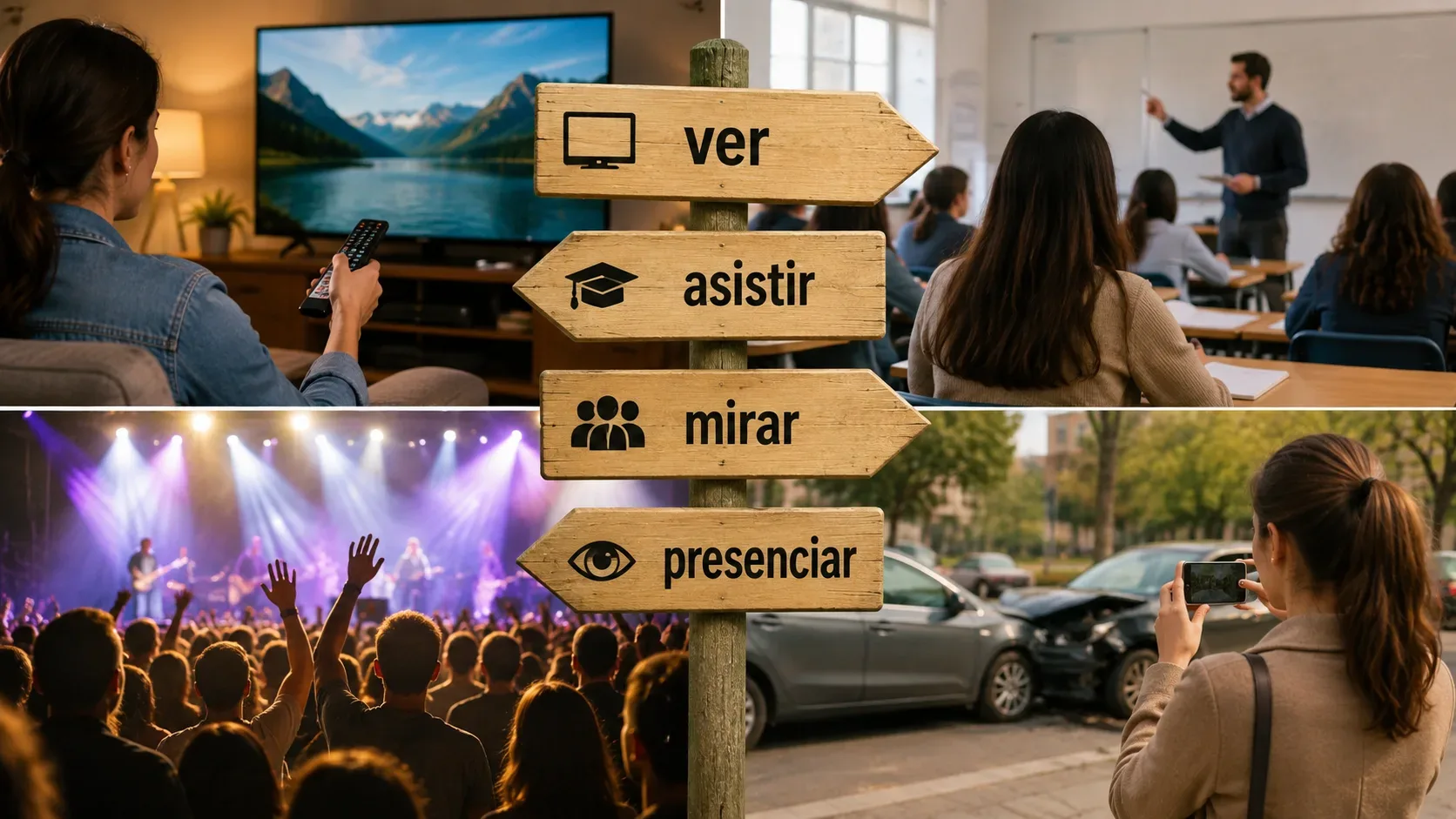
In Spanish, the Portuguese verb “assistir” does not have a single translation. The right choice depends on the scene: when it means watching a film, series, video or television, the most neutral option is ver; when it means attending a class, meeting or event, use asistir a; when someone was present as an event happened, presenciar makes that idea explicit; and when the focus is on directing one’s gaze or observing deliberately, use mirar.
A common mistake for Portuguese speakers is to treat asistir as an automatic equivalent of “assistir.” In Spanish, this verb normally comes closer to attend, be present, care for or help, not “watch TV.” The distinction becomes easier when you start from the communicative situation rather than the isolated word.
Quick choice: which verb fits each situation?
| What the Portuguese “assistir” means | Most useful Spanish choice | Example |
|---|---|---|
| Watch a film, series, video or TV | ver | Voy a ver una película. |
| Attend a class, meeting, lecture or event | asistir a | Asistí a la clase. |
| Witness an accident, argument or other event | presenciar | Presencié el accidente. |
| Look at or observe something deliberately | mirar | Mira la pantalla. |
For films, series, videos and television, use “ver” as the default
If Portuguese assistir means consuming audiovisual content, ver is the safest practical choice in general Spanish: ver una película, ver una serie, ver un video, ver la televisión or ver televisión. The Diccionario de la lengua española starts from the sense “to perceive with the eyes” and also records meanings such as observing, examining and considering, which helps explain the verb’s broad use.
- I want to watch a film today. → Quiero ver una película hoy.
- We are watching a series. → Estamos viendo una serie.
- Did you watch the match yesterday? → ¿Viste el partido ayer?
- She spends a lot of time watching TV. → Pasa mucho tiempo viendo la televisión.
Ver el partido describes following or watching the match. The person may have watched it on television or live; if you want to emphasize that the person attended the stadium event, asistir al partido shifts the focus to physical presence.
“Mirar” is not simply “to watch”: the focus is on the gaze
The DLE defines mirar, in its basic sense, as directing one’s sight toward an object. That is why it works especially well when the intended idea is to look at, gaze at, notice or observe visually.
- Mira esto. → Look at this.
- Estoy mirando el mapa. → I am looking at the map.
- Miró por la ventana. → He/She looked out the window.
- No me mires así. → Don’t look at me like that.
Ver and mirar can overlap in real usage. There are varieties and contexts in which speakers use mirar la televisión or similar constructions, while elsewhere ver la televisión is much more usual. The contrast between ver and mirar involves intention, attention and regional preference; the Mexican Academy of Language, for example, discusses the distinction without treating the two verbs as perfect equivalents.
For learners who want a neutral formulation, a useful rule is: use ver for watching content and mirar when the sentence highlights where someone directs their gaze. This avoids turning a usage difference into a rigid rule that does not hold in every region.
“Asistir” means to attend or be present — normally with “a”
The most important false friend for Portuguese speakers is asistir. The DLE records, among other senses, attending a meeting, course or public event and being present. For the question addressed here, think primarily of to attend.
- I attended the Spanish class. → Asistí a la clase de español.
- She is going to attend the meeting. → Va a asistir a la reunión.
- Many people attended the concert. → Mucha gente asistió al concierto.
- I couldn’t attend the lecture. → No pude asistir a la conferencia.
The preposition matters: in this sense, the typical construction is asistir a + event/activity. Compare two sentences that could both use Portuguese assistir but express different ideas in Spanish:
- Vi el concierto por televisión. = I watched the concert on TV.
- Asistí al concierto. = I attended the concert; I was there.
In addition, asistir can also mean to help, care for or provide assistance, including in medical or caregiving contexts. That is another reason not to translate it mechanically as Portuguese “assistir” in the audiovisual sense.
“Presenciar” is useful when you mean “to be there when it happened”
Presenciar foregrounds the role of a witness. The DLE defines it as being present at or attending a fact or event. It is especially useful for accidents, incidents, ceremonies, arguments, historical events or situations that someone directly saw happen.
- He witnessed the accident. → Presenció el accidente.
- We witnessed an argument in the street. → Presenciamos una discusión en la calle.
- Thousands witnessed the ceremony. → Miles de personas presenciaron la ceremonia.
Ver can also appear in many of these sentences: Vi un accidente is perfectly possible. The difference is one of focus. Presenciar makes it more explicit that the person was present as a witness to the event, so it can be more precise and, in many contexts, somewhat more formal.
The same Portuguese “assistir” can require different Spanish verbs
See how the translation changes when the scene changes:
| Portuguese meaning | Spanish | Why? |
|---|---|---|
| I watched the film at home. | Vi la película en casa. | Consuming content. |
| I watched the premiere at the cinema. | Vi el estreno en el cine. | The focus is on seeing the work. |
| I attended the opening session of the conference. | Asistí a la sesión de apertura del congreso. | The focus is on attendance. |
| I witnessed the accident from the window. | Presencié el accidente desde la ventana. | The focus is on witnessing the event. |
| I stayed there watching what he was doing. | Me quedé mirando lo que hacía. | The focus is on visual observation. |
A practical rule for avoiding the false friend
Before translating Portuguese “assistir,” ask one short question: am I watching content, attending, witnessing, or directing my gaze?
- If it is a film, series, TV, video or match, start with ver.
- If it means attending a class, meeting, lecture, concert or event, use asistir a.
- If it means being present as an event unfolds, especially as a witness, use presenciar.
- If it means deliberately looking at something or someone, use mirar.
This rule does not erase regional variation or the natural overlap between ver and mirar, but it solves most of the situations that confuse Portuguese speakers. Instead of searching for one Spanish word that always equals “assistir,” choose the verb that describes what the person is actually doing in the scene.