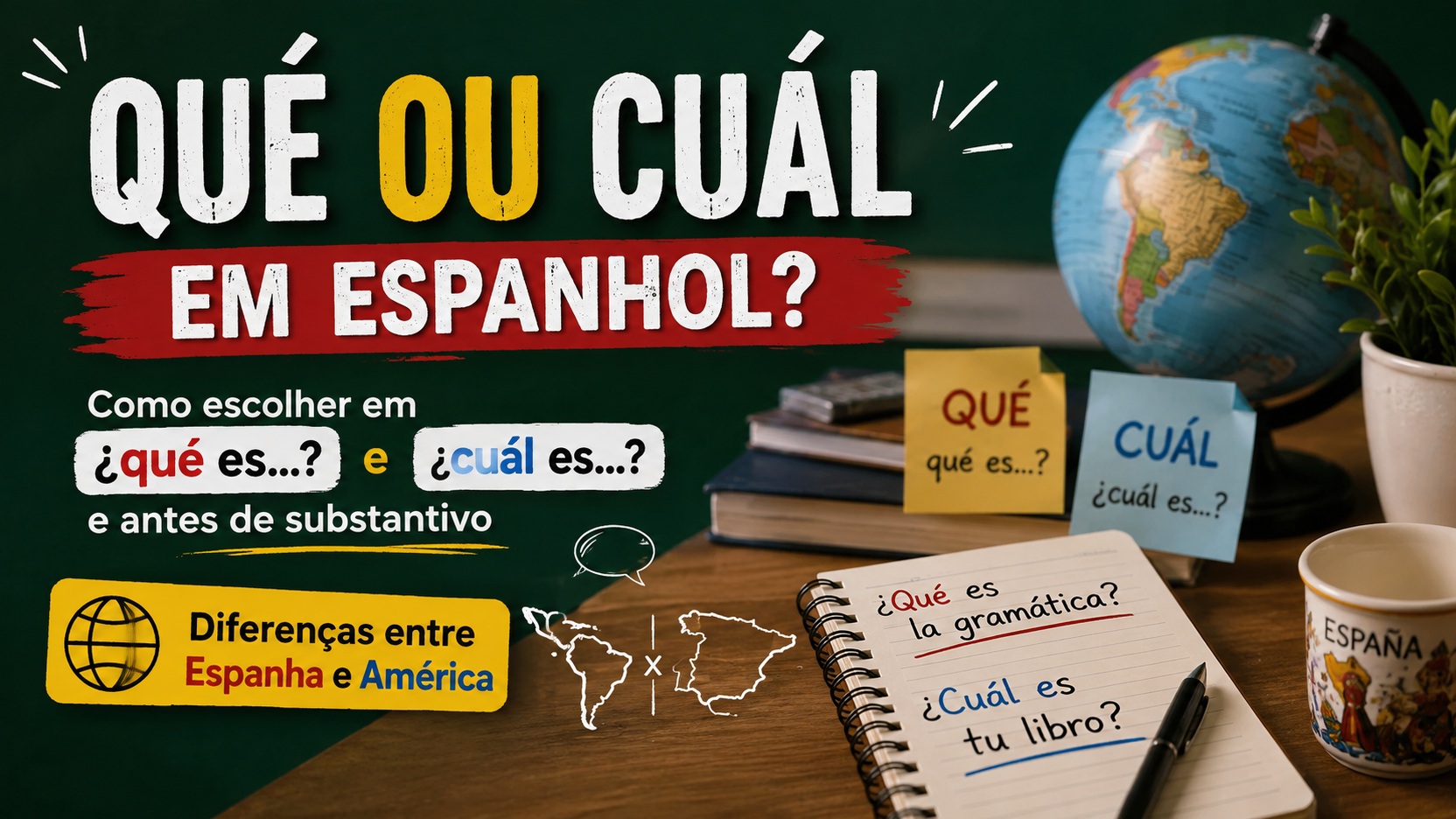
To decide between qué and cuál, it helps to think less about translating the Portuguese words “que” and “qual” and more about the job the question is doing. Qué often asks for content or a definition, or directly modifies a noun. Cuál often identifies or selects a possibility. The regional caveat that prevents many incorrect corrections is this: cuál before a noun is not simply forbidden. The Diccionario panhispánico de dudas, published by the Real Academia Española and ASALE, records this use as equivalent to qué and says it is much more frequent in the Americas than in Spain.
That difference explains why two apparently reliable materials can teach different rules. A course designed around the variety spoken in Spain may tell learners to use only qué before a noun. A pan-Hispanic resource or one aimed at the Americas may also recognize cuál libro, cuál problema, or cuáles opciones. The point is not to decide which page is “right,” but to know which variety and which structure the rule was formulated for.
Start with the function of the question, not the translation
In Portuguese, “que” and “qual” are distributed in a way that does not perfectly match qué and cuál. That is why word-for-word translation can produce sentences that seem logical to a Brazilian learner but sound odd in Spanish.
The question ¿Qué es la fotosíntesis? asks for a definition: it wants to know what photosynthesis is. By contrast, ¿Cuál es la capital de Colombia? asks for identification: among the cities that could fill that role, which one is the capital? The expected answer is not a definition of “capital,” but a name: Bogotá.
This contrast is especially useful with the verb ser. When the intention is to define something, explain its nature, or ask “what is this?”, qué is the normal choice. When the intention is to fill in an identity, a name, a value, or an option, cuál is very common.
Thus, ¿Qué es un adjetivo? asks for an explanation of the concept. ¿Cuál es el adjetivo de esta frase? asks you to identify a specific word in the sentence. ¿Qué es eso? asks what that thing is. ¿Cuál es tu número de teléfono? asks which value corresponds to your phone number.
¿Qué es...? and ¿cuál es...? are not mechanically interchangeable
A common classroom rule says that qué is for open-ended questions and cuál for closed questions. It can help at the beginning, but it should not be treated as an absolute formula.
It is perfectly natural to ask ¿Qué prefieres, té o café? even with two explicit options. It can also be natural to use ¿Cuál prefieres? when the alternatives have already been established in context. The difference does not depend only on counting how many possible answers there are; it depends on how the speaker frames what they are looking for.
The Centro Virtual Cervantes material “En sintonía con el español” uses precisely the idea of a new topic and a more open answer for qué, and of choice or greater precision among possibilities already given for cuál. It is a useful heuristic, as long as it is not turned into a mathematical rule.
Think of a conversation. If someone asks ¿Qué quieres cenar?, they are opening the field to a type of food or to an answer that has not yet been delimited. Once three restaurants have been mentioned, ¿Cuál prefieres? points to a choice among references that are already available. Context is part of the grammar of the question.
Before a noun, qué is the safer option in Spain
When the interrogative comes directly before a noun, qué is the most predictable construction for learners of the peninsular variety: ¿Qué libro estás leyendo?, ¿Qué película quieres ver?, ¿Qué idioma estudias?, ¿De qué problema hablas?
The RAE and ASALE classify this qué as an interrogative determiner. It can accompany nouns referring to things, people, places, and other kinds of referents. For that reason, the guidance “before a noun, use qué” works well as a production default for someone who wants to speak in a broadly neutral way or stay close to usage in Spain.
The Instituto Cervantes material aimed at learners presents the rule just as directly. In an exercise on qué, cuál, and cuáles, the page marks the combination qué + noun as correct and uses examples such as ¿Qué tema te ha resultado más interesante? and ¿Qué actividad te está gustando más?
But cuál + noun is not “always wrong”
Here is the most important correction to many simplified explanations. In its current edition, the Diccionario panhispánico de dudas states that cuál, when it comes before a noun, can function as an interrogative determiner and be equivalent to qué. The same source adds that this use is much more frequent in the Americas than in Spain.
That means constructions such as ¿Cuál muchacha?, ¿Cuál libro prefieres?, or ¿Cuáles opciones tienen? can legitimately occur in varieties spoken in the Americas. They do not need to be treated automatically as errors caused by English influence or as “incorrect” Spanish. At the same time, it would be unwise to turn the RAE’s observation into “everyone in the Americas speaks this way.” Frequency and naturalness vary among countries, regions, registers, and speakers.
A study published by Centro Virtual Cervantes on the adaptation of the course Aula internacional into Aula América draws attention to exactly this point. In the adaptation, the authors record a broader distribution of qué and cuál combined with a noun in varieties of the Americas and use the contrast as an example of a grammatical difference that teaching materials need to take into account.
The apparent contradiction between “only qué + noun” and “cuál + noun also exists” can therefore be resolved this way: the first formulation is an efficient pedagogical rule for a particular standard, especially the peninsular one; the second describes a broader pan-Hispanic reality.
How to choose without memorizing a tree of exceptions
If you are producing Spanish and want a quick decision, there is a conservative path. With an explicitly stated noun, use qué: ¿Qué libro?, ¿Qué calle?, ¿Qué opción?, ¿Qué perfume? This choice is widely understood and avoids sounding regionally marked in Spain.
If the noun is already clear and you want to select or identify an item, use cuál or cuáles: Hay tres libros. ¿Cuál prefieres?; Estas son las opciones. ¿Cuál te conviene?; Hay varias rutas. ¿Cuáles son más rápidas?
If you want to make the selection explicit, the cuál de structure is also very useful: ¿Cuál de estos libros prefieres?, ¿Cuál de las dos rutas es más corta?, ¿Cuáles de estas opciones son válidas? In these cases, cuál does not directly modify the main noun in the question; it functions as the head of the selection, and the group introduced by de delimits the set.
If you are listening to Spanish from the Americas, do not “mentally correct” every occurrence of cuál
+ noun. First recognize that the structure is documented. Then pay attention to the country, the speaker, and the register. For comprehension, the goal is to recognize variation; for production, you can choose a pattern consistent with the variety you are learning.
The plural matters too: cuál and cuáles change, qué does not
Qué does not vary in number: we say ¿Qué libro? and ¿Qué libros? The word remains the same. Cuál, by contrast, has the plural form cuáles: ¿Cuál prefieres? and ¿Cuáles prefieres?
This difference is clear when a question expects one answer or several. ¿Cuál es tu película favorita? points to a singular identification. ¿Cuáles son tus películas favoritas? allows several. Before a noun, in varieties where that construction is natural, the number distinction also appears in cuál/cuáles.
For a Brazilian learner, this is useful because it prevents an automatic association between Portuguese “qual” and Spanish cuál. Sometimes Portuguese uses “qual” where Spanish prefers qué + noun. In other situations, Spanish really does call for cuál or cuáles because the question is selecting a referent from an already delimited set.
Indirect questions keep the accent mark
The difference between qué and cuál does not disappear when the question is no longer enclosed by question marks. In No sé qué libro comprar, qué is still interrogative and keeps its accent mark. In Dime cuál prefieres, cuál also keeps its accent mark.
The same applies to sentences such as Quiero saber qué significa esta palabra and No recuerdo cuál era su dirección. The question is embedded in another clause, but it remains an indirect interrogative. That is why qué and cuál remain stressed and accented.
This detail helps separate qué from que and cuál from cual, which can have other functions without an accent mark. To solve the question addressed in this article, always think in terms of the interrogative forms qué, cuál, and cuáles.
Three pairs that show the difference in practice
Compare ¿Qué es un podcast? with ¿Cuál es tu podcast favorito? The first question asks for a definition; the second asks for the identification of an item that occupies a place in the speaker’s preference.
Now compare ¿Qué libro compraste? with ¿Cuál compraste? In the first sentence, libro is expressed and qué determines it. In the second, the noun can be recovered from context and cuál stands on its own to identify the choice. In many varieties in the Americas, ¿Cuál libro compraste? can also occur, but that form is far less typical of Spain.
Finally, compare ¿Qué opción te parece mejor? with ¿Cuál de estas opciones te parece mejor? Both questions can lead to the same answer, but they structure the selection differently. The first puts qué directly before the noun. The second uses cuál and delimits the set with de estas opciones.
What to do when your course and a native speaker disagree
Do not immediately conclude that one of them is wrong. In Spanish, teaching materials often simplify the distribution to reduce cognitive load, while real language preserves regional differences that do not fit into a one-line rule.
If your course is centered on Spain, the rule qué + noun is an excellent production default. If you interact with speakers from Mexico, Colombia, the Caribbean, Central America, or other areas of the
Americas, you may encounter cuál + noun with varying degrees of naturalness. The RAE/ASALE record confirms that the construction belongs to Spanish and is much more frequent in the Americas, but it does not justify treating all regions as identical.
It is also useful to separate recognition from production. You can recognize ¿Cuál libro quieres? as a legitimate construction in certain varieties and, at the same time, choose to say ¿Qué libro quieres? to keep your own Spanish less regionally marked.
The practical rule that survives real cases
If you need to decide right now, use this logic in prose: for a definition, an explanation, or “what is it?”, prefer qué. To identify or choose an item, especially when the noun has already been given or is implicit, prefer cuál or cuáles. Before an explicitly stated noun, qué is the safer and more general option, especially in Spain. If you encounter cuál + noun in Spanish from the Americas, do not dismiss it as an error: it is a recognized use and is more frequent on the other side of the Atlantic.
This way of thinking is more useful than translating Portuguese “que” as qué and “qual” as cuál. It also avoids the overbroad rule that cuál can “never” come before a noun. Real Spanish is more organized than it may seem, but that organization includes regional variation.