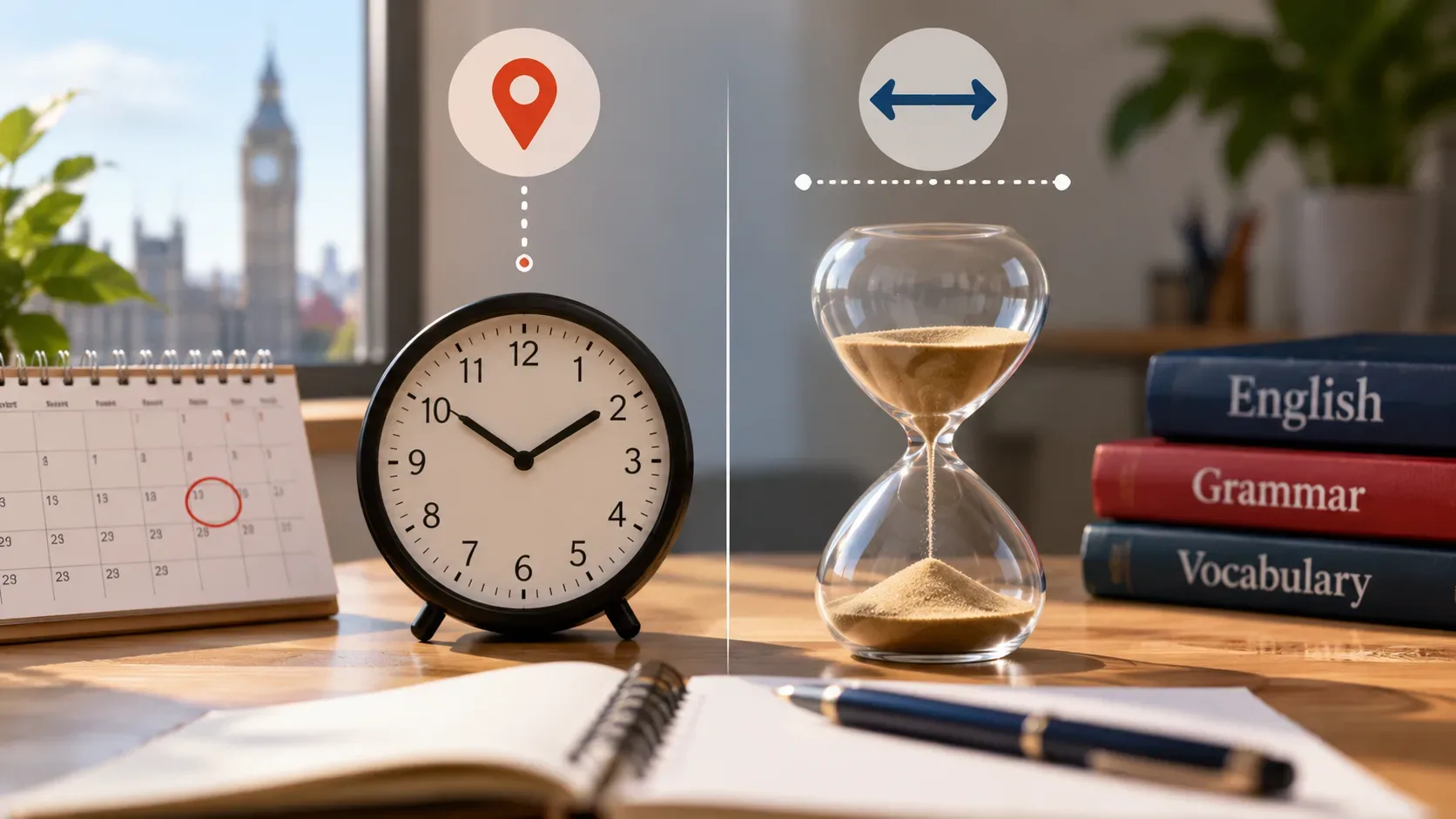
Since and for are not chosen simply by the name of the verb tense. The central difference is meaning: since marks the point when a situation started, while for measures how long it lasts or lasted. Thus, since 2022 answers “since when?”, while for four years answers “for how long?”. The present perfect is very common with both words, but it is not the rule that determines the choice.
The rule that solves most cases
| Choice | Use with | Mental question | Examples |
|---|---|---|---|
| since | a starting point | When did it start? | since Monday, since 2020, since 8 a.m. |
| for | a duration | For how long? | for two days, for five years, for a long time |
This distinction is stated in references such as Cambridge Grammar and Oxford Learner's Dictionaries. The most reliable strategy is to look first at the time information after the preposition.
Why the present perfect appears so often
One common use of the present perfect is to describe states or activities that started in the past and continue up to the present. That is why I've lived here since 2022 gives the starting point, while I've lived here for four years gives the duration. The British Council uses for, since, and how long when explaining unfinished situations.
But for does not belong only to the present perfect. Cambridge shows that it can refer to periods in the past, present, or future: I lived there for three years describes a finished period; I've lived here for three years can extend to now; We'll stay there for three days describes a future duration. In every case, for answers “how long?”.
Since also works outside the present perfect
Since links a starting point to a later reference point. That point is often the present, but it can be in the past. Compare She had worked there since 2018 before she moved with That was his first visit since 2019. The Cambridge Grammar entry on since records uses as a preposition, conjunction, and adverb and shows combinations with different tenses.
So choose since or for from the time information first; then choose the verb tense according to the sentence's timeline.
Decision map
- Does the expression measure an interval? Use for: for ten minutes, for six months.
- Does it identify the beginning? Use since: since Tuesday, since 2018.
- Is the starting point an event or clause? Since still works: since I changed jobs, since she arrived.
- Are both beginning and end stated? Prefer from ... to ...: from 2018 to 2021, not since 2018 to 2021.
- Do you mean “at some point within a period” rather than duration? You may need during: during the meeting says when something happened; for two hours says how long it lasted.
What can follow since
The starting point can be a year, day, clock time, event, or clause: since 2020, since Monday, since 8 a.m., since my birthday, since I started college, and since leaving school. All of them answer, in one way or another, the question “since when?”.
What can follow for
With for, the focus is the length of the interval: for 20 minutes, for two weeks, for several years, for a long time, for ages. The period may be finished or still continuing. Therefore, for by itself does not mean “up to now”; tense and context show whether the situation continues.
Common mistakes for Portuguese speakers
| Avoid | Prefer | Reason |
|---|---|---|
| since three years | for three years | three years is a duration. |
| for 2020 | since 2020 | 2020 is a starting point. |
| since 2018 to 2021 | from 2018 to 2021 | both beginning and end are stated. |
| during three hours | for three hours | the intended meaning is duration. |
Since two years ago is possible, but forms such as for two years or a starting date are often more direct. The British Council notes that since ... ago is grammatically possible, although simpler alternatives are common.
Examples in different tenses
| Context | Example | Reading |
|---|---|---|
| Present perfect | I've worked here since 2021. | since marks the beginning. |
| Present perfect | I've worked here for five years. | for measures the duration. |
| Past simple | I worked there for five years. | finished period, still expressed as duration. |
| Past perfect | By the time she left, she had worked there since 2018. | the reference point is in the past. |
| Future | We'll stay for ten days. | future duration. |
| Past simple | That was my first visit since 2019. | since still means “from that point onward”. |
Since can also mean “because”
Not every since is temporal. As a conjunction, it can also introduce a reason, close to because: Since you're here, let's start. In that case, “since when?” makes no sense; the relation is causal.
Rule of thumb
Do not start with “which verb tense is this?”. Ask first: “is the following information a starting point or a duration?”. A starting point takes since; a duration takes for. Then choose the tense according to whether the situation is connected to the present, finished in the past, or projected into the future.
This is why How long have you lived here? can be answered with For five years or Since 2021: the first gives the duration; the second gives the starting point.