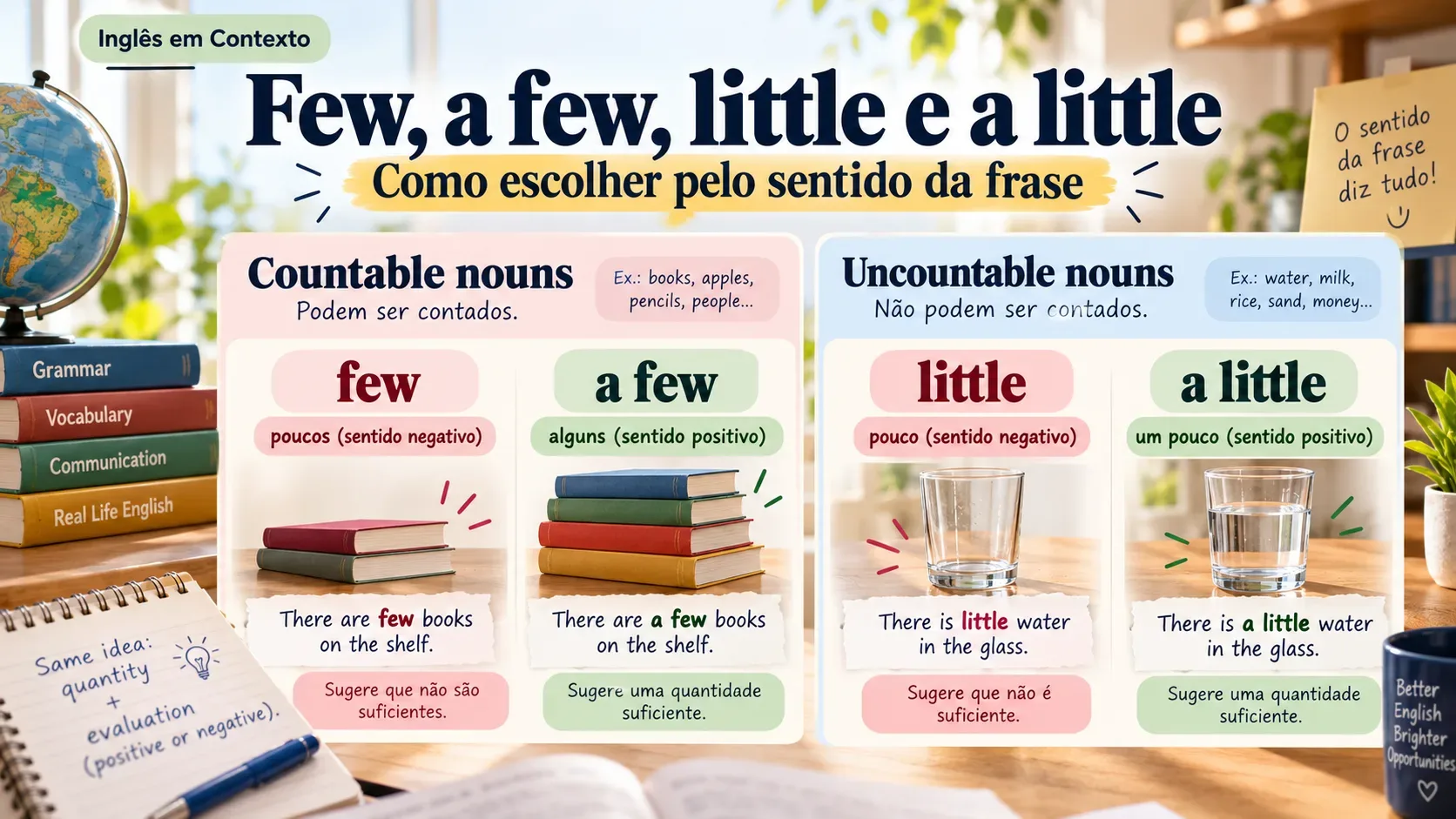
To choose among few, a few, little and a little, ask two questions: is the noun plural and countable, or uncountable? Does the sentence highlight that some quantity exists, or express disappointment that it is small? Use a few and few with plural countable nouns; use a little and little with uncountable nouns. The presence of a generally presents an available quantity more positively; without a, the expression tends to emphasize scarcity.
This is not an exact calculation. A few and a little do not, by themselves, promise that an amount is sufficient, just as few and little do not necessarily mean zero. Context tells you whether the amount meets a need. Cambridge and British Council grammar guidance explain the contrast as a difference in perspective on a small quantity.
How to decide in two steps
First, check how the noun works in the English sentence, not how it translates into another language. Books, chairs and questions can be counted and take plural forms. Water, time, information, advice and money, in the uses shown here, are uncountable.
- If the noun is plural and countable, choose between few and a few.
- If the noun is uncountable, choose between little and a little.
- If the sentence stresses a shortage or less than the desired amount, prefer the form without a; if it stresses that some amount is available, prefer the form with a.
That last step describes a tendency in meaning, not a mathematical rule about sufficiency. The same number of items may be described differently depending on the speaker's expectations.
Table: noun type and intended meaning
| Expression | Noun type | Usual interpretation | Example |
|---|---|---|---|
| few | Plural countable | Not many; the number is viewed as small or insufficient | Few seats are available. |
| a few | Plural countable | Some; a small number exists | A few seats are available. |
| little | Uncountable | Not much; the amount is viewed as small or insufficient | There is little time. |
| a little | Uncountable | Some; a small amount exists | There is a little time. |
In these examples, what changes is the evaluation of the quantity, not a fixed measurement. You can also compare many/few for countable items and much/little for an uncountable amount.
Few or a few: compare countable examples
We have a few chairs, so everyone can sit. There are some chairs and, in context, enough for the group. We have few chairs, so some guests may have to stand. There are not many chairs relative to the need. Both sentences use plural chairs; the choice changes the emphasis.
There are a few solutions worth trying. The sentence highlights options that exist. There are few solutions left. The sentence emphasizes that only a small number of options remain. Few does not claim that there is no solution at all; a different construction may be needed for that meaning.
With few, you often hear an evaluation close to 'fewer than I expected or wanted'. With a few, the usual emphasis is 'there are some', even if the total is still small.
Little or a little: compare uncountable examples
We have a little time, so let's check the plan. Some time is still available. We have little time, so let's decide now. Time is presented as scarce for the task. Time is uncountable in this use, so few time is not correct.
There's a little milk left; you can make coffee. Some milk remains. There's little milk left; we may need to buy more. The remainder is presented as insufficient or less than desired. Again, the sentences do not tell us how many millilitres there are.
In everyday English, very little is a common way to emphasize scarcity: We have very little information. Little on its own as a quantifier can sound more formal, as the British Council notes.
What changes with only, very and quite?
- Only a few highlights a limit: Only a few tickets remain. The a stays, but only draws attention to the restriction.
- Very few strengthens the sense of scarcity: Very few tickets remain.
- Quite a few is an established expression usually meaning a considerable number, not 'almost none': Quite a few people came.
So do not treat 'with a = enough; without a = not enough' as an automatic translation. The article, modifiers and the rest of the sentence work together. A statement using a few or a little may go on to say that the amount is still insufficient.
Common errors and look-alike uses
- Do not put few before uncountable nouns: use a little or little with information, advice and money, not a few information, few advice or a few money.
- Do not use little as a quantifier for countable plurals: say a few books or few books, not a little books.
- Do not use a singular noun after a few: a few questions, not a few question. The article a belongs to the expression a few; it does not make the following noun singular.
- To count units of an uncountable noun, name the unit: a few pieces of information counts pieces, not information.
- A little has other functions: I'm a little tired modifies an adjective and She smiled a little modifies a verb. In a little water, it quantifies a noun. In a little café, little describes size, not an amount of coffee.
These expressions can also stand alone when the noun is clear from context: Do you have any questions? I have a few. Here, a few refers back to questions.
Practice: choose from the context
For each sentence, identify the noun type first and then the speaker's intention. The answers give the interpretation suggested by this context; in a different context, another choice could change the meaning.
- We have ___ minutes; let's take a short break.
- ___ students understood the instructions, so I'll explain again.
- There is ___ information in this report; we need more data.
- Add ___ water to the sauce.
Answers: 1. a few, because minutes is plural and countable and there is time for a break; 2. few, because students is plural and countable and the number is presented as low; 3. little, because information is uncountable and more data is needed; 4. a little, because water is uncountable and a small amount is requested.