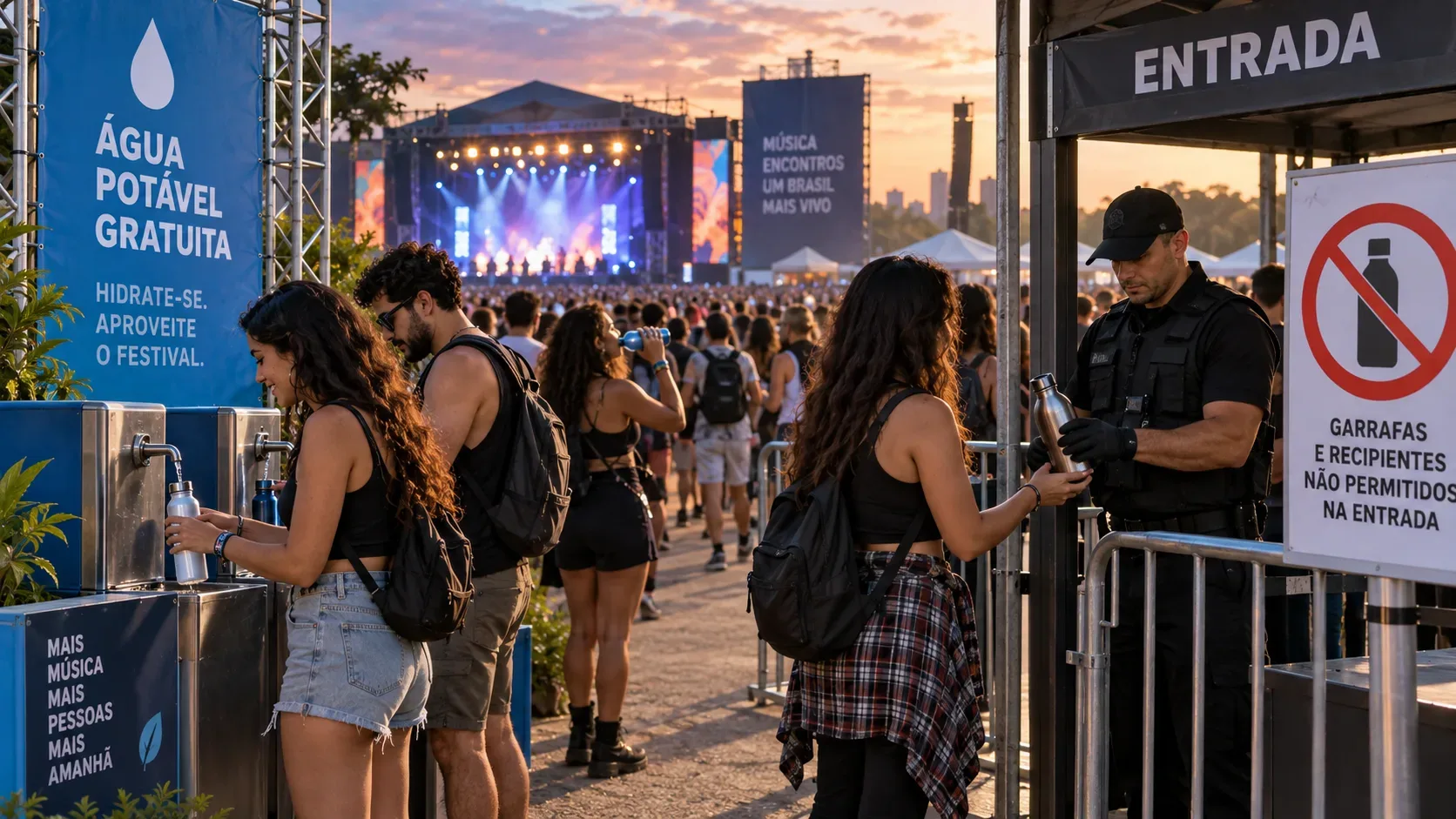
Since September 1, 2026, Decree 13.109 has set a federal rule for access to drinking water at events open to the public in Brazil. For concert and festival attendees, two points should not be confused: people may enter with bottles or other personal-use containers holding drinking water, while the organizer's duty to provide free water applies to events expected to have more than 1,000 participants.
What Decree 13.109 requires at a glance
- Entering with water: event organizers must allow consumers to enter with bottles and other personal-use containers holding drinking water.
- Container restrictions: organizers may restrict the materials used for bottles or containers when necessary for public safety and physical integrity, provided the restriction is communicated in advance.
- Free water at larger events: when expected attendance exceeds 1,000 people, drinking water must be made available free of charge through drinking fountains or individual packages.
- Access to water points: fountains and free distribution points must be located in areas that are easy for the public to reach, taking the venue layout and estimated attendance into account.
- Sales do not replace free supply: selling water or other beverages does not remove the duty to provide free drinking water when that requirement applies.
Which events are covered
The decree defines events open to the public as those involving a significant concentration of participants. It expressly lists festivals, congresses, conferences, fairs, concerts, and sporting or cultural events. The rule applies to free and paid events, whether held indoors or outdoors.
Decree 13.109 is dated August 31, 2026, was published in Brazil's Federal Official Gazette on September 1, 2026, and took effect on the date of publication.
Can I enter a concert with my own bottle of water?
Yes, within the scope of the decree. Article 3 requires organizers to allow consumers to enter with bottles and other personal-use containers holding drinking water for consumption during the event.
This rule is not tied to the 1,000-person threshold. That threshold appears in Article 4, which creates the additional duty to provide free water. Therefore, an event covered by the decree does not cease to be subject to the bring-your-own-water rule merely because expected attendance is 1,000 people or fewer.
When can a bottle be refused
The decree allows organizers to impose restrictions on the materials used for bottles and personal containers. However, a restriction must satisfy two conditions: it must be limited to what is necessary to protect consumer safety and physical integrity, and it must have been communicated to the public in advance.
In practice, organizers may adopt a materials policy that is consistent with the event's safety risks. The text of the decree does not turn this authorization into a blanket permission to ban every personal container holding water. The authorization stated in the rule is tied to material and safety.
Before leaving for the venue, check the event's official page, ticket information, and access rules. If there is a restriction, look for which materials are accepted and whether the rule was disclosed beforehand.
When is the event required to provide free water?
The specific free-supply duty applies to events with expected attendance of more than 1,000 people. In those cases, organizers must provide drinking water free of charge through drinking fountains or individual packages.
Access must also be practical: fountains and distribution points must be placed in areas that are easy for attendees to reach, taking the physical structure of the venue and the estimated number of participants into account. The same article also requires adequate space and infrastructure for rapid access, assistance, and rescue in emergencies.
| Situation | What the decree establishes |
|---|---|
| Event open to the public covered by the decree | It must allow entry with a personal container holding drinking water, subject to material restrictions justified by safety and communicated in advance. |
| Event expected to have up to 1,000 participants | Article 4 does not create the specific duty to provide free water; the Article 3 rule allowing entry with water still applies. |
| Event expected to have more than 1,000 participants | In addition to allowing entry with water, it must provide free drinking water through fountains or individual packages and keep water points easy to access. |
| Event sells bottled water | Sales do not replace the free-water duty when that duty applies. |
Can the event still sell water?
Yes. The decree does not prohibit the sale of water or other beverages. It states that commercial sales do not remove the free-supply obligation for events that fall under Article 4.
It also provides for consumer-protection authorities to monitor the prices of bottled mineral water sold at events in order to curb unjustified price increases and other practices that demand a manifestly excessive advantage from consumers.
Checklist before going to a concert or festival
- check whether the event has published rules for bottles and containers;
- verify which materials are accepted at the entrance;
- if expected attendance is above 1,000 people, look in advance for information on drinking fountains or free-water distribution points;
- do not assume that bars or water sales replace the free-water points;
- keep the ticket, rules page, and organizer notices in case you need to show what guidance was published before the event.
What to do if an event rule appears to conflict with the decree
First, ask the organizer for the reason for the restriction and the rule being applied at that entrance. If the issue is not resolved, Decree 13.109 assigns enforcement to the bodies that make up Brazil's National Consumer Protection System, within their respective powers. Noncompliance may lead to administrative sanctions under the Consumer Defense Code, without prejudice to other applicable measures.
Official source
The full text is available in Decree No. 13.109 of August 31, 2026, on Brazil's official legislation portal.