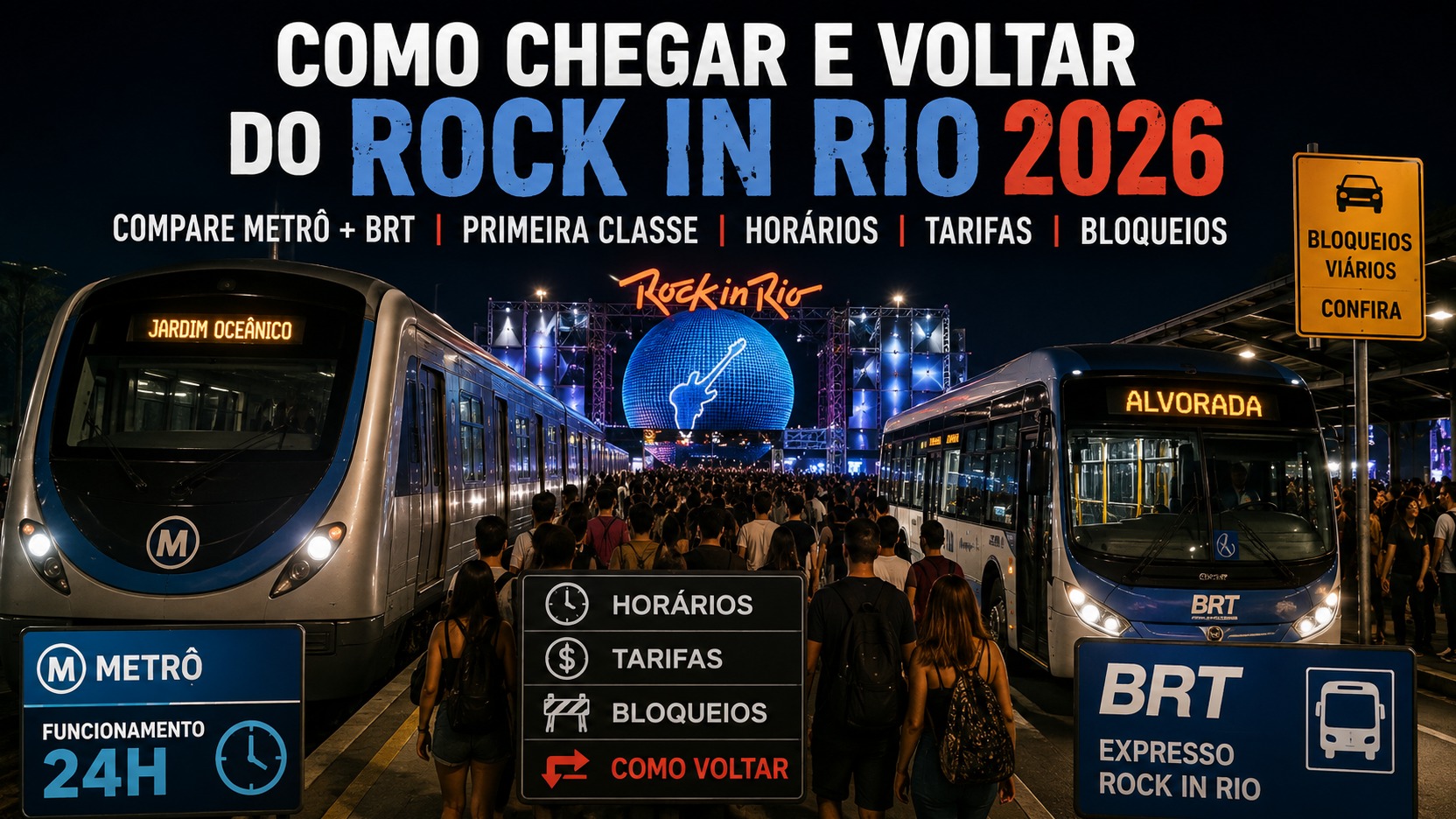
Choosing transportation for Rock in Rio 2026 should be done mainly with the return trip in mind. On the seven festival days - September 4, 5, 6, 7, 11, 12 and 13 - the area around Cidade do Rock will have road closures, BRT will run special lines, and MetrôRio will maintain late-night service with one important rule: Jardim Oceânico will be available for boarding 24 hours a day, while the other stations will remain open overnight only for passengers to exit.
For most people who are already near a metro station, the Metro + BRT Expresso combination tends to be the lower-cost option with a special operation designed for the festival. The total reported by Rio City Hall is R$ 44,80 round trip: R$ 15,80 for the two metro legs and R$ 29 for the special BRT. Anyone already in Barra, Recreio, or able to reach one of the BRT terminals easily can pay only the R$ 29 for the Expresso. Primeira Classe costs much more, but removes the transfer and drops passengers at an exclusive entrance inside Cidade do Rock.
The prices and schedules in this guide were checked on August 29, 2026. Because event transportation is volatile information, it is worth checking the Jaé app, MetrôRio and the Ticketmaster page again on the day you go to the festival.
The quick decision: which option makes the most sense
Metro + BRT Expresso is the most logical choice for anyone leaving from Zona Sul, Centro, Tijuca or other areas well served by the metro and looking to control spending. The route requires a transfer at Jardim Oceânico, but the operation was designed specifically to absorb the festival flow. The major advantage on the way back is that Jardim Oceânico continues to allow boarding overnight.
BRT Expresso without the metro is especially attractive for anyone already in Barra da Tijuca, Recreio, Jacarepaguá or near the Alvorada and Paulo da Portela terminals. The special ticket costs R$ 29 and includes a same-day round trip. If you use the service only for the return trip, the price is still R$ 29.
Primeira Classe makes sense for anyone who prioritizes comfort, wants to avoid the metro-BRT transfer, or prefers to leave from a specific boarding point on an executive bus. The official service takes passengers on a nonstop outbound route and drops them at an exclusive entrance inside Cidade do Rock, near New Dance Order. For boarding points in Rio and Greater Rio, updated guides and press coverage indicate a fare of R$ 220 per person, round trip; routes from other cities have different prices and should be confirmed when purchasing.
Private cars and ride-hailing apps are not good options for building a door-to-door plan. Rio City Hall has restricted traffic around Parque Olímpico, and there will be no public parking in the event area. Ride-hailing services and taxis may still be useful outside the blocked zone, but passengers should not count on direct access to the festival entrance.
How Metro + BRT Expresso Rock in Rio works
The official connection between the metro and the special BRT will take place exclusively at Jardim Oceânico/Barra da Tijuca. Rio City Hall explicitly states that Vicente de Carvalho will not have a direct connection to the special service. This resolves a common question for people familiar with other network connections and can prevent a wrong transfer on show day.
The regular MetrôRio fare is R$ 7,90 per leg. On festival days, payment can be made with Jaé, Riocard, NFC contactless payment and cards accepted by the concessionaire. Adding the round trip on the metro to the R$ 29 BRT Expresso fare brings the total Metro + BRT cost to R$ 44,80 per person.
BRT Expresso has three services. SE008 connects Terminal Jardim Oceânico to Terminal Centro Olímpico directly, with a travel time estimated by Rio City Hall at 30 minutes. SE009 connects Terminal Alvorada to Morro do Outeiro station directly, with an estimated time of 18 minutes. SE010 leaves Terminal Paulo da Portela and runs to Morro do Outeiro, stopping at Praça Seca, Tanque and Taquara, in about 40 minutes. These times refer to the special BRT segment, not the full trip from your home.
The BRT ticket costs R$ 29 per person and per festival day, includes a round trip and is sold exclusively in the Jaé app. The purchase uses the balance in the Conta Transporte account, which can be topped up by Pix or credit card. The QR Code is linked to the selected date and cannot be used on another day.
On arrival, passengers who used the special BRT must validate the QR Code at the designated structure near the entrance and receive the wristband that authorizes boarding for the return trip. This step matters: do not head straight to the stages without sorting out the return wristband. Anyone who arrives by another mode and decides to use only the special BRT to return can also do so, but must buy the R$ 29 ticket and follow the indicated validation procedure for the return.
According to the Municipal Transportation Department, the special BRT services will operate until 04:00. That provides a long window for leaving after the shows, but it does not mean the rest of the BRT network will be operating normally at the same time. If your final destination requires another line after the Expresso, check in advance whether that connection will still be available.
Does the metro run 24 hours? Yes, but not the way it may seem
The most important late-night rule is this: Jardim Oceânico remains open 24 hours for boarding on Rock in Rio days. The other stations keep their regular boarding hours and, after closing, remain open only for passengers to exit. It is therefore incorrect to interpret the operation as all stations allowing entry throughout the night.
On September 4, 5, 11 and 12, regular metro service runs from 05:00 to midnight. On Sundays, September 6 and 13, regular hours are from 07:00 to 23:00. On the September 7 holiday, service will also run from 07:00 to 23:00. After those times, passengers coming from Cidade do Rock can board at Jardim Oceânico and get off at other stations, but should not expect to enter the network at another station that has already moved into overnight exit-only operation.
MetrôRio also warns that tickets will not be sold at Jardim Oceânico station overnight. The practical advice is simple: buy your return fare or make sure your card has enough balance before going to the festival. This avoids ending the night with the metro available but without a payment method ready for boarding.
Primeira Classe: more expensive, more direct
Primeira Classe is the festival's official executive transportation service. Rock in Rio says the service will have 20 boarding points in Rio de Janeiro and Greater Rio, as well as more than 18 cities served on other routes. The main difference is that passengers are dropped at an exclusive entrance inside Cidade do Rock, without a BRT transfer.
For the outbound trip, the festival lists boarding windows between 11:00 and 19:00. The Ticketmaster page for Rio routes lists departures starting at 11:30 and emphasizes that passengers must respect their selected time,
arriving at least 20 minutes early. The buses do not make intermediate boarding stops on the outbound route.
For the return, no specific time needs to be booked on Rio routes. The return terminal opens at 22:00 and buses depart according to capacity or demand. Ticketmaster states that the last buses on these routes leave the festival two hours after the end of the Palco Mundo show. For anyone who wants to leave before the crowd or avoid standing through transfers, this predictability is the service's main advantage.
Price is the factor that completely changes the comparison. For boarding points in Rio and Greater Rio, publications updated this week report R$ 220 per person, round trip. Ticketmaster itself confirms the boarding points, schedules and operating rules, but the price can vary by origin, especially on routes outside Rio. For that reason, treat R$ 220 as a reference for urban boarding points and confirm the final price on the purchase page.
Road closures: why driving complicates both directions
CET-Rio has scheduled road closures from 14:00 to 05:00 on every festival day. Affected roads include Avenida Embaixador Abelardo Bueno, sections of Avenida Engenheiro Carlos Carvalho, Estrada Coronel Pedro Corrêa, the side lane of Avenida Salvador Allende, and streets immediately around Parque Olímpico.
Inside the blocked area, access will be restricted to pre-registered residents, official vehicles and BRT. Rio City Hall also states that there will be no designated parking area around the event. This changes the logic for anyone thinking about driving close to Cidade do Rock and deciding on the return later: the point you can reach by car may be far from the entrance and may change depending on operations.
For taxis and ride-hailing apps, the logic is similar. They can be useful for reaching a terminal, station or point outside the restriction, but should not be treated as a guaranteed pick-up and drop-off solution at the event entrance. On the way out, you also have to account for the concentration of thousands of people, road closures and ride-hailing surge pricing.
How to get back late at night without hitting a closed connection
If you chose Metro + BRT, the safest sequence is to leave Cidade do Rock, take BRT Expresso within the operating window of the special service and continue to Jardim Oceânico. From there, the station allows boarding overnight. The other stations can be used for exit even after regular boarding has ended.
If your final destination depends on a regular bus after the metro, check that last leg separately. The special operation solves the Cidade do Rock-Jardim Oceânico-metro corridor, but it does not guarantee that every neighborhood bus line will be running when you arrive.
Anyone who needs to continue to Centro, Rodoviária, Terminal Gentileza or Aeroporto Santos Dumont has an additional option: VLT Line 1 will operate 24 hours on festival days. Between 23:00 and 05:00 there will be an express service every 60 minutes, serving Terminal Gentileza, Rodoviária, Cordeiro da Graça, Carioca, Cinelândia and Santos Dumont. The fare reported by Rio City Hall is R$ 5.
With Primeira Classe, the return is simpler because passengers go back to the exclusive terminal and board the executive bus. For routes within the city of Rio, the operation starts at 22:00 and continues until the limit stated by Ticketmaster, two hours after the end of the Palco Mundo show.
Which transportation to choose based on where you start
Anyone leaving from Zona Sul, Centro or Tijuca who already has a metro station nearby tends to spend less and maintain good predictability with Metro + BRT. The key point is reaching Jardim Oceânico and making the correct connection to the special BRT.
Anyone in Barra or Recreio should look at BRT Expresso first. The direct Alvorada-Morro do Outeiro line has an estimated 18-minute travel time on the special segment and avoids the additional R$ 15,80 round-trip metro cost. For those closer to Jacarepaguá, the route from Paulo da Portela may be more convenient.
Anyone arriving through Galeão or Santos Dumont, or staying far from a station, may find Primeira Classe simpler, especially if sitting on the bus and avoiding transfers matters more. There are official boarding points connected to the airports and several neighborhoods, but the cost is much higher than public transportation.
For groups, the price difference grows quickly. Four people using Metro + BRT spend R$ 179,20 in total for the round trip within that combination. Four R$ 220 Primeira Classe vouchers would reach R$ 880. The question, then, is how much the group is willing to pay to trade transfers and more movement for a direct executive bus.
What to have ready before you leave
If you are using BRT Expresso, install or update Jaé, buy the ticket for the correct date and check the order in the app before leaving. If the metro is part of your route, make sure your card or payment method is ready for the return, because Jardim Oceânico will not sell tickets overnight.
If you are using Primeira Classe, check the boarding point, time and passenger name on the voucher. Ticketmaster recommends arriving at least 20 minutes before boarding and does not provide a grace period for passengers who miss their selected departure. Because traffic time to the festival can vary, the operation itself recommends allowing a generous margin between boarding and the attraction you want to see.
If you are still considering a car or ride-hailing app, plan a drop-off point outside the restricted area and an alternative for the return. The official traffic plan makes it clear that access around Cidade do Rock will prioritize public transportation and authorized vehicles.
Summary of the choice
For saving money, Metro + BRT Expresso is the benchmark: R$ 44,80 round trip for anyone using both modes, with the connection at Jardim Oceânico. If you can already board the special BRT without using the metro, the cost drops to R$ 29 round trip.
For fewer transfers and less walking between modes, Primeira Classe delivers the most direct experience, with an executive bus and exclusive entrance inside Cidade do Rock, but the R$ 220 reference for Rio and Greater Rio is almost five times the cost of Metro + BRT.
For late-night travel, the rule that prevents mistakes is to remember that Jardim Oceânico allows boarding 24 hours a day, while the other metro stations are exit-only outside regular hours. And for any option, the 14:00-to-05:00 road closures make it unreliable to build your main plan around a private car or ride-hailing pickup at the festival entrance.