Thirty years after the accident that killed the five members of the Mamonas Assassinas and four other people, the explanation usually appears summarized in one sentence: the pilot turned the wrong way after going into the air. This version touches on an important point in the sequence, but is too short to reproduce what the technical investigation pointed out.
The CENIPA report describes a combination of failures and contributing conditions. The approach to Guarulhos was already destabilized; the aircraft reached the final phase with high speed and outside the expected parameters, started a go-around and began to fly visually. After that, the crew remained in a high relief sector, at an altitude incompatible with the obstacles, without realizing the risk situation in time to avoid it. Fatigue, training, supervision, cockpit coordination, planning and environmental conditions appear in the document as parts of the scenario that led to the impact.
The short answer: CENIPA did not identify a single cause
The investigation of the Aviation Accident Investigation and Prevention System is carried out with preventive purposes. It seeks to understand circumstances and factors that contributed to an incident and produce safety recommendations. It is not an investigation created to criminally convict a person or to distribute percentages of guilt.
In the case of the Learjet 25D with registration PT-LSD, the summary of the final report states that the two crew members were involved in procedural failures and failed to observe safety limits. As a result, they ended up flying in a sector of steep relief, below the traffic altitude stipulated for that type of aircraft and below terrain elevations, until the collision.
This formulation is important because it changes the question. Instead of looking for a single gesture that would have caused it all, the technical reading reconstructs a chain: how the approach deteriorated, how the go-around was conducted, how awareness of position and altitude was lost, and what human and organizational conditions helped form this scenario.
What happened on the approach to Guarulhos
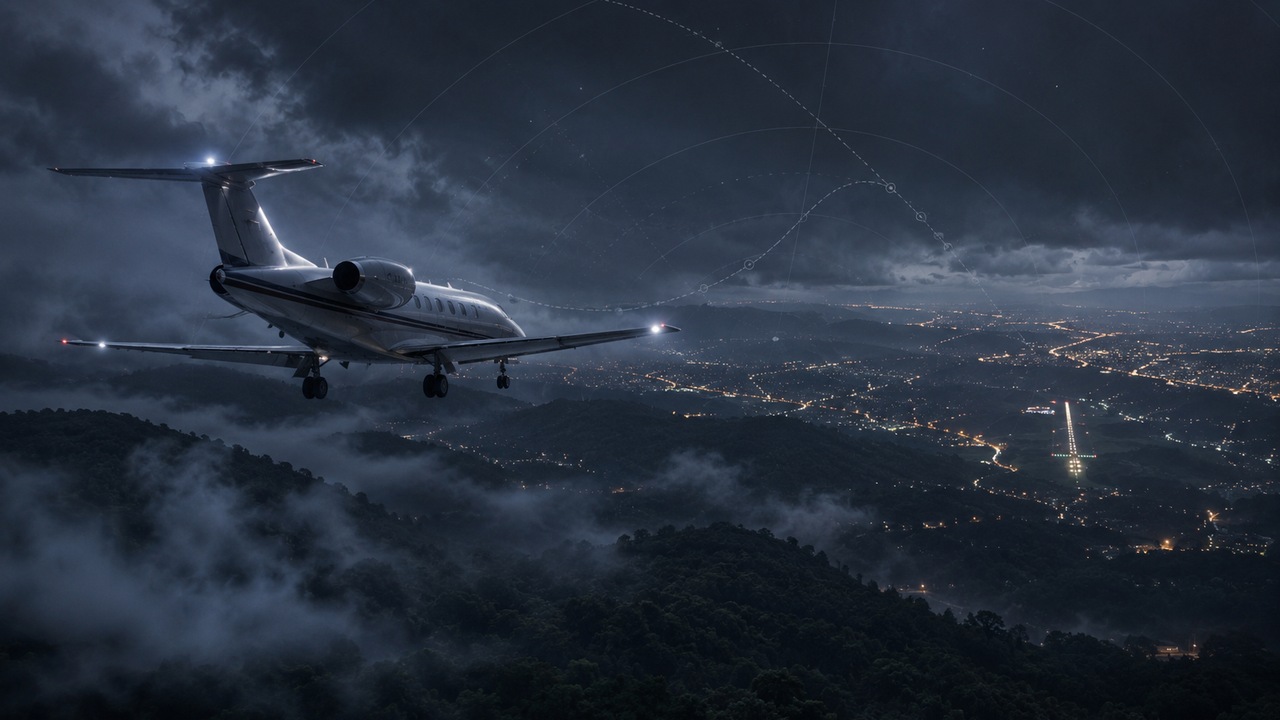
The flight from Brasília to Guarulhos took off at 9:58 pm on March 2, 1996. The cruise went without any known abnormalities. On descent, the PT-LSD started to receive radar vectoring from São Paulo Control for the final approach of the Charlie 2 procedure, ILS on runway 09R in Guarulhos.
The problem began to become clear in the final phase. According to the report, the crew did not slow down the plane enough to stabilize it. The aircraft arrived on final approach outside the expected speed, alignment, landing configuration and ramp. The document records a speed of 205 knots and a lateral deviation to the left of the runway when the crew began the go-around.
Lashing, in itself, is not a sign of error. It is a normal and safety maneuver when the approach does not offer suitable conditions for landing. The decisive point is what happened before and after it. The aircraft entered the go-around after a disorganized approach and then transitioned from instrument operation to visual flight in an area surrounded by elevations.
Why the left turn story is a simplification
One of the most repeated versions says that, after going in, the Learjet should have turned right, but the pilot turned left and went straight to Serra da Cantareira. The idea helps to visualize the result, but it erases important details from the report itself.
The document records that the aircraft was already turning left when it informed the Guarulhos Tower that it was in visual conditions and requested the possibility of continuing to the left to enter the downwind leg. The Tower considered that the plane would make a 270 degree turn until it reached the wind leg in the southern sector and advised it to continue towards that sector.
This detail changes the popular scene from a simple order on the one hand and simple disobedience on the other. The sequence involved interpretation of the aircraft's intention, change to visual flight rules and a turn performed at high speed. The report itself highlights that this speed increased the radius of the curve, moving the jet laterally away from the runway and bringing it closer to the elevations of the northern sector.
Afterwards, São Paulo Control verified via radar that the PT-LSD had not landed and coordinated the transfer back to approach control, also because of two other traffic arriving via instruments. Upon first contact, the crew reported being in visual condition. In visual flight, the responsibility for maintaining obstacle separation rested with the pilot in command. At 11:16 pm, on a trajectory parallel to the runway, the plane reached an elevation of 3,300 feet.
Therefore, just saying that the plane crashed because it turned to the left transforms a chain of decisions and conditions into a single image. The turn is part of the sequence, but the report also gives weight to the unstabilized approach, speed, altitude, preparation for the go-around and the crew's ability to perceive the surrounding terrain.
Fatigue: a 16 and a half hour journey
Among the human factors, CENIPA recorded that the crew had been working 16 hours and 30 minutes at the time of the accident. The reports found no evidence of alcohol or drug consumption and the medical certificates were valid, but the investigation concluded that the long journey affected performance and reduced attention span.
The report related the observed failures to typical physical fatigue behavior. This does not mean that fatigue alone brought the plane down. This means that it was considered a factor that degraded attention and aggravated stress in a flight phase that already required quick decisions and precise coordination.
The difference is essential. In accident investigation, one contributing factor need not be sufficient to produce the outcome alone. It integrates a system of conditions that, combined, increased the probability that the crew would not stop the sequence of errors in time.
Cabin coordination, experience and training
CENIPA also classified cabin coordination as deficient. The investigation found that essential tasks were relegated to the background, that the aircraft was not configured properly for the approach and landing phases and that the interaction between commander and co-pilot did not offer the expected safety barrier.
The copilot's lack of experience in the model was pointed out as a contributor, mainly due to insufficient advice to the commander and inappropriate phraseology. The report also identified gaps in the instruction and training of both crew members and related these deficiencies to the non-existence, in the operating company, of a training program approved by the then Department of Civil Aviation.
The investigation also recorded oversight failures. The company had not presented an aeronautical accident prevention program and the document described problems in complying with operational and labor requirements linked to crew composition and rest. These conclusions show why the technical explanation goes beyond the cockpit: flight safety also depends on training, management and supervision of the operation.
Approach and go-around planning
Another contributing factor was called poor planning. The report associates it with the lack of preparation for the approach and landing and, mainly, with the possibility of a go-around.
The missed approach was treated as an indication of insufficient descent planning. The failures that came after the go-around were considered signs of a lack of planning for that phase in visual flight. In other words, the problem did not start the moment the plane turned: the safety margin had already been consumed beforehand.
This point helps to understand how complex accidents form. A stabilized approach creates clear parameters for deciding whether to land or go around. When speed, alignment, configuration and trajectory are outside of expectations, the crew needs to recognize early that the landing should not continue and execute the next procedure with discipline. In PT-LSD, the report describes just the opposite: a prolonged approach outside the parameters and a go-around followed by new failures.
Dark night, clouds and poorly lit relief
The region also contributed to making the perception of risk difficult. The report described the area flown over as having low population density, almost no lighting, on a dark night and with cloud cover. In a scenario like this, a mountain range may not offer clear visual references for those flying at night.
This does not transfer operational responsibility to the environment. The relief did not arise unexpectedly. What research shows is that external conditions can reduce visual cues and make a loss of situational awareness more serious. When the aircraft was already at a low altitude for that sector, the poor lighting and cloud cover reduced the ability to perceive the terrain in time.
The report also mentioned the likelihood of there being a passenger in the cabin and said this could have caused interference. The language needs to be preserved: it is a possibility considered by investigators, not a proven fact. This is another example of how popular versions can turn hypothesis into certainty.
So, after all, what caused the accident?
The best summary is that the Learjet entered a sequence of progressive loss of safety margins. The final approach was not stabilized. The attack happened late within this sequence. Then, the flight began to be conducted visually in a mountainous region, with high speed, insufficient planning for that phase and degraded situational awareness. The aircraft remained at an altitude unsuitable for the relief and collided with the mountain without the crew realizing the threat in time.
Fatigue, cockpit coordination failures, little experience of the copilot in the model, deficiencies in instruction, supervision and planning and the visibility conditions of the environment were identified as contributing factors. None of them need be chosen as the only cause. The report functions precisely as a systemic explanation of how several links came together.
What the report does not authorize to say
CENIPA did not conclude that a single curve order explains the entire accident. The dynamics described by the agency are more complex and include destabilized approach, go-around, change to visual flight, high speed, inadequate altitude and difficulties in situational awareness.
It is also not correct to transform security recommendations into an automatic condemnation of controllers. The report recommended revisions to standard phraseology and improvements to training and equipment, but the purpose of a preventative recommendation is to reduce future risks, not to declare criminal guilt.
Similarly, the possible presence of a passenger in the cabin was presented as a probability. And the tests mentioned in the document did not indicate alcohol or drug consumption by the crew. Separating what was verified, what was inferred and what was merely considered possible prevents the investigation from being recounted as a collection of certainties that it never stated.
Aeronautical investigation is not a court ruling
The distinction between CENIPA's work and the judicial sphere is one of the most important parts of this story. The technical report was produced to prevent new accidents. It organizes facts, contributing factors, and recommendations. A police investigation or legal process follows other rules, works with legal responsibility and can reach its own conclusions.
In the case of the Mamonas Assassinas, the criminal investigation followed a separate path. Three flight controllers were indicted by the Civil Police on charges of manslaughter. In August 1997, the investigation against them was closed due to lack of evidence. The decision recorded at the time considered that, from the moment the Learjet began to fly visually, it was up to the pilot to ensure separation from obstacles, and highlighted the low altitude and high speed of the aircraft.
This judicial outcome should not be used to rewrite the CENIPA report as if it were a sentence. The two spheres answer different questions. The aviation investigation asks what conditions contributed and what needs to change to avoid a repeat. The Court asks if there are elements to attribute responsibility according to the law.
The more faithful version is less simple, but explains it better
The phrase 'turned the wrong way' survives because it fits into a few seconds and offers an image that is easy to repeat. The technical report, however, shows that the accident was already being built before that curve. The approach was outside the parameters, the crew had a long journey, there were training and coordination failures, the go-around had not been properly planned and the visual flight continued in an area of high relief, dark and poorly lit.
The left turn matters, but it does not replace the rest. The central point of the investigation is precisely to understand how several safety barriers failed one after the other until the aircraft remained on a trajectory incompatible with the terrain. This reading is less comfortable than looking for a single culprit or a single wrong command, but it is much closer to what CENIPA actually recorded.