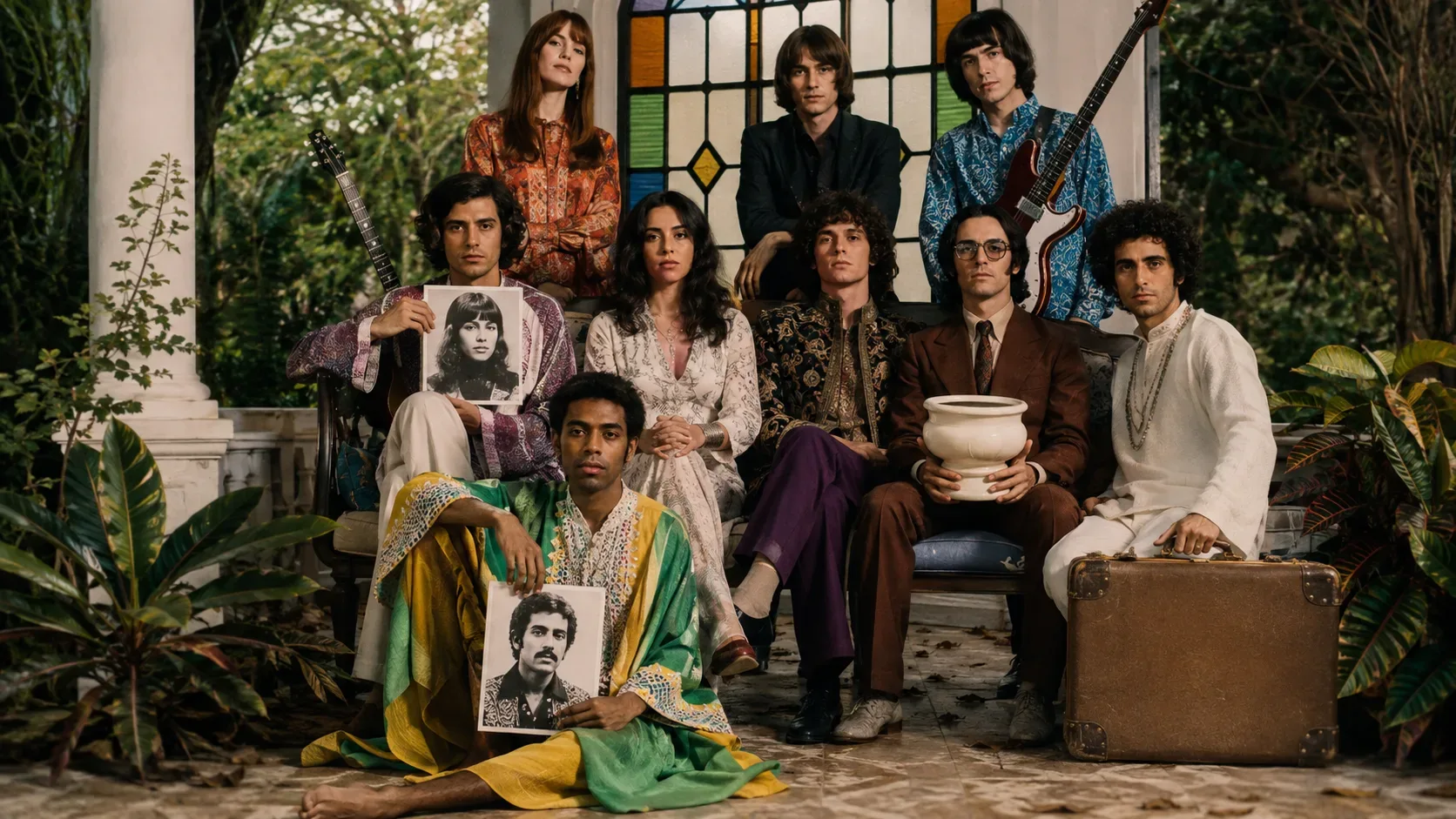
The cover of Tropicália ou Panis et Circencis brings together almost the entire group linked to the 1968 collective album: Caetano Veloso, Gilberto Gil, Gal Costa, Tom Zé, Torquato Neto, Rogério Duprat and the three members of Os Mutantes — Rita Lee, Arnaldo Baptista and Sérgio Dias. Nara Leão and José Carlos Capinam also appear, but within portraits held by Caetano and Gil.
The most interesting answer, however, begins after the names. The photograph set up as a family portrait brings together traditional elements and signs of rupture: a urinal treated as a cup, electric guitars, a suitcase associated with the Northeast, contrasting clothes, photographs within the photograph itself and a frame in national colors. Part of these meanings is documented; another part comes from later critical readings. This difference matters because the EBC itself records that the session was not born from a closed and previously defined concept.
Who appears on the cover of Tropicália or Panis et Circencis
The portrait was taken by photographer Olivier Perroy in his own home, in São Paulo. The setting was a garden with a colonial-style stained glass window. According to the Gilberto Gil Institute, the final disposition was as follows:
- Gilberto Gil appears on the ground, at the front of the group, wearing a tropical-colored toga and holding the portrait of Capinam.
- Caetano Veloso is leaning against the back of the seat and holding the photograph of Nara Leão.
- Gal Costa and Torquato Neto are sitting side by side.
- Rogério Duprat, conductor and responsible for the album's arrangements, appears sitting with a urinal in his hands, held as if it were a cup.
- Tom Zé carries a briefcase.
- Os Mutantes appear in the back: Rita Lee, Arnaldo Baptista and Sérgio Dias, visually associated with the guitars and the presence of rock in the group.
- Nara Leão and Capinam did not physically participate in the session and were incorporated into the composition through the two portraits.
Nara and Capinam did not arrive in time for photography, according to the Gilberto Gil Institute. Instead of simply leaving them out, the group found a visual solution: their images were inserted within the larger image. The result reinforces the collective character of the cover without pretending that both were present at the scene.
What the objects and poses mean
The portraits of Nara Leão and Capinam
Here is a very concrete explanation, without the need to look for occult symbolism. Caetano holds Nara; Gil holds Capinam because the two were unable to participate in the session. The solution, however, produces an effect compatible with tropicalist language: the photograph contains other photographs and transforms a practical limitation into part of the composition.
There is also an important difference between presence on the album and physical presence on the cover. Nara recorded “Lindonéia”, while Capinam was one of the composers involved in the project. Portraits prevent group photography from reducing the collective to just those who managed to attend that day.
Tom Zé's suitcase
Tom Zé's briefcase was not chosen at random. The Gilberto Gil Institute records that he took the object to make it look like it had just arrived from the Northeast.
Hence comes a recurring interpretation of the suitcase as a sign of northeastern displacement or the figure of the migrant. It is safer, however, to separate the two layers: the documented intention was to suggest the arrival of the Northeast; the broader social reading of migration is a critical interpretation constructed from this staging.
Rogério Duprat's urinal
Duprat found an old urinal and held it like a cup of tea. The gesture moves a banal and less than noble object into a pose associated with etiquette and formality.
Subsequent studies relate the scene to nonsense and the artistic avant-gardes of the early 20th century, especially the tradition of removing everyday objects from their usual use to produce estrangement. The literature on the cover also brings the gesture closer to Marcel Duchamp. This association is a consistent critical reading, but it should not be presented as if Duprat had left a definitive explanation for the object.
The guitars of Os Mutantes
The guitars are one of the clearest signs of the sound modernization that surrounded Tropicália. Os Mutantes, formed in that period by Rita Lee, Arnaldo Baptista and Sérgio Dias, brought rock, electric instruments and experimentation to the partnership with Gil, Caetano and Duprat.
This had special weight in 1967 and 1968, when the electric guitar was an object of dispute in the Brazilian music environment. The EBC records the opposition of sectors that defended an idea of “purity” of MPB to the incorporation of these instruments. On the cover, therefore, the guitars are not just musicians' accessories: they help to visualize the encounter between Brazilian references and international pop culture.
Gal, Torquato, Caetano and Gil dismantle the conventional portrait
The scene has the basic organization of a family photograph, but almost nothing remains fully behaved. Gal and Torquato are side by side in a relatively conventional position; Caetano occupies the back of the bench instead of simply sitting; Gil takes to the floor in an outfit that clashes with his more formal attire.
Academic reading of the cover usually sees this combination as a parody or subversion of the traditional family portrait. The album deliberately brings together signs that seem to belong to different worlds: formality and irreverence, tradition and pop, provincial and cosmopolitan, national and foreign. Historical studies on the record understand this juxtaposition as part of the tropicalist critique of conservative cultural standards.
The frame by Rubens Gerchman is also part of the message
The photograph is just one part of the cover. The graphic work is associated with the artist Rubens Gerchman, and a statement by Gerchman himself, reproduced in a study by USP Magazine, describes the artists as placed inside one of his “living boxes”, accompanied by green and yellow colors.
This relationship changes the way we look at composition. The geometric bands in green, yellow and blue directly evoke the national colors, while the image is also surrounded by a large black area. A study published in 2024 in the magazine Estudos em Design interprets this chromatic opposition as part of the cover's countercultural discourse: national symbols appear, but are placed in tension with a visual presentation that is neither solemn nor nationalistic in the conventional sense.
In other words, the cover does not reject the idea of Brazil. It fills the picture with Brazil and, at the same time, shuffles what could be considered Brazilian, modern, foreign, popular or of “good taste”. This visual synthesis combines especially well with the logic that Tropicalismo applied to music.
And the stained glass window in the background?
The colonial-looking stained glass window was not built especially for the record. It was already part of the garden of Olivier Perroy's house, where the session took place.
Still, the setting helps to produce the effect of an old family portrait. Bench, garden and stained glass create a relatively conventional domestic frame; Inside, the tropicalistas introduce guitars, unexpected poses, contrasting costumes, photographs and Duprat's urinal. The shock works visually even without giving each detail a previously planned intention.
This caveat is especially important in this case: according to EBC's special project on Tropicália, the cover started to provoke a lot of analysis, but the photography did not have an entirely closed concept in its preparation.
The cover is a Brazilian version of Sgt. Pepper’s?
The comparison with Sgt. Pepper’s Lonely Hearts Club Band, released by the Beatles in 1967, appears frequently in studies of the cover and the album. Academic research points to similarities between collective portraits and the arrangement of many visual references in the same image.
But reducing Tropicália or Panis et Circencis to an imitation of Sgt. Pepper’slose precisely what is unique about the image. Gerchman's frame, the reference to “living boxes”, the staging of the Brazilian family portrait, Tom Zé's suitcase, Nara and Capinam's photographs and Duprat's urinal belong to a much more specific construction. The parallel with the Beatles helps to contextualize Tropicalist's interest in international pop; Doesn't explain the entire cover.
Why does the title say “Circencis”?
There is also a graphic detail that tends to attract attention. The Instituto Gilberto Gil records that both the name of the album and the song were spelled incorrectly: “Circencis” appears on the cover, while the correct Latin form indicated by the institution is “circuenses”.
Therefore, using Tropicália or Panis et Circencis when talking about the cover is not necessarily a transcription error: it is reproducing the historical spelling printed on the LP itself.
The meaning of the cover is right in the mix
If it were necessary to condense the image into an idea, it would not be in an isolated symbol. The effect comes from the whole: a family photo that doesn't behave like a family photo; national colors used within an irreverent composition; electric guitars next to a suitcase linked to the Northeast; artists present alongside collaborators transformed into photographs; and a conductor drinking “tea” in a urinal.
This reading is compatible with studies that see Tropicália as a deliberate opening to confrontation and dialogue between distinct cultural languages, rather than the defense of a Brazilian identity based on the exclusion of external influences.
The cover, therefore, functions almost as a visual miniature of the album. To go beyond the image, the natural bridge is to understand why the album became a tropicalist manifesto: the same logic of approximation, shock and mixture that appears in the portrait also runs through the LP's songs and arrangements.